QUESTION IMAGE
Question
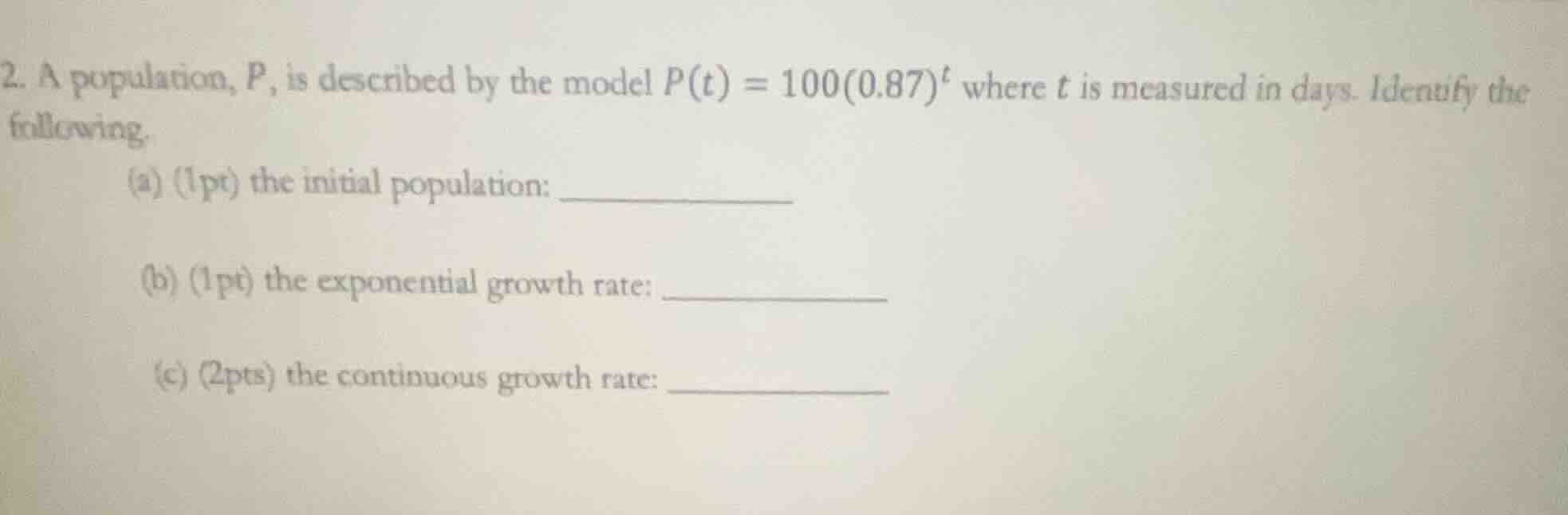
- a population, p, is described by the model $p(t) = 100(0.87)^t$ where $t$ is measured in days. identify the following.
(a) (1pt) the initial population:
(b) (1pt) the exponential growth rate:
(c) (2pts) the continuous growth rate:
Step1: Find initial population (t=0)
Substitute $t=0$ into $P(t)=100(0.87)^t$. Since any non-zero number to the power of 0 is 1:
$P(0)=100(0.87)^0=100\times1=100$
Step2: Find exponential growth rate
The model is $P(t)=P_0(1+r)^t$. Compare with $P(t)=100(0.87)^t$, so $1+r=0.87$. Solve for $r$:
$r=0.87-1=-0.13=-13\%$
Step3: Find continuous growth rate
Relate $P(t)=P_0(0.87)^t$ to continuous model $P(t)=P_0e^{kt}$. Set $0.87=e^k$, take natural log of both sides:
$k=\ln(0.87)\approx-0.1393=-13.93\%$

Snap & solve any problem in the app
Get step-by-step solutions on Sovi AI
Photo-based solutions with guided steps
Explore more problems and detailed explanations
(a) 100
(b) -13% (or -0.13)
(c) ≈-13.93% (or ≈-0.1393)