QUESTION IMAGE
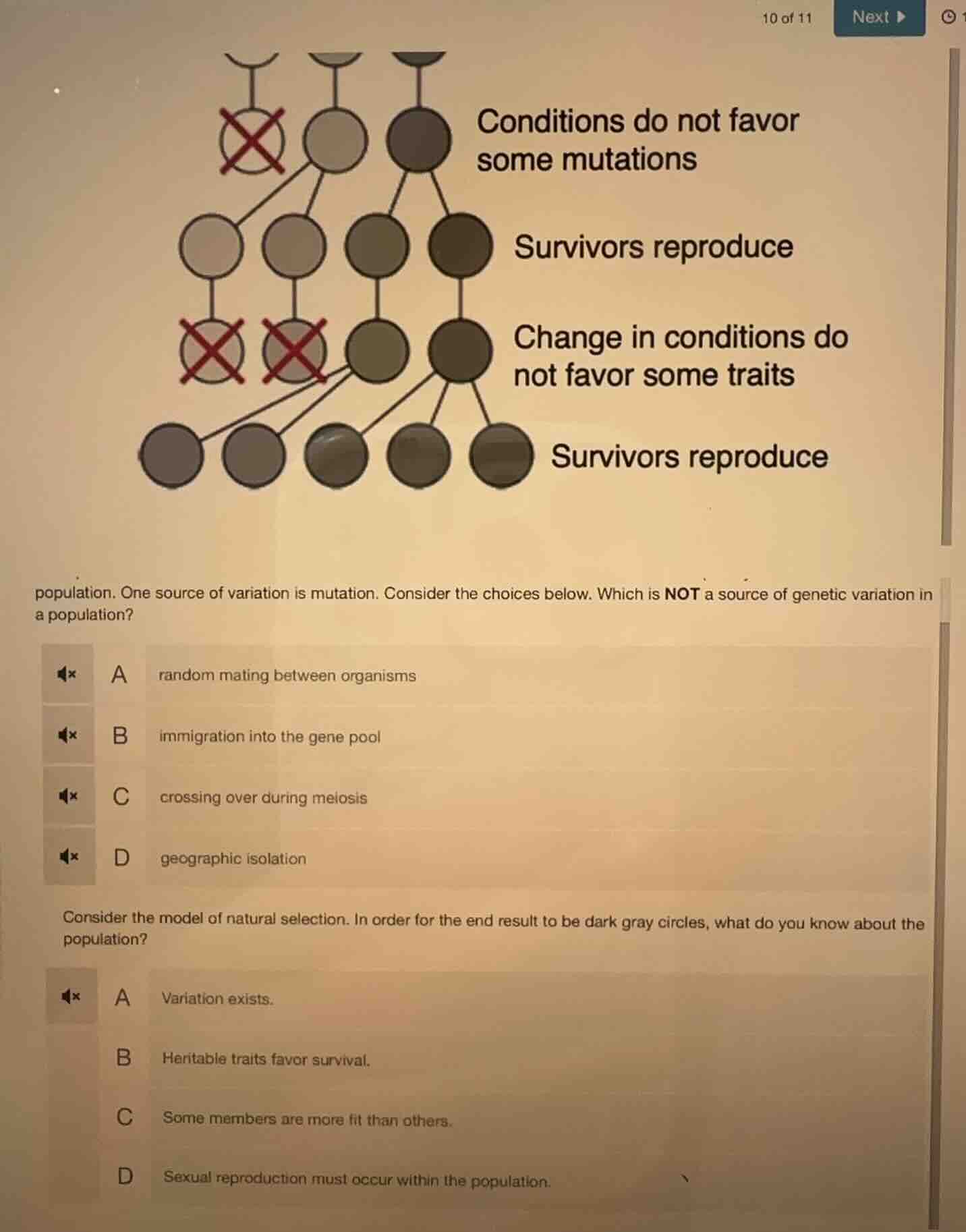
Question
population. one source of variation is mutation. consider the choices below. which is not a source of genetic variation in a population? a random mating between organisms b immigration into the gene pool c crossing over during meiosis d geographic isolation consider the model of natural selection. in order for the end result to be dark gray circles, what do you know about the population? a variation exists. b heritable traits favor survival. c some members are more fit than others. d sexual reproduction must occur within the population.
First Question (Which is NOT a source of genetic variation):
- Option A: Random mating shuffles alleles but doesn't introduce new genetic material, yet it's part of maintaining variation (but not a source of new variation? Wait, no—sources of genetic variation are mutation, gene flow, genetic recombination (like crossing over), and immigration (gene flow). Random mating is about allele distribution, not a source of new variation? Wait, no, let's recall: Sources of genetic variation are mutation (new alleles), gene flow (immigration/emigration, bringing new alleles), genetic recombination (crossing over, independent assortment), and random fertilization. Wait, the question is which is NOT a source. Let's analyze each:
- A: Random mating—Random mating is about how alleles are combined during reproduction, not a source of new genetic variation (it doesn't create new alleles or new combinations via new genes, just shuffles existing ones). But wait, crossing over (C) is a source (recombination), immigration (B) is gene flow (source), geographic isolation (D) is a mechanism for speciation, not a source of variation. Wait, no—geographic isolation prevents gene flow, so it's not a source of variation. Wait, maybe I messed up. Let's re-express:
- Mutation: new alleles.
- Gene flow (immigration/emigration): brings new alleles (source).
- Genetic recombination (crossing over, independent assortment, random fertilization): new combinations of existing alleles.
- Random mating: is about the randomness of mating, not a source of variation (it's part of Hardy-Weinberg, but not a source). Wait, but the options:
- A: Random mating—not a source of new variation (just shuffles existing alleles).
- B: Immigration—gene flow, brings new alleles (source).
- C: Crossing over—recombination, new allele combinations (source).
- D: Geographic isolation—prevents gene flow, so it's a barrier, not a source of variation. Wait, but the question is which is NOT a source. So between A and D? Wait, maybe the key is: Geographic isolation is a mechanism for divergence, not a source of variation. Random mating is part of the process but not a source. Wait, maybe the correct answer is A? No, wait, let's check standard sources: Sources of genetic variation are mutation, gene flow, genetic recombination (crossing over, independent assortment, random fertilization). Random mating is an assumption of Hardy-Weinberg, not a source of variation. Immigration (gene flow) is a source. Crossing over is a source. Geographic isolation is not a source (it's a barrier). So the answer is D? No, wait, the question is which is NOT a source. Let's see:
- A: Random mating—not a source (just shuffles existing alleles, no new variation created).
- B: Immigration—gene flow, brings new alleles (source).
- C: Crossing over—recombination, new allele combinations (source).
- D: Geographic isolation—prevents gene flow, so it's a barrier, not a source of variation. But maybe the intended answer is A? Wait, no, maybe I made a mistake. Alternatively, maybe the correct answer is D? Wait, no, let's think again. The question is "which is NOT a source of genetic variation". So:
- Mutation: source.
- Gene flow (immigration): source (brings new alleles).
- Genetic recombination (crossing over): source (new combinations).
- Random mating: not a source (just ensures random combination, no new variation).
- Geographic isolation: not a source (it's a mechanism for speciation, not creating variation).
But t…
To determine which is NOT a source of genetic variation, we analyze each option:
- A: Random mating shuffles existing alleles but does not introduce new genetic material (it is not a source of new variation).
- B: Immigration (gene flow) brings new alleles (source of variation).
- C: Crossing over (genetic recombination) creates new allele combinations (source of variation).
- D: Geographic isolation is a barrier to gene flow (not a source, but this is a mechanism for divergence, not variation).
Among these, random mating (A) is not a source of new genetic variation (it maintains existing variation through random allele combination, not creation).
The model shows different-colored circles (variation), selection (some die), and survivors (dark gray) reproducing. For natural selection to result in dark gray dominance:
- A: Variation exists (evident from different-colored circles initially).
- B: Heritable traits favor survival (implied, but variation is a prerequisite).
- C: Some members are more fit (true, but variation is the foundation).
- D: Sexual reproduction is unnecessary (natural selection occurs in asexual populations too).
Natural selection requires variation (differences to select), so the answer is A.

Snap & solve any problem in the app
Get step-by-step solutions on Sovi AI
Photo-based solutions with guided steps
Explore more problems and detailed explanations
A. random mating between organisms