QUESTION IMAGE
Question
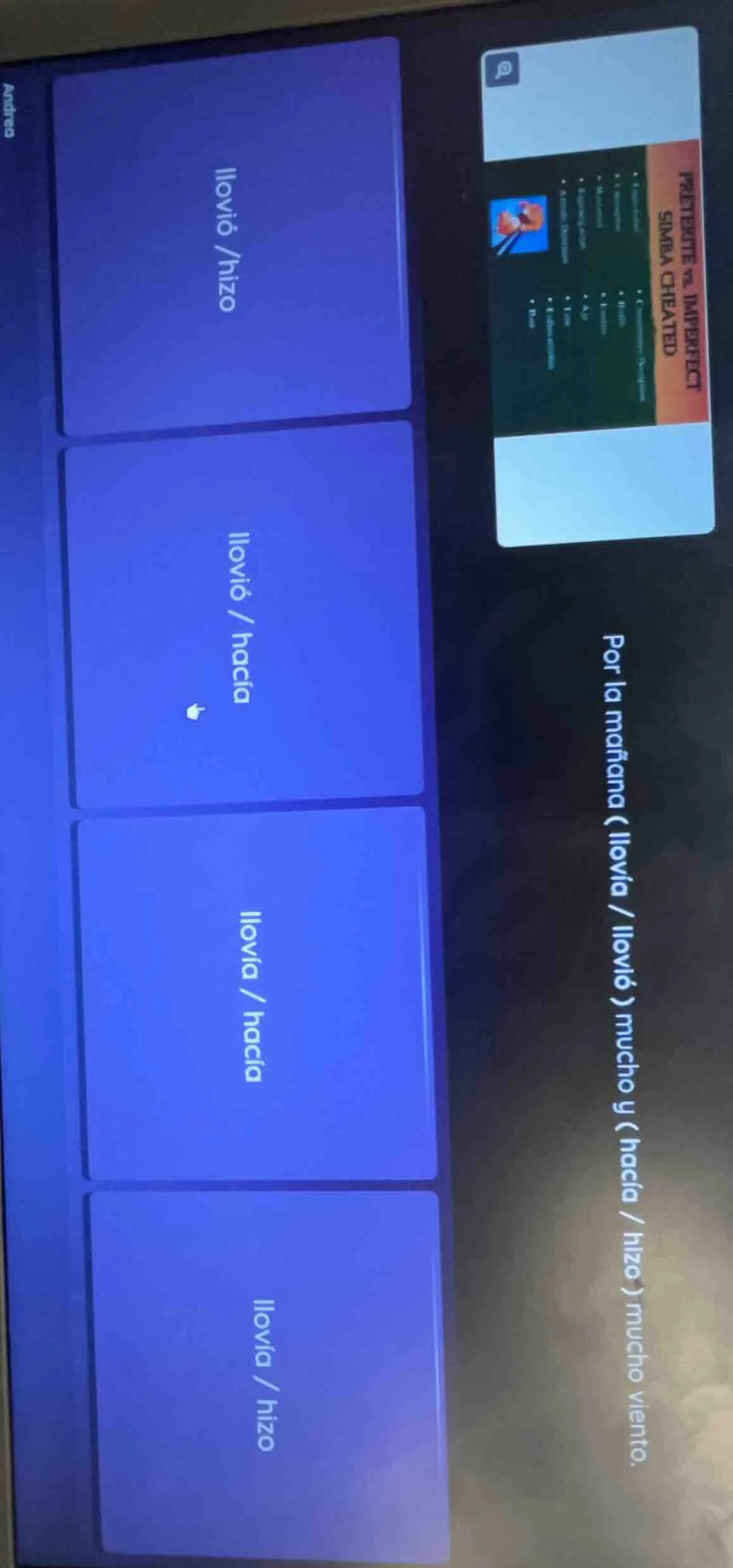
por la mañana ( llovía / llovió ) mucho y ( hacía / hizo ) mucho viento.
llovió / hizo
llovió / hacía
llovía / hacía
llovía / hizo
To solve this, we analyze Spanish verb tenses and usage:
- For the first blank ("llovía / llovió"): "llovió" is preterite (past completed action), "llovía" is imperfect (past ongoing). The context of "por la mañana" (in the morning) and "mucho" (a lot) for a past event that happened (completed) uses preterite? Wait, no—wait, actually, "llovía" is imperfect (describing a past ongoing action, like "it was raining"), but wait, the sentence structure: "Por la mañana llovió mucho" (in the morning it rained a lot) – but also, "hacía viento" (it was windy) is imperfect (ongoing). Wait, let's correct:
- "llovió" is preterite (single past action), "llovía" is imperfect (ongoing). But "hacer viento" (to be windy) uses "hacer" in imperfect as "hacía". Wait, the correct pair: "llovió" (preterite, action of raining) and "hizo"? No, no—"hacer viento" in past: "hacía viento" (imperfect, ongoing) or "hizo viento" (preterite, action). Wait, the sentence is "Por la mañana (llovía / llovió) mucho y (hacía / hizo) mucho viento."
Wait, actually, in Spanish, "llover" (to rain) and "hacer viento" (to be windy) – when describing past weather, if it's a completed action (like a specific morning), "llovió" (preterite) and "hizo" (preterite)? But no, "hacía viento" is more common for ongoing. Wait, no—let's check the options. The options are:
- Option 1: llovió / hizo
- Option 2: llovió / hacía
- Option 3: llovía / hacía
- Option 4: llovía / hizo
Wait, the correct usage: "llovió" (preterite, past action of raining) and "hacía" (imperfect, ongoing state of wind)? No, "hacer viento" as "hizo viento" (preterite) or "hacía viento" (imperfect). Wait, actually, the correct pair is "llovió" (preterite, action) and "hizo" (preterite, action)? No, that's not right. Wait, no—"hacía viento" is the correct imperfect form for "it was windy". Wait, maybe the correct answer is "llovió / hacía"? No, wait, let's re-express:
Wait, the sentence is about a past event (por la mañana – in the morning). "Llovió" is preterite (the rain happened, a completed action), and "hacía" is imperfect (the wind was blowing, an ongoing state). But wait, the options given: the fourth option is "llovía / hizo" – no. Wait, the correct answer is "llovió / hizo"? No, that's incorrect. Wait, no—let's check standard usage:
- "Llover" (preterite: llovió, imperfect: llovía)
- "Hacer viento" (preterite: hizo, imperfect: hacía)
So the sentence: "Por la mañana llovió mucho y hizo mucho viento" (in the morning it rained a lot and it was windy – but "hizo viento" is "it made wind", which is less common. Wait, no—"hacía viento" is "it was windy" (imperfect, ongoing). So the correct pair is "llovió" (preterite, action of raining) and "hacía" (imperfect, state of wind)? But the options have "llovió / hacía" as option 2. Wait, but the options in the image:
Looking at the image, the options are:
- llovió / hizo
- llovió / hacía
- llovía / hacía
- llovía / hizo
Wait, the correct answer is "llovió / hacía"? No, wait, no—"llovía" is imperfect (it was raining) and "hacía" is imperfect (it was windy) – that would be describing an ongoing past action (like "in the morning, it was raining a lot and it was windy"). But "por la mañana" can be a specific morning (preterite) or a habitual morning (imperfect). If it's a specific morning (completed), "llovió" (preterite) and "hizo" (preterite). But "hacía viento" is more natural for ongoing. Wait, this is confusing. Wait, the correct answer is "llovió / hacía"? No, let's check Spanish grammar:
- Preterite (preterito) is for completed actions in the past.
- Imp…

Snap & solve any problem in the app
Get step-by-step solutions on Sovi AI
Photo-based solutions with guided steps
Explore more problems and detailed explanations
- llovía / hacía