QUESTION IMAGE
Question
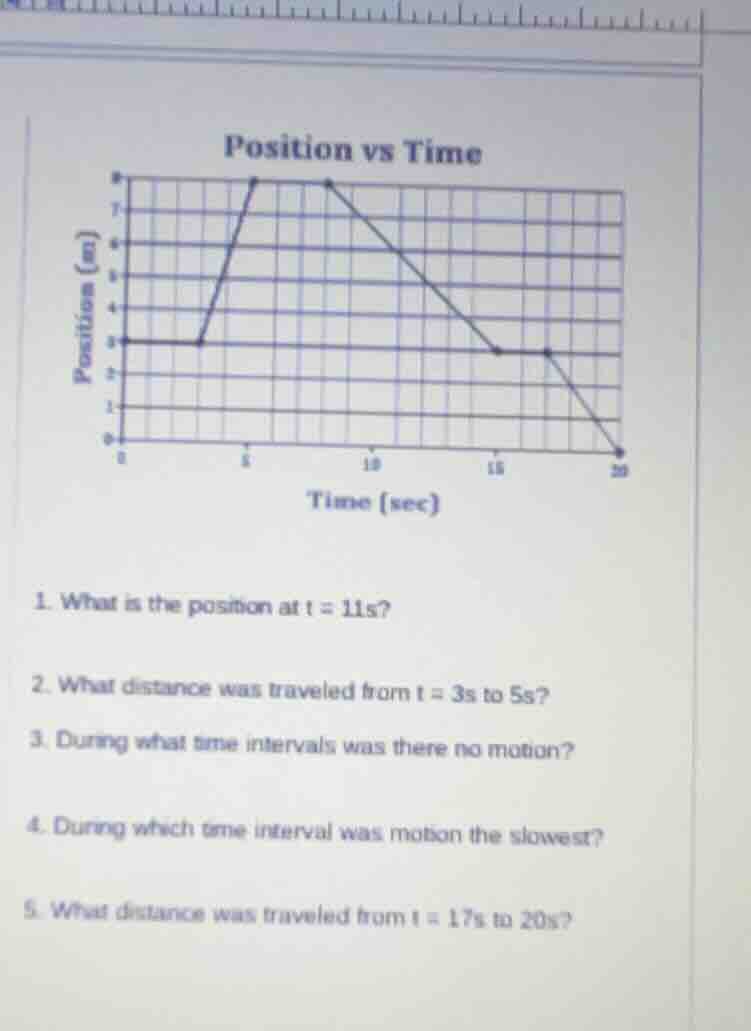
position vs time
position (m)
time (sec)
- what is the position at t = 11s?
- what distance was traveled from t = 3s to 5s?
- during what time intervals was there no motion?
- during which time interval was motion the slowest?
- what distance was traveled from t = 17s to 20s?
1. What is the position at \( t = 11 \, \text{s} \)?
Step 1: Analyze the graph
Look at the "Position vs Time" graph. Find the point corresponding to \( t = 11 \, \text{s} \) on the time axis (x - axis) and then determine the position (y - axis) at that time. From the graph, the line from \( t = 8 \, \text{s} \) to \( t = 15 \, \text{s} \) has a slope, and at \( t = 11 \, \text{s} \), we can see the position.
Step 2: Read the position
By looking at the graph, when \( t = 11 \, \text{s} \), the position is \( 6 \, \text{m} \) (assuming the grid lines and the graph's scale: the y - axis has markings, and at \( t = 11 \), the position value from the line is 6 m).
Step 1: Find positions at \( t = 3 \, \text{s} \) and \( t = 5 \, \text{s} \)
From the graph, at \( t = 3 \, \text{s} \), the position (\( x_1 \)) is \( 3 \, \text{m} \). At \( t = 5 \, \text{s} \), the position (\( x_2 \)) is \( 8 \, \text{m} \) (assuming the graph's scale, the vertical jump from \( t = 3 \) to \( t = 5 \) shows this change).
Step 2: Calculate distance
Distance is the absolute difference between the final and initial positions. So, distance \( d=\vert x_2 - x_1\vert=\vert8 - 3\vert = 5 \, \text{m} \).
Step 1: Recall the meaning of no motion on a position - time graph
On a position - time graph, no motion (zero velocity) is represented by a horizontal line (since position does not change with time).
Step 2: Identify the horizontal segments
- From \( t = 0 \, \text{s} \) to \( t = 3 \, \text{s} \): The position is constant (horizontal line), so no motion.
- From \( t = 5 \, \text{s} \) to \( t = 8 \, \text{s} \): The position is constant (horizontal line), so no motion.
- From \( t = 15 \, \text{s} \) to \( t = 17 \, \text{s} \): The position is constant (horizontal line), so no motion.

Snap & solve any problem in the app
Get step-by-step solutions on Sovi AI
Photo-based solutions with guided steps
Explore more problems and detailed explanations
The position at \( t = 11 \, \text{s} \) is \( 6 \, \text{m} \).