QUESTION IMAGE
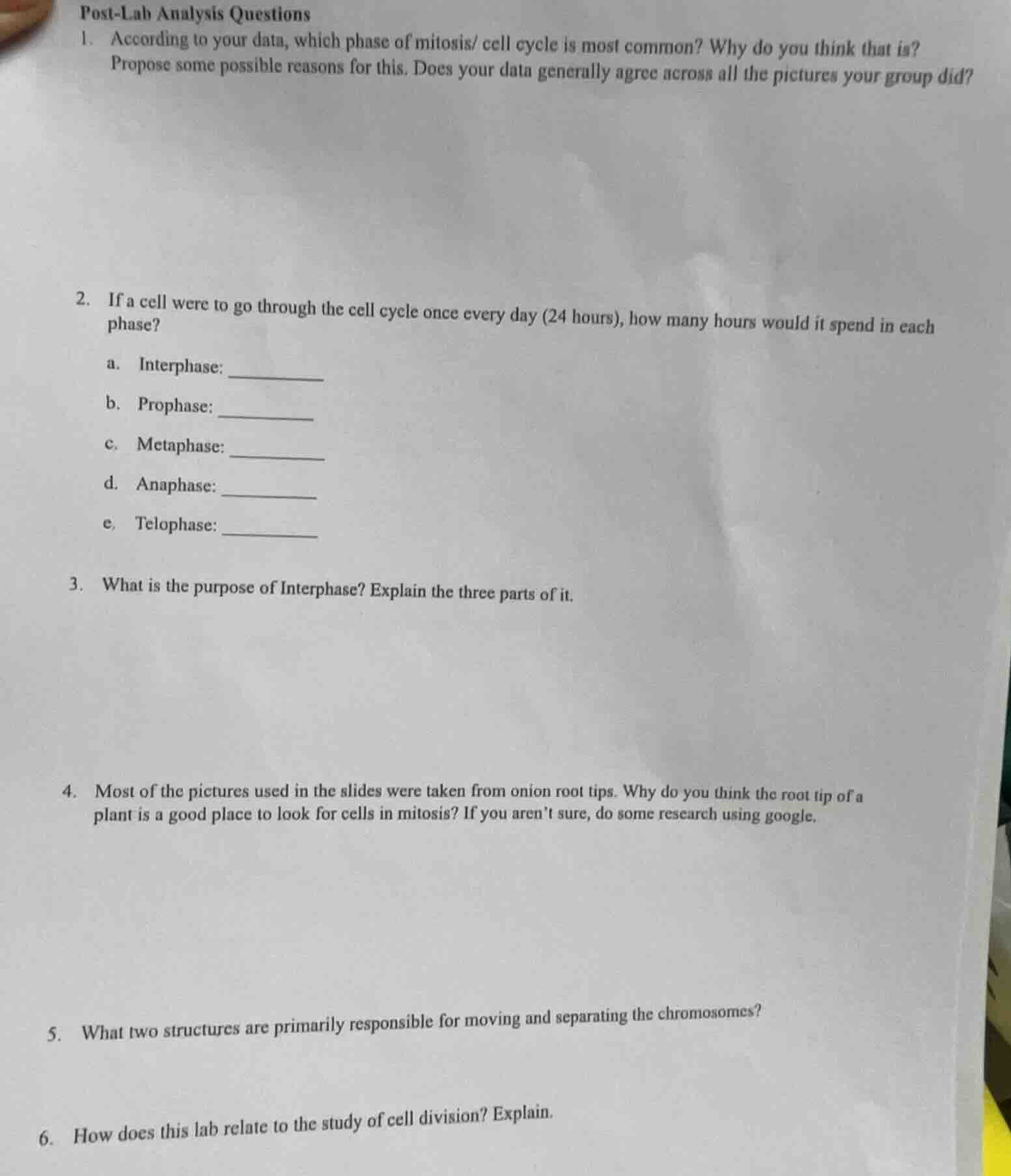
Question
post-lab analysis questions
- according to your data, which phase of mitosis/ cell cycle is most common? why do you think that is? propose some possible reasons for this. does your data generally agree across all the pictures your group did?
- if a cell were to go through the cell cycle once every day (24 hours), how many hours would it spend in each phase?
a. interphase: _______
b. prophase: _______
c. metaphase: _______
d. anaphase: _______
e. telophase: _______
- what is the purpose of interphase? explain the three parts of it.
- most of the pictures used in the slides were taken from onion root tips. why do you think the root tip of a plant is a good place to look for cells in mitosis? if you arent sure, do some research using google.
- what two structures are primarily responsible for moving and separating the chromosomes?
- how does this lab relate to the study of cell division? explain.
Brief Explanations
- Interphase is the longest cell cycle phase because cells grow, replicate DNA, and prepare for division here. Group data usually agrees as this is a universal cell trait.
- Uses standard percentage durations of each phase in a 24-hour cycle: Interphase (~90%), Prophase (~4%), Metaphase (~2%), Anaphase (~1%), Telophase (~3%).
- Interphase prepares cells for division; its three parts each have specific growth/DNA tasks.
- Onion root tips have actively dividing meristematic tissue.
- Spindle fibers attach to chromosomes, centrioles organize spindle fibers.
- The lab provides visual, hands-on observation of mitotic stages, reinforcing cell division concepts.

Snap & solve any problem in the app
Get step-by-step solutions on Sovi AI
Photo-based solutions with guided steps
Explore more problems and detailed explanations
- The most common phase is Interphase.
- Reason: Cells spend the majority of their cycle growing, replicating DNA, and carrying out normal functions here, rather than dividing.
- Group data generally agrees across samples because this is a consistent feature of eukaryotic cell cycles.
- a. Interphase: $\boldsymbol{21.6}$ hours
b. Prophase: $\boldsymbol{0.96}$ hours
c. Metaphase: $\boldsymbol{0.48}$ hours
d. Anaphase: $\boldsymbol{0.24}$ hours
e. Telophase: $\boldsymbol{0.72}$ hours
- The purpose of Interphase is to grow, replicate DNA, and prepare the cell for mitosis.
- G₁ Phase: Cell grows and synthesizes proteins/organelles.
- S Phase: DNA and centrosomes are fully replicated.
- G₂ Phase: Cell continues growing and checks for DNA damage before division.
- Onion root tips have a meristematic zone at their tip. This tissue contains rapidly dividing cells that are constantly undergoing mitosis to allow the root to grow in length, making it an ideal sample to observe all stages of mitosis.
- The two structures are spindle fibers (microtubules) and centrioles (in animal cells; in plant cells, spindle fibers form from microtubule organizing centers).
- This lab directly relates to cell division by providing visual, hands-on observation of the distinct stages of mitosis and interphase. It reinforces the sequence of cell division, the relative duration of each phase, and the structural changes cells undergo during division, which are core concepts in the study of cell division.