QUESTION IMAGE
Question
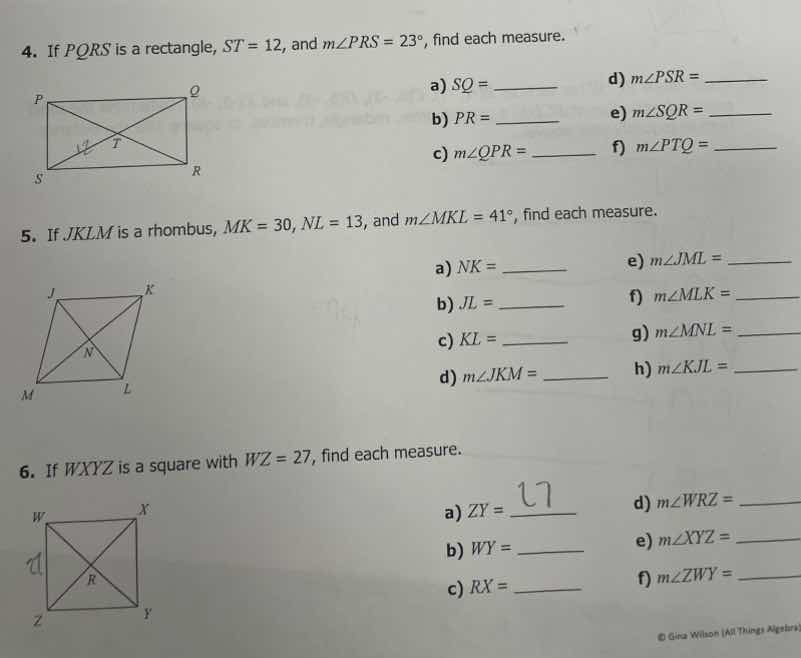
- if pqrs is a rectangle, ( st = 12 ), and ( mangle prs = 23^{circ} ), find each measure.
a) ( sq=)
b) ( pr=)
c) ( mangle qpr=)
d) ( mangle psr=)
e) ( mangle sqr=)
f) ( mangle ptq=)
- if jklm is a rhombus, ( mk = 30 ), ( nl = 13 ), and ( mangle mkl = 41^{circ} ), find each measure.
a) ( nk=)
b) ( jl=)
c) ( kl=)
d) ( mangle jkm=)
e) ( mangle jml=)
f) ( mangle mlk=)
g) ( mangle mnl=)
h) ( mangle kjl=)
- if wxyz is a square with ( wz = 27 ), find each measure.
a) ( zy=)
b) ( wy=)
c) ( rx=)
d) ( mangle wrz=)
e) ( mangle xyz=)
f) ( mangle zwy=)
© gina wilson (all things algebra)
Problem 4: PQRS is a rectangle
Step1: Recall rectangle diagonal properties
In a rectangle, diagonals are equal and bisect each other. So $SQ=PR=2\times ST$.
Step2: Calculate SQ and PR
$ST=12$, so $SQ=PR=2\times12=24$.
Step3: Find $\angle PSR$
All angles in a rectangle are right angles, so $\angle PSR=90^\circ$.
Step4: Find $\angle QPR$
$\angle PRS=23^\circ$, and $PQ\parallel SR$, so alternate interior angles are equal: $\angle QPR=\angle PRS=23^\circ$.
Step5: Find $\angle SQR$
First, $\angle PRQ=\angle PRS=23^\circ$. In $\triangle QSR$, $\angle SQR=90^\circ - 23^\circ=67^\circ$.
Step6: Find $\angle PTQ$
$\angle QTR=180^\circ-2\times23^\circ=134^\circ$, and $\angle PTQ=\angle QTR=134^\circ$ (vertical angles).
Step1: Recall rhombus diagonal properties
Diagonals bisect each other at right angles. So $NK=\frac{1}{2}MK$, $JL=2\times NL$.
Step2: Calculate NK and JL
$MK=30$, so $NK=\frac{30}{2}=15$. $NL=13$, so $JL=2\times13=26$.
Step3: Calculate KL
Use Pythagoras in $\triangle KNL$: $KL=\sqrt{NK^2+NL^2}=\sqrt{15^2+13^2}=\sqrt{225+169}=\sqrt{394}$.
Step4: Find $\angle JKM$
Diagonals bisect angles, so $\angle JKM=\angle MKL=41^\circ$.
Step5: Find $\angle JML$
Opposite angles of a rhombus are equal, and $\angle MKL=41^\circ$, so $\angle JML=2\times41^\circ=82^\circ$.
Step6: Find $\angle MLK$
Consecutive angles are supplementary: $\angle MLK=180^\circ-82^\circ=98^\circ$.
Step7: Find $\angle MNL$
Diagonals intersect at right angles, so $\angle MNL=90^\circ$.
Step8: Find $\angle KJL$
$\angle KJL=\angle MKL=41^\circ$ (alternate interior angles, $JK\parallel ML$).
Step1: Recall square side properties
All sides of a square are equal, so $ZY=WZ=27$.
Step2: Calculate diagonal WY
Diagonal of a square is $side\times\sqrt{2}$, so $WY=27\sqrt{2}$.
Step3: Calculate RX
Diagonals bisect each other, so $RX=\frac{1}{2}WY=\frac{27\sqrt{2}}{2}$.
Step4: Find $\angle WRZ$
Diagonals of a square bisect right angles, so $\angle WRZ=45^\circ$.
Step5: Find $\angle XYZ$
All angles in a square are right angles, so $\angle XYZ=90^\circ$.
Step6: Find $\angle ZWY$
Diagonals bisect right angles, so $\angle ZWY=45^\circ$.

Snap & solve any problem in the app
Get step-by-step solutions on Sovi AI
Photo-based solutions with guided steps
Explore more problems and detailed explanations
a) $SQ=24$
b) $PR=24$
c) $m\angle QPR=23^\circ$
d) $m\angle PSR=90^\circ$
e) $m\angle SQR=67^\circ$
f) $m\angle PTQ=134^\circ$
---