QUESTION IMAGE
Question
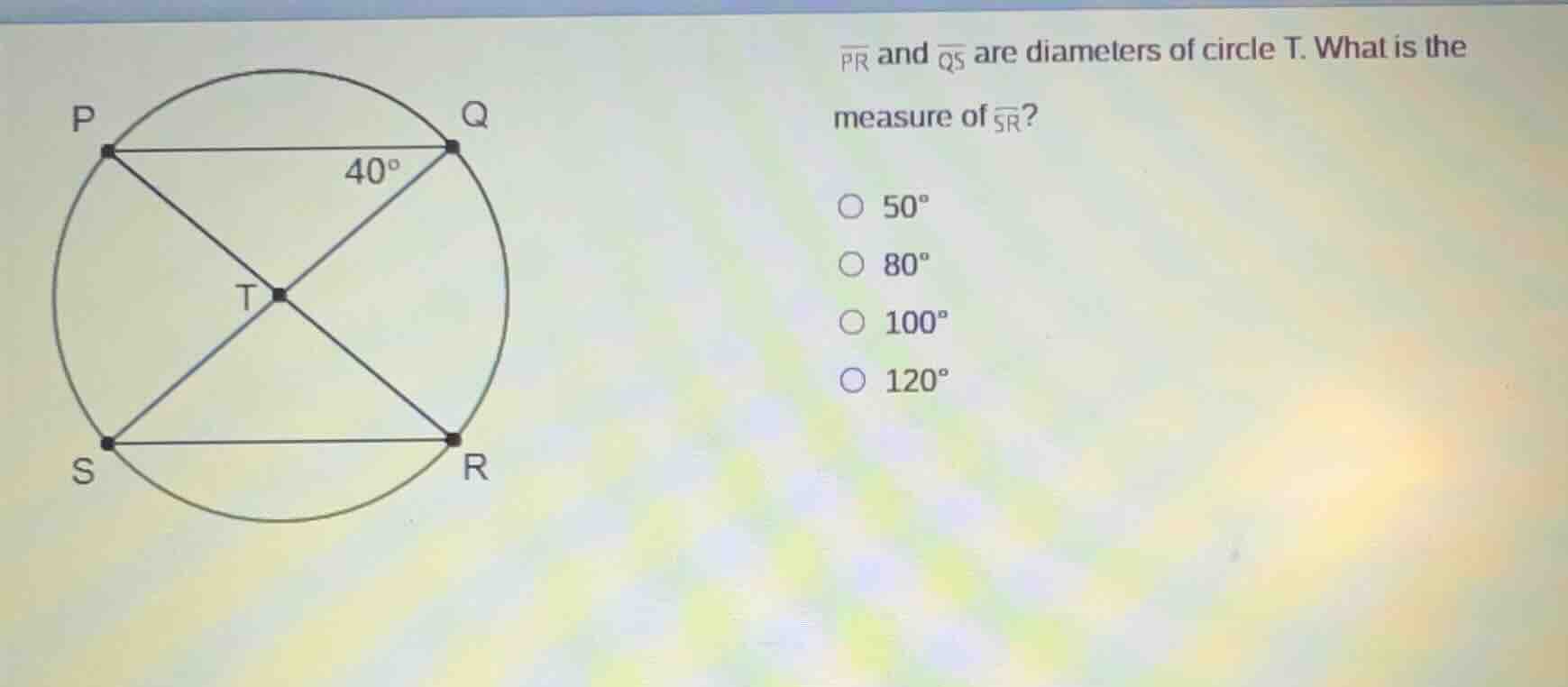
pr and qs are diameters of circle t. what is the measure of sr? 50° 80° 100° 120°
Step1: Identify triangle properties
Since \( PR \) and \( QS \) are diameters, \( T \) is the center. \( TP = TQ \) (radii), so \( \triangle TPQ \) is isosceles. Given \( \angle PQT = 40^\circ \), \( \angle QPT = 40^\circ \).
Step2: Find central angle \( \angle PTQ \)
In \( \triangle TPQ \), sum of angles is \( 180^\circ \). So \( \angle PTQ = 180^\circ - 40^\circ - 40^\circ = 100^\circ \).
Step3: Relate to arc \( SR \)
Vertical angles \( \angle PTQ \) and \( \angle STR \) are equal? Wait, no. Wait, \( QS \) and \( PR \) are diameters, so \( \angle SRT \) related? Wait, actually, \( \angle QTR \) is supplementary? Wait, no. Wait, \( PR \) is diameter, so \( \angle PQR = 90^\circ \)? No, better: \( \angle ST R \) and \( \angle PTQ \) are vertical angles? Wait, no, \( T \) is center, \( PT = TR = QT = TS \) (radii). So \( \triangle TQR \): \( QT = TR \), so isosceles? Wait, no, the arc \( SR \): the central angle for arc \( SR \) is \( \angle STR \). Wait, \( \angle PTQ = 100^\circ \)? Wait, no, earlier step: \( \angle PTQ = 180 - 40 - 40 = 100^\circ \). Then, since \( PR \) and \( QS \) are diameters, they intersect at \( T \), so \( \angle STR \) and \( \angle PTQ \) are vertical angles? No, \( \angle ST R \) and \( \angle PTQ \): wait, \( QS \) is diameter, so \( \angle QTS = 180^\circ \). Wait, maybe better: the arc \( PQ \) has central angle \( \angle PTQ = 100^\circ \)? No, wait, no: in \( \triangle TPQ \), angles at \( P \) and \( Q \) are 40, so angle at \( T \) is 100. Then, since \( PR \) is diameter, \( \angle PTR = 180^\circ \). So \( \angle STR = 180^\circ - \angle PTQ = 180 - 100 = 80^\circ \)? No, wait, no. Wait, \( QS \) is diameter, so \( \angle QTS = 180^\circ \). Wait, I think I messed up. Let's start over.
Wait, \( PR \) and \( QS \) are diameters, so \( T \) is the center. \( TP = TQ = TR = TS \) (radii). \( \angle PQT = 40^\circ \), so in \( \triangle TPQ \), \( \angle QPT = 40^\circ \) (since \( TP = TQ \)). Then \( \angle PTQ = 180 - 40 - 40 = 100^\circ \). Now, \( \angle PTQ \) and \( \angle STR \) are vertical angles? No, \( \angle PTQ \) and \( \angle STR \): wait, \( PQ \) and \( SR \) are parallel? The figure shows \( PQ \parallel SR \) (since \( PQ \) and \( SR \) are both chords, and \( PR \) and \( QS \) are diameters, so the quadrilateral \( PQRS \) is a rectangle? Wait, \( PQ \parallel SR \), \( PS \parallel QR \), and all angles 90? No, because \( \angle PQT = 40^\circ \). Wait, no, if \( PR \) and \( QS \) are diameters, then \( \angle PQR = 90^\circ \) (angle inscribed in semicircle). Wait, \( PR \) is diameter, so any angle subtended by \( PR \) on the circle is 90. So \( \angle PQR = 90^\circ \). Then \( \angle RQT = 90^\circ - 40^\circ = 50^\circ \). Then, in \( \triangle TQR \), \( TQ = TR \) (radii), so \( \angle TRQ = 50^\circ \), so \( \angle QTR = 180 - 50 - 50 = 80^\circ \). Wait, no, the arc \( SR \): the central angle for arc \( SR \) is \( \angle STR \). Wait, \( \angle STR \) and \( \angle QTR \): no, \( QS \) is diameter, so \( \angle QTS = 180^\circ \). Wait, I'm confused. Wait, the correct approach: the arc \( SR \) measure is equal to the central angle \( \angle STR \). Since \( PR \) is diameter, \( \angle PTR = 180^\circ \). \( \angle PTQ = 100^\circ \) (from earlier), so \( \angle QTR = 180^\circ - 100^\circ = 80^\circ \)? No, no. Wait, \( \angle PTQ = 100^\circ \), and \( \angle STR \) is equal to \( \angle PTQ \)? No, vertical angles: \( \angle PTQ \) and \( \angle STR \) are vertical angles? Wait, \( PQ \) and \( SR \) are chords, \( PR \) and \( QS \) intersect at \…

Snap & solve any problem in the app
Get step-by-step solutions on Sovi AI
Photo-based solutions with guided steps
Explore more problems and detailed explanations
\( 100^\circ \) (Option: \( 100^\circ \))