QUESTION IMAGE
Question
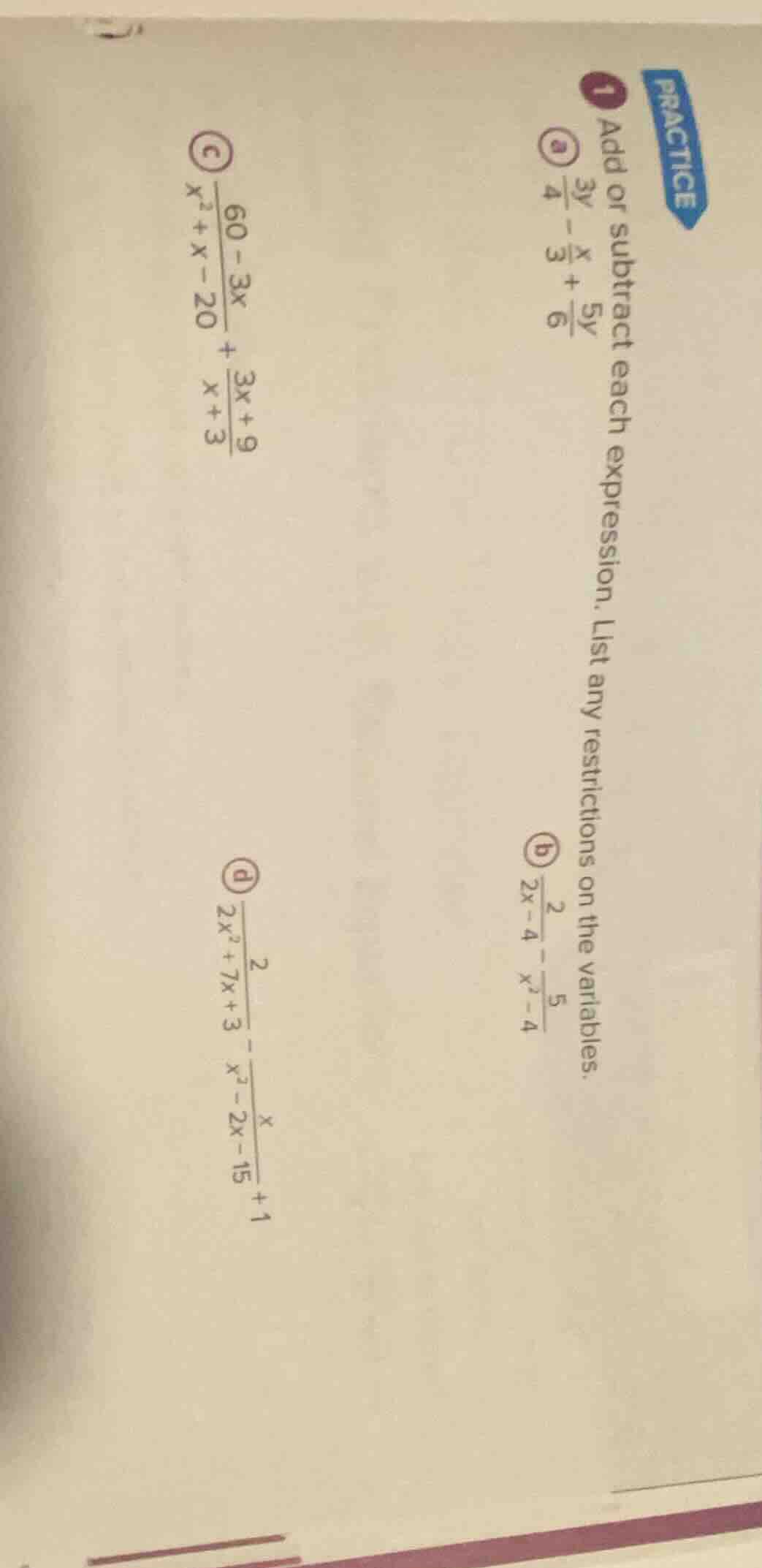
practice 1 add or subtract each expression. list any restrictions on the variables. a (\frac{3y}{4} - \frac{x}{3} + \frac{5y}{6}) b (\frac{2}{2x - 4} - \frac{5}{x^2 - 4}) c (\frac{60 - 3x}{x^2 + x - 20} + \frac{3x + 9}{x + 3}) d (\frac{2}{2x^2 + 7x + 3} - \frac{x}{x^2 - 2x - 15} + 1)
Part (a)
Step1: Find common denominator
Common denominator of 4,3,6 is 12.
Step2: Rewrite each term
$\frac{3y}{4}=\frac{9y}{12}$, $\frac{x}{3}=\frac{4x}{12}$, $\frac{5y}{6}=\frac{10y}{12}$
Step3: Combine the terms
$\frac{9y}{12}-\frac{4x}{12}+\frac{10y}{12}=\frac{9y-4x+10y}{12}$
Step4: Simplify numerator
$\frac{19y-4x}{12}$
No restrictions (variables can be any real number).
---
Part (b)
Step1: Factor denominators
$2x-4=2(x-2)$, $x^2-4=(x-2)(x+2)$
Restriction: $x
eq2, x
eq-2$ (denominator ≠0)
Step2: Find common denominator
Common denominator is $2(x-2)(x+2)$
Step3: Rewrite each term
$\frac{2}{2(x-2)}=\frac{x+2}{2(x-2)(x+2)}$, $\frac{5}{(x-2)(x+2)}=\frac{10}{2(x-2)(x+2)}$
Step4: Subtract the terms
$\frac{x+2-10}{2(x-2)(x+2)}=\frac{x-8}{2(x-2)(x+2)}$
---
Part (c)
Step1: Factor first denominator
$x^2+x-20=(x+5)(x-4)$
Restriction: $x
eq-5, x
eq4, x
eq-3$ (denominator ≠0)
Step2: Simplify first fraction numerator
$60-3x=-3(x-20)$
Step3: Find common denominator
Common denominator is $(x+5)(x-4)(x+3)$
Step4: Rewrite each term
$\frac{-3(x-20)}{(x+5)(x-4)}=\frac{-3(x-20)(x+3)}{(x+5)(x-4)(x+3)}$, $\frac{3x+9}{x+3}=\frac{3(x+3)}{x+3}=3=\frac{3(x+5)(x-4)}{(x+5)(x-4)(x+3)}$
Step5: Expand numerators
$-3(x^2-17x-60) + 3(x^2+x-20)$
$=-3x^2+51x+180+3x^2+3x-60$
Step6: Simplify numerator
$54x+120=6(9x+20)$
Step7: Combine into single fraction
$\frac{6(9x+20)}{(x+5)(x-4)(x+3)}$
---
Part (d)
Step1: Factor denominators
$2x^2+7x+3=(2x+1)(x+3)$, $x^2-2x-15=(x-5)(x+3)$
Restriction: $x
eq-3, x
eq-\frac{1}{2}, x
eq5$ (denominator ≠0)
Step2: Rewrite 1 as fraction
$1=\frac{(2x+1)(x+3)(x-5)}{(2x+1)(x+3)(x-5)}$
Step3: Find common denominator
Common denominator is $(2x+1)(x+3)(x-5)$
Step4: Rewrite each term
$\frac{2}{(2x+1)(x+3)}=\frac{2(x-5)}{(2x+1)(x+3)(x-5)}$, $\frac{x}{(x-5)(x+3)}=\frac{x(2x+1)}{(2x+1)(x+3)(x-5)}$
Step5: Combine all terms
$\frac{2(x-5)-x(2x+1)+(2x+1)(x+3)(x-5)}{(2x+1)(x+3)(x-5)}$
Step6: Expand numerators
$2x-10-2x^2-x + (2x+1)(x^2-2x-15)$
$=x-10-2x^2 + 2x^3-4x^2-30x+x^2-2x-15$
Step7: Simplify numerator
$2x^3-5x^2-31x-25$

Snap & solve any problem in the app
Get step-by-step solutions on Sovi AI
Photo-based solutions with guided steps
Explore more problems and detailed explanations
a) $\frac{19y-4x}{12}$; No variable restrictions
b) $\frac{x-8}{2(x-2)(x+2)}$; $x
eq2, x
eq-2$
c) $\frac{6(9x+20)}{(x+5)(x-4)(x+3)}$; $x
eq-5, x
eq4, x
eq-3$
d) $\frac{2x^3-5x^2-31x-25}{(2x+1)(x+3)(x-5)}$; $x
eq-3, x
eq-\frac{1}{2}, x
eq5$