QUESTION IMAGE
Question
practice 2
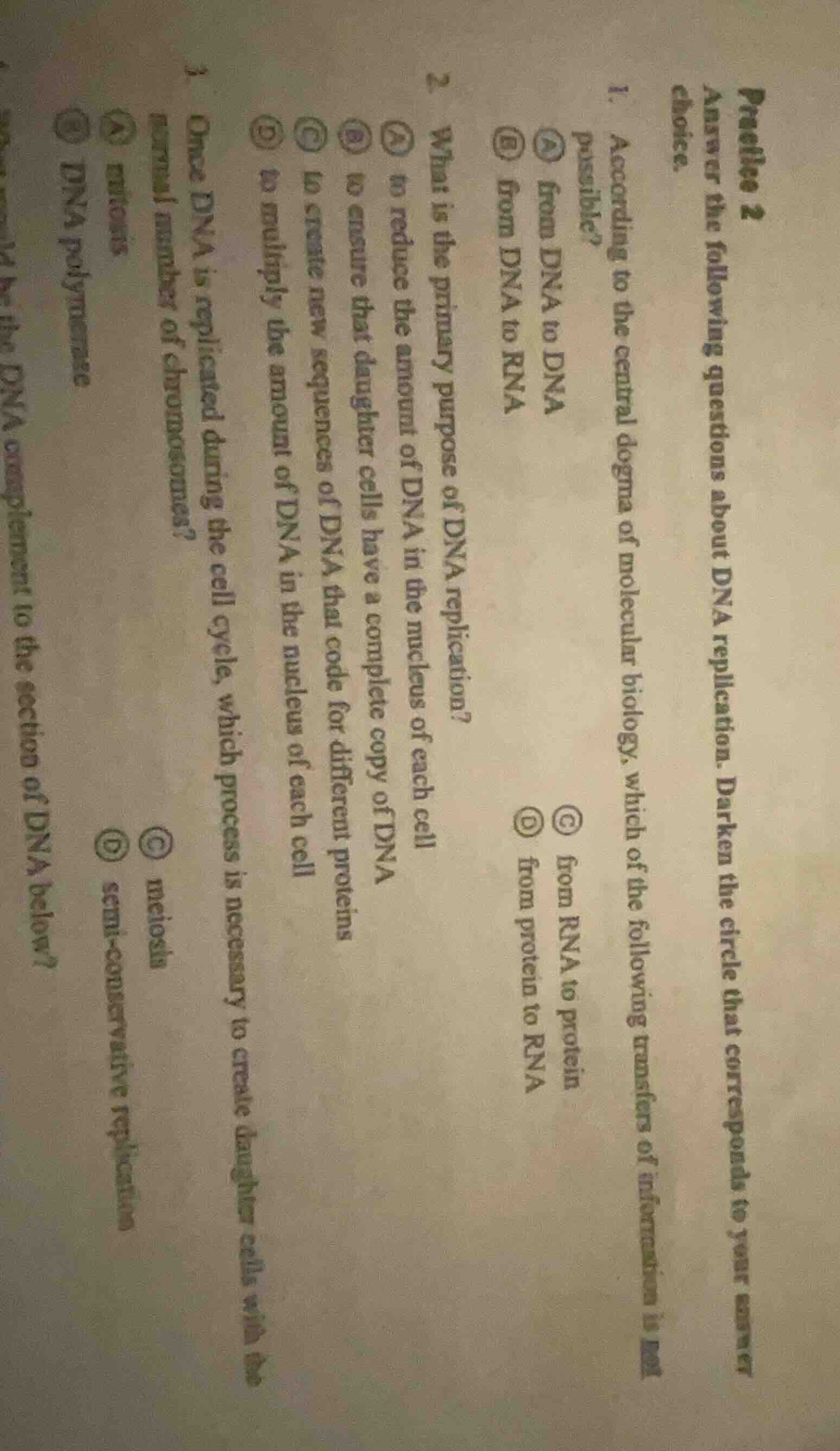
answer the following questions about dna replication. darken the circle that corresponds to your answer choice.
- according to the central dogma of molecular biology, which of the following transfers of information is not possible?
a from dna to dna
b from dna to rna
c from rna to protein
d from protein to rna
- what is the primary purpose of dna replication?
a to reduce the amount of dna in the nucleus of each cell
b to ensure that daughter cells have a complete copy of dna
c to create new sequences of dna that code for different proteins
d to multiply the amount of dna in the nucleus of each cell
- once dna is replicated during the cell cycle, which process is necessary to create daughter cells with the normal number of chromosomes?
a mitosis
c meiosis
b dna polymerase
d semi-conservative replication
- what would be the dna complement to the section of dna below?
Brief Explanations
- The central dogma of molecular biology describes the flow of genetic information as DNA → RNA → protein. Transfer from protein to RNA is not a natural, standard part of this process.
- DNA replication's core function is to produce an identical copy of the parent DNA, so that when cells divide, each daughter cell receives a full, complete set of genetic material.
- After DNA replication, mitosis is the cell division process that splits the cell into two daughter cells, each retaining the normal, full number of chromosomes (same as the parent cell). Meiosis reduces chromosome number, semi-conservative replication is the DNA replication method, and DNA polymerase is an enzyme for replication, not cell division.

Snap & solve any problem in the app
Get step-by-step solutions on Sovi AI
Photo-based solutions with guided steps
Explore more problems and detailed explanations
- D. from protein to RNA
- B. to ensure that daughter cells have a complete copy of DNA
- A. mitosis