QUESTION IMAGE
Question
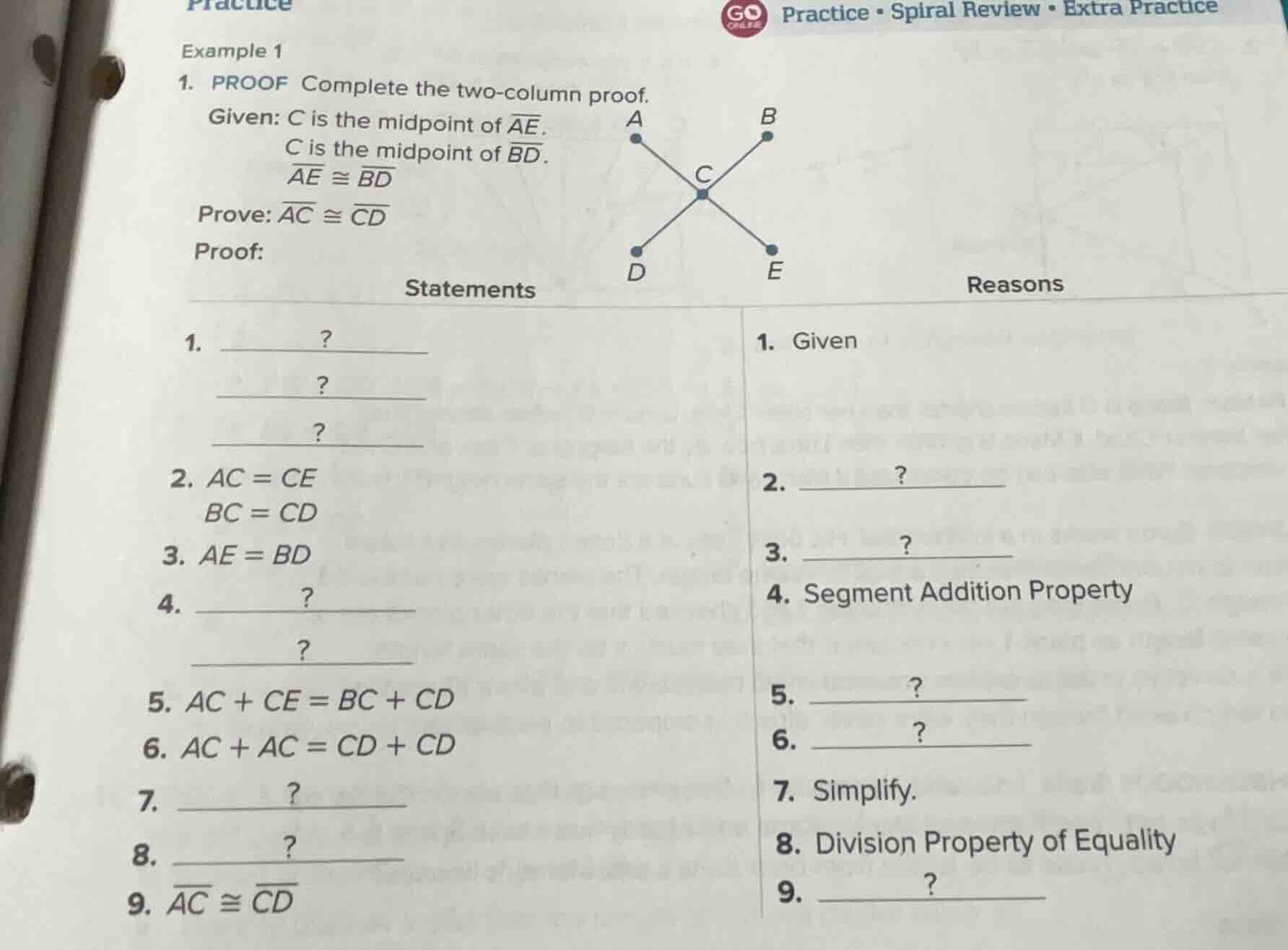
practice example 1 1. proof complete the two - column proof. given: c is the midpoint of \\(\overline{ae}\\). c is the midpoint of \\(\overline{bd}\\). \\(\overline{ae} \cong \overline{bd}\\) prove: \\(\overline{ac} \cong \overline{cd}\\) proof: | statements | reasons | | --- | --- | | 1.? | 1. given | |? | |? | | 2. \\(ac = ce\\) \\(bc = cd\\) | 2.? | | 3. \\(ae = bd\\) | 3.? | | 4.? | 4. segment addition property | |? | | 5. \\(ac + ce = bc + cd\\) | 5.? | | 6. \\(ac + ac = cd + cd\\) | 6.? | | 7.? | 7. simplify. | | 8.? | 8. division property of equality | | 9. \\(\overline{ac} \cong \overline{cd}\\) | 9.? |
Step1: Fill in Given Statements
We know the given information is: \( C \) is the midpoint of \( \overline{AE} \), \( C \) is the midpoint of \( \overline{BD} \), and \( \overline{AE} \cong \overline{BD} \). So we put these in the first row of statements.
Statements: 1. \( C \) is the midpoint of \( \overline{AE} \); \( C \) is the midpoint of \( \overline{BD} \); \( \overline{AE} \cong \overline{BD} \)
Step2: Reason for \( AC = CE \) and \( BC = CD \)
The definition of a midpoint states that a midpoint of a segment divides the segment into two congruent (and thus equal in length) segments. So the reason for \( AC = CE \) and \( BC = CD \) is the Definition of Midpoint.
Reason: 2. Definition of Midpoint
Step3: Reason for \( AE = BD \)
If two segments are congruent, their lengths are equal. Since \( \overline{AE} \cong \overline{BD} \), by the Definition of Congruent Segments, \( AE = BD \).
Reason: 3. Definition of Congruent Segments
Step4: Apply Segment Addition Property
The Segment Addition Property for \( \overline{AE} \) is \( AE = AC + CE \) and for \( \overline{BD} \) is \( BD = BC + CD \). So we write these as statements.
Statements: 4. \( AE = AC + CE \); \( BD = BC + CD \)
Step5: Substitute \( AE \) and \( BD \)
Since \( AE = BD \) (from step 3), we can substitute \( AE \) with \( BD \) and \( BD \) with \( AE \) in the equations from step 4. So the reason for \( AC + CE = BC + CD \) is Substitution Property of Equality.
Reason: 5. Substitution Property of Equality
Step6: Substitute \( AC \) and \( CD \)
From step 2, we know \( AC = CE \) and \( BC = CD \). So we can substitute \( CE \) with \( AC \) and \( BC \) with \( CD \) in the equation from step 5. The reason for \( AC + AC = CD + CD \) is Substitution (using \( AC = CE \) and \( BC = CD \)).
Reason: 6. Substitution (using \( AC = CE \), \( BC = CD \))
Step7: Simplify \( AC + AC \) and \( CD + CD \)
Simplifying \( AC + AC \) gives \( 2AC \) and \( CD + CD \) gives \( 2CD \). So the statement is \( 2AC = 2CD \).
Statements: 7. \( 2AC = 2CD \)
Step8: Apply Division Property of Equality
Dividing both sides of \( 2AC = 2CD \) by 2 (using the Division Property of Equality) gives \( AC = CD \).
Statements: 8. \( AC = CD \)
Step9: Reason for \( \overline{AC} \cong \overline{CD} \)
If two segments have equal lengths, they are congruent. Since \( AC = CD \), by the Definition of Congruent Segments, \( \overline{AC} \cong \overline{CD} \).
Reason: 9. Definition of Congruent Segments
Final Proof Table:
| Statements | Reasons |
|---|---|
| 2. \( AC = CE \); \( BC = CD \) | 2. Definition of Midpoint |
| 3. \( AE = BD \) | 3. Definition of Congruent Segments |
| 4. \( AE = AC + CE \); \( BD = BC + CD \) | 4. Segment Addition Property |
| 5. \( AC + CE = BC + CD \) | 5. Substitution Property of Equality (using \( AE = BD \)) |
| 6. \( AC + AC = CD + CD \) | 6. Substitution (using \( AC = CE \), \( BC = CD \)) |
| 7. \( 2AC = 2CD \) | 7. Simplify |
| 8. \( AC = CD \) | 8. Division Property of Equality |
| 9. \( \overline{AC} \cong \overline{CD} \) | 9. Definition of Congruent Segments |

Snap & solve any problem in the app
Get step-by-step solutions on Sovi AI
Photo-based solutions with guided steps
Explore more problems and detailed explanations
The completed two - column proof is as shown in the above table.