QUESTION IMAGE
Question
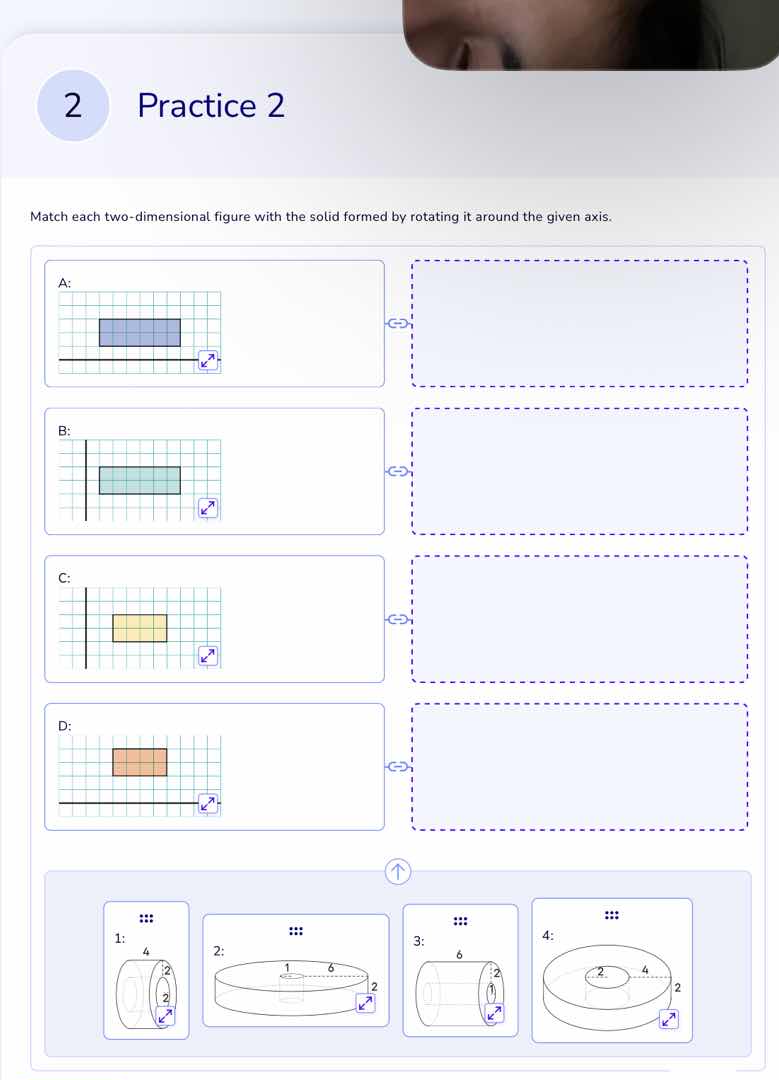
2 practice 2 match each two - dimensional figure with the solid formed by rotating it around the given axis. a: figure b: figure c: figure d: figure 1: figure 2: figure 3: figure 4: figure
Response
To solve this problem, we analyze each 2D figure and the axis of rotation to determine the resulting 3D solid (using the concept of "rotation of a rectangle to form a cylinder" and "rotation of a rectangle with a gap to form a cylindrical shell or a larger cylinder with a smaller cylinder removed").
Analyzing Figure A:
- Figure A is a rectangle (blue) with the axis of rotation (horizontal line) below the rectangle, at a vertical distance (let’s assume grid units). When a rectangle rotates around an axis parallel to one of its sides (here, the horizontal axis is parallel to the length of the rectangle), it forms a cylinder. The radius of the cylinder is the vertical distance from the rectangle to the axis, and the height is the length of the rectangle.
- Matching with the 3D solids: Solid 3 (a cylinder with radius ~2 and height ~6) fits, as the rotation of A (with the axis below) creates a cylinder with consistent dimensions.
Analyzing Figure B:
- Figure B is a rectangle (teal) with a vertical axis (black line) to the left of the rectangle. The axis is parallel to the height of the rectangle. Rotating the rectangle around this vertical axis forms a cylinder where the radius is the horizontal distance from the rectangle to the axis, and the height is the height of the rectangle.
- The horizontal distance from the rectangle to the axis is large, so the resulting cylinder has a large radius. Solid 2 (a wide, flat cylinder with radius ~6 and height ~2) matches this, as the rotation around the left vertical axis creates a wide cylinder.
Analyzing Figure C:
- Figure C is a rectangle (yellow) with a vertical axis (black line) to the left of the rectangle, but the horizontal distance from the rectangle to the axis is smaller than in Figure B. Rotating this rectangle around the vertical axis forms a cylinder with a smaller radius (but still a cylinder). However, if we consider the gap (the rectangle is offset from the axis), rotating it creates a cylindrical shell (or a larger cylinder with a smaller cylinder removed). Solid 4 (a ring-shaped cylinder with inner radius ~2 and outer radius ~4, height ~2) matches this, as the rotation of C (with the axis close to the rectangle) creates a hollow cylinder.
Analyzing Figure D:
- Figure D is a rectangle (brown) with the axis of rotation (horizontal line) below the rectangle, at a vertical distance. The vertical distance here is smaller than in Figure A (so the radius of the cylinder is smaller). Rotating this rectangle around the horizontal axis forms a cylinder with a smaller radius. Solid 1 (a cylinder with radius ~2 and height ~4) fits, as the rotation of D (with a closer axis) creates a shorter, thicker cylinder.
Final Matches:
- A ↔ 3 (Cylinder from rotating a rectangle around a parallel horizontal axis)
- B ↔ 2 (Wide cylinder from rotating a rectangle around a left vertical axis)
- C ↔ 4 (Hollow cylinder from rotating a rectangle around a left vertical axis with a small gap)
- D ↔ 1 (Shorter cylinder from rotating a rectangle around a parallel horizontal axis with a closer axis)

Snap & solve any problem in the app
Get step-by-step solutions on Sovi AI
Photo-based solutions with guided steps
Explore more problems and detailed explanations
A: 3
B: 2
C: 4
D: 1