QUESTION IMAGE
Question
- practice: organizing information
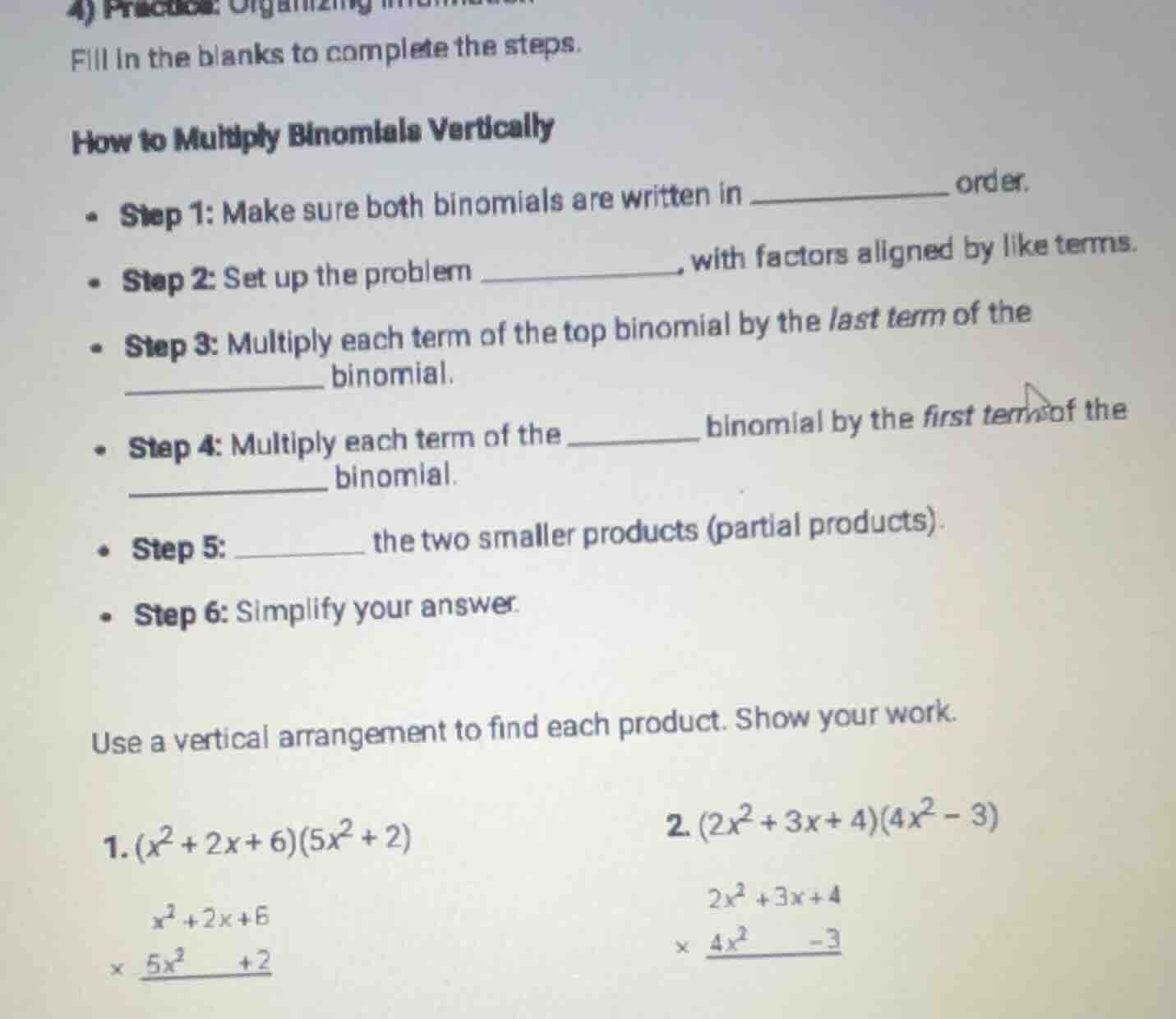
fill in the blanks to complete the steps.
how to multiply binomials vertically
- step 1: make sure both binomials are written in __________ order.
- step 2: set up the problem __________, with factors aligned by like terms.
- step 3: multiply each term of the top binomial by the last term of the __________ binomial.
- step 4: multiply each term of the ______ binomial by the first term of the ________ binomial.
- step 5: ________ the two smaller products (partial products).
- step 6: simplify your answer.
use a vertical arrangement to find each product. show your work.
- ((x^2 + 2x + 6)(5x^2 + 2))
(\begin{array}{r}x^2 + 2x + 6\\times 5x^2 + 2\hlineend{array})
- ((2x^2 + 3x + 4)(4x^2 - 3))
(\begin{array}{r}2x^2 + 3x + 4\\times 4x^2 - 3\hlineend{array})
Filling the Blanks (Steps for Multiplying Binomials Vertically)
Step 1:
To multiply binomials vertically, we first ensure both binomials are in descending (or standard) order of exponents. So the first blank is "descending" (or "standard" or "descending powers of the variable").
Step 2:
We set up the problem vertically (like a multiplication of numbers) so that like terms are aligned. So the second blank is "vertically".
Step 3:
We multiply each term of the top binomial by the last term of the bottom binomial. So the third blank is "bottom".
Step 4:
We multiply each term of the top binomial by the first term of the bottom binomial. So the first blank in Step 4 is "top" and the second is "bottom".
Step 5:
After getting the two partial products (from multiplying by last and first terms of the bottom binomial), we add them. So the fifth blank is "Add".
Solving the Vertical Multiplication Problems
1. \((x^2 + 2x + 6)(5x^2 + 2)\)
We set up the vertical multiplication:
\[
\]
- Multiply \((x^2 + 2x + 6)\) by \(2\) (last term of the bottom binomial):
\[
\]
- Multiply \((x^2 + 2x + 6)\) by \(5x^2\) (first term of the bottom binomial). We need to shift one position to the left (since \(5x^2\) is a term with degree \(2\)):
\[
\]
- Now, add the two partial products:
\[
\]
So, \((x^2 + 2x + 6)(5x^2 + 2) = 5x^4 + 10x^3 + 32x^2 + 4x + 12\).
2. \((2x^2 + 3x + 4)(4x^2 - 3)\)
We set up the vertical multiplication:
\[
\]
- Multiply \((2x^2 + 3x + 4)\) by \(-3\) (last term of the bottom binomial):
\[
\]
- Multiply \((2x^2 + 3x + 4)\) by \(4x^2\) (first term of the bottom binomial). We shift one position to the left:
\[
\]
- Now, add the two partial products:
\[
\]
So, \((2x^2 + 3x + 4)(4x^2 - 3) = 8x^4 + 12x^3 + 10x^2 - 9x - 12\).
Final Answers for Blanks:
- descending (or standard)
- vertically
- bottom
- top, bottom
- Add
Final Answers for Products:
- \(\boldsymbol{5x^4 + 10x^3 + 32x^2 + 4x + 12}\)
- \(\boldsymbol{8x^4 + 12x^3 + 10x^2 - 9x - 12}\)

Snap & solve any problem in the app
Get step-by-step solutions on Sovi AI
Photo-based solutions with guided steps
Explore more problems and detailed explanations
Filling the Blanks (Steps for Multiplying Binomials Vertically)
Step 1:
To multiply binomials vertically, we first ensure both binomials are in descending (or standard) order of exponents. So the first blank is "descending" (or "standard" or "descending powers of the variable").
Step 2:
We set up the problem vertically (like a multiplication of numbers) so that like terms are aligned. So the second blank is "vertically".
Step 3:
We multiply each term of the top binomial by the last term of the bottom binomial. So the third blank is "bottom".
Step 4:
We multiply each term of the top binomial by the first term of the bottom binomial. So the first blank in Step 4 is "top" and the second is "bottom".
Step 5:
After getting the two partial products (from multiplying by last and first terms of the bottom binomial), we add them. So the fifth blank is "Add".
Solving the Vertical Multiplication Problems
1. \((x^2 + 2x + 6)(5x^2 + 2)\)
We set up the vertical multiplication:
\[
\]
- Multiply \((x^2 + 2x + 6)\) by \(2\) (last term of the bottom binomial):
\[
\]
- Multiply \((x^2 + 2x + 6)\) by \(5x^2\) (first term of the bottom binomial). We need to shift one position to the left (since \(5x^2\) is a term with degree \(2\)):
\[
\]
- Now, add the two partial products:
\[
\]
So, \((x^2 + 2x + 6)(5x^2 + 2) = 5x^4 + 10x^3 + 32x^2 + 4x + 12\).
2. \((2x^2 + 3x + 4)(4x^2 - 3)\)
We set up the vertical multiplication:
\[
\]
- Multiply \((2x^2 + 3x + 4)\) by \(-3\) (last term of the bottom binomial):
\[
\]
- Multiply \((2x^2 + 3x + 4)\) by \(4x^2\) (first term of the bottom binomial). We shift one position to the left:
\[
\]
- Now, add the two partial products:
\[
\]
So, \((2x^2 + 3x + 4)(4x^2 - 3) = 8x^4 + 12x^3 + 10x^2 - 9x - 12\).
Final Answers for Blanks:
- descending (or standard)
- vertically
- bottom
- top, bottom
- Add
Final Answers for Products:
- \(\boldsymbol{5x^4 + 10x^3 + 32x^2 + 4x + 12}\)
- \(\boldsymbol{8x^4 + 12x^3 + 10x^2 - 9x - 12}\)