QUESTION IMAGE
Question
practice pedigree charts
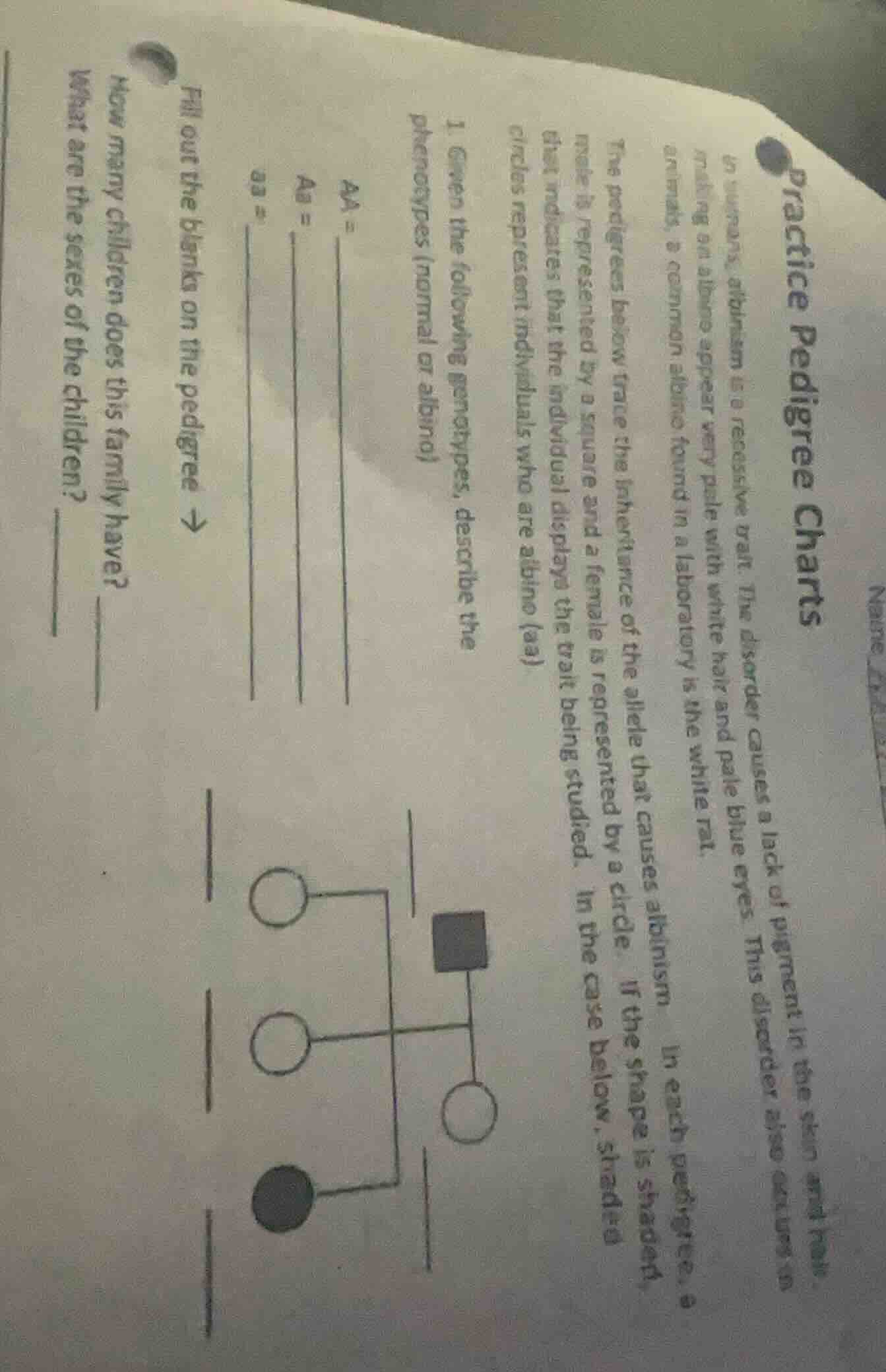
in humans, albinism is a recessive trait. the disorder causes a lack of pigment in the skin and hair, resulting in an albino appear very pale with white hair and pale blue eyes. this disorder also occurs in animals, a common albino found in a laboratory is the white rat.
the pedigrees below trace the inheritance of the allele that causes albinism. in each pedigree, a male is represented by a square and a female is represented by a circle. if the shape is shaded, that indicates that the individual displays the trait being studied. in the case below, shaded circles represent individuals who are albino (aa)
- given the following genotypes, describe the phenotypes (normal or albino)
aa =
aa =
aa =
fill out the blanks on the pedigree
how many children does this family have?
what are the sexes of the children?
Part 1: Genotype to Phenotype (Albinism, a recessive trait)
Albinism is a recessive trait, meaning the allele for albinism (\(a\)) is recessive to the normal allele (\(A\)).
Step 1: Analyze \(AA\) genotype
A person with \(AA\) has two dominant normal alleles. Since the albinism allele (\(a\)) is recessive, the dominant allele (\(A\)) will be expressed.
Phenotype: Normal (no albinism, as there are no recessive \(a\) alleles to cause the trait).
Step 2: Analyze \(Aa\) genotype
A person with \(Aa\) has one dominant normal allele (\(A\)) and one recessive albinism allele (\(a\)). The dominant allele (\(A\)) masks the recessive allele (\(a\)), so the normal phenotype is expressed.
Phenotype: Normal (carrier of the albinism allele, but does not show the trait).
Step 3: Analyze \(aa\) genotype
A person with \(aa\) has two recessive albinism alleles. Since there are no dominant alleles to mask the recessive trait, the albinism phenotype is expressed.
Phenotype: Albino (shows the albinism trait, as both alleles are recessive for the disorder).
Part 2: Number of Children
To determine the number of children, we count the offspring (the individuals connected below the parental generation). From the pedigree, we can see there are 3 children (the three individuals in the row below the parents).
Part 3: Sexes of the Children
In pedigree charts:
- A square represents a male.
- A circle represents a female.
Looking at the children:
- The first child (top) is a circle → female.
- The second child (middle) is a circle → female.
- The third child (bottom) is a circle (shaded) → female? Wait, no—wait, the parental male (square) and female (circle) have three children? Wait, maybe I miscounted. Wait, the pedigree: the parents (the shaded square (male, albino? Wait no, shaded circles are albino (aa). Wait, the first row: shaded square (male, aa), circle (female, A_). Their children: three? Wait, the three circles? Wait, no—maybe the children are the three individuals: two unshaded circles and one shaded circle? Wait, the image shows three children: let's check the symbols:
- Top child: unshaded circle → female (normal).
- Middle child: unshaded circle → female (normal).
- Bottom child: shaded circle → female (albino). Wait, but a square is male, circle is female. So all three children are circles → females? Wait, maybe the pedigree has three children, all female? Or maybe I misread. Wait, the original problem: “What are the sexes of the children?” From the symbols: circles are female, squares are male. The three children are all circles → so all three are female? Wait, maybe the pedigree has three children: two normal females (unshaded circles) and one albino female (shaded circle).
Final Answers
- Phenotypes:
- \(AA\): Normal
- \(Aa\): Normal
- \(aa\): Albino
- Number of children: \(3\)
- Sexes of the children: All female (or specify: 3 females, as all are represented by circles).
Step-by-Step for Genotype-Phenotype (Albinism is recessive, \(a\) is recessive allele, \(A\) is dominant normal allele)
Step 1: \(AA\)
- Genotype: \(AA\) (homozygous dominant)
- Alleles: Two \(A\) (normal) alleles.
- Phenotype: Normal (no albinism, since dominant allele masks recessive trait).
Step 2: \(Aa\)
- Genotype: \(Aa\) (heterozygous)
- Alleles: One \(A\) (normal), one \(a\) (albinism).
- Phenotype: Normal (dominant \(A\) masks recessive \(a\); carrier of albinism allele).
Step 3: \(aa\)
- Genotype: \(aa\) (homozygous recessive)
- Alleles: Two \(a\) (albinism) alleles.
- Phenotype: Albino (recessi…

Snap & solve any problem in the app
Get step-by-step solutions on Sovi AI
Photo-based solutions with guided steps
Explore more problems and detailed explanations
- Phenotypes:
- \(AA\): Normal
- \(Aa\): Normal
- \(aa\): Albino
- Number of children: \(\boldsymbol{3}\)
- Sexes of the children: \(\boldsymbol{3}\) females (all represented by circles)