QUESTION IMAGE
Question
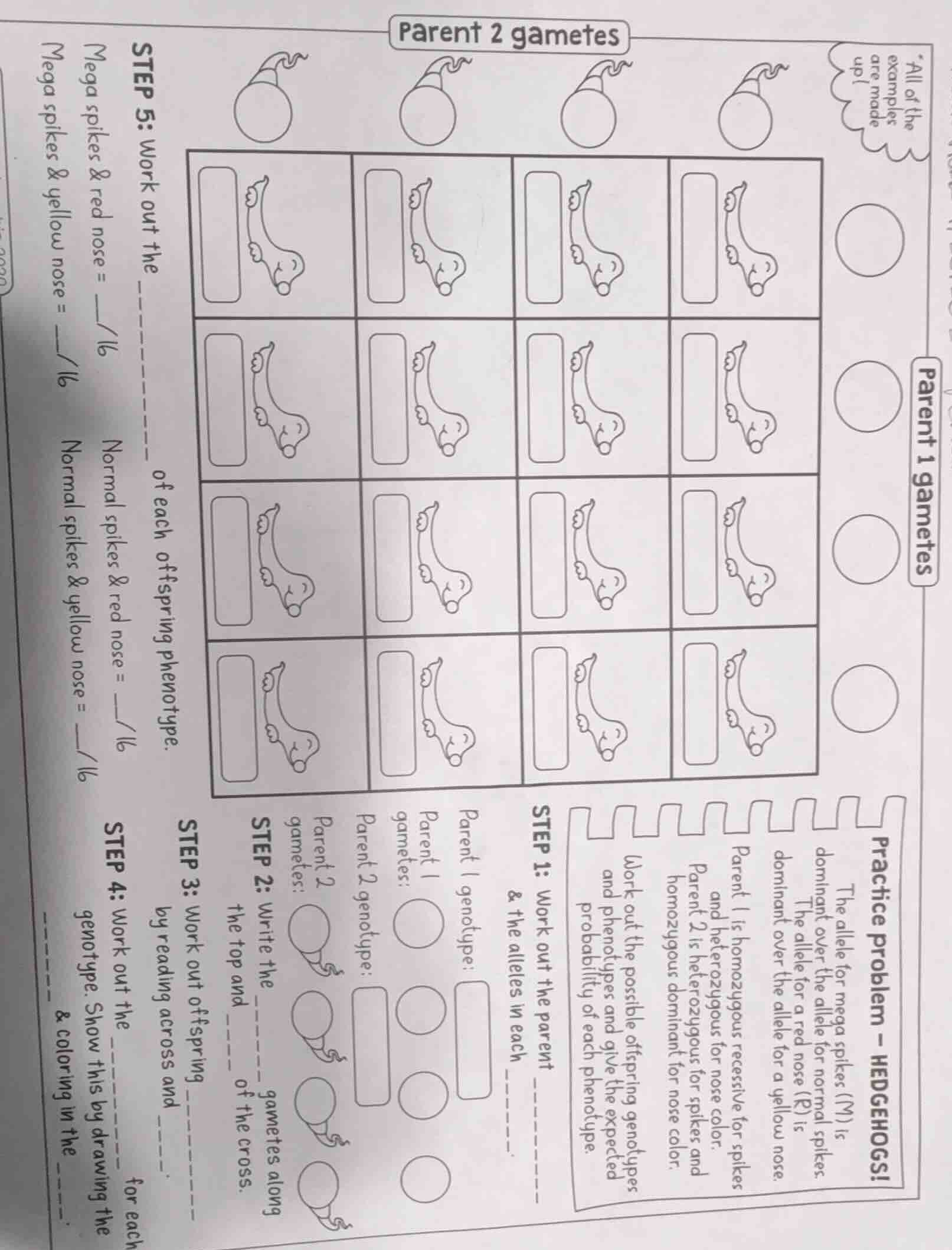
practice problem - hedgehogs!
the allele for mega spikes (m) is dominant over the allele for normal spikes.
the allele for a red nose (r) is dominant over the allele for a yellow nose.
parent 1 is homozygous recessive for spikes and heterozygous for nose color.
parent 2 is heterozygous for spikes and homozygous dominant for nose color.
work out the possible offspring genotypes and phenotypes and give the expected probability of each phenotype.
step 1: work out the parent & the alleles in each ----.
parent 1 genotype:
parent 1 gametes:
parent 2 genotype:
parent 2 gametes:
step 2: write the ---- gametes along the top and ---- of the cross.
step 3: work out offspring ---- by reading across and ----.
step 4: work out the ---- for each genotype. show this by drawing the ---- & coloring in the ----.
step 5: work out the ---- of each offspring phenotype.
mega spikes & red nose = ----/16
normal spikes & red nose = ----/16
mega spikes & yellow nose = ----/16
normal spikes & yellow nose = ----/16
To solve this genetics problem with hedgehog traits, we follow these steps:
Step 1: Determine Parent Genotypes and Gametes
- Parent 1: Homozygous recessive for spikes (so genotype \( mm \)) and heterozygous for nose color (since \( R \) is dominant for red, \( r \) for yellow; genotype \( Rr \)). Thus, Parent 1 genotype: \( mmRr \).
- Gametes: Parent 1 can produce \( mR \) and \( mr \) (since \( mm \) gives only \( m \), and \( Rr \) gives \( R \) or \( r \)).
- Parent 2: Heterozygous for spikes (genotype \( Mm \)) and homozygous dominant for nose color (genotype \( RR \)). Thus, Parent 2 genotype: \( MmRR \).
- Gametes: Parent 2 can produce \( MR \) and \( mR \) (since \( Mm \) gives \( M \) or \( m \), and \( RR \) gives only \( R \)).
Step 2: Set Up the Punnett Square
Parent 1 gametes: \( mR \), \( mr \) (2 types).
Parent 2 gametes: \( MR \), \( mR \) (2 types). Wait, no—wait, the Punnett square in the image has 4 columns (Parent 2 gametes) and 4 rows (Parent 1 gametes)? Wait, no, let’s recheck. Wait, the problem says Parent 1 is homozygous recessive for spikes (\( mm \)) and heterozygous for nose (\( Rr \))—so gametes: \( mR \), \( mr \) (2 gametes? But the Punnett square has 4 rows? Wait, maybe I misread. Wait, the image shows a 4x4 Punnett square (4 rows, 4 columns), so each parent has 4 gametes? Wait, no—maybe Parent 1 is \( mmRr \) (so for spikes: \( mm \) → only \( m \); for nose: \( Rr \) → \( R \) or \( r \))—so 2 gametes: \( mR \), \( mr \). Parent 2 is \( MmRR \) (spikes: \( Mm \) → \( M \) or \( m \); nose: \( RR \) → \( R \))—so 2 gametes: \( MR \), \( mR \). But the Punnett square is 4x4, so maybe there’s a mistake, or maybe Parent 1 is \( mmRr \) (producing 2 gametes) and Parent 2 is \( MmRr \)? Wait, no—the problem states: “Parent 1 is homozygous recessive for spikes and heterozygous for nose color. Parent 2 is heterozygous for spikes and homozygous dominant for nose color.”
So correct gametes:
- Parent 1 (\( mmRr \)): \( mR \), \( mr \) (2 gametes, but Punnett square has 4 rows? Maybe a typo, or maybe Parent 1 is \( mmRr \) (so 2 gametes, but the square is 4x4—maybe the problem expects 4 gametes? Wait, no—let’s proceed with the given Punnett square structure (4x4).
Step 3: Fill the Punnett Square
Let’s list all combinations:
| Parent 2 \ Parent 1 | \( mR \) | \( mR \) | \( mr \) | \( mr \) |
|---|---|---|---|---|
| \( MR \) | \( MmRR \) | \( MmRR \) | \( MmRr \) | \( MmRr \) |
| \( mR \) | \( mmRR \) | \( mmRR \) | \( mmRr \) | \( mmRr \) |
| \( mR \) | \( mmRR \) | \( mmRR \) | \( mmRr \) | \( mmRr \) |
Wait, no—this is confusing. Wait, maybe Parent 1 has 4 gametes (e.g., if Parent 1 is \( mmRr \), but that would only produce 2 gametes. Alternatively, maybe Parent 1 is \( mmRr \) (spikes: \( mm \), nose: \( Rr \)) and Parent 2 is \( MmRR \) (spikes: \( Mm \), nose: \( RR \)), and the Punnett square is 4x4 because we consider independent assortment (but for two genes, a 4x4 square is for two heterozygous genes, but here one gene is homozygous in each parent).
Alternatively, let’s use the traits:
- Spikes: \( M \) (mega) dominant over \( m \) (normal).
- Nose color: \( R \) (red) dominant over \( r \) (yellow).
Step 4: Analyze Phenotypes
We need to find the fraction of offspring with each phenotype:
- Mega spikes & red nose: Genotype has \( M \) (for spikes) and \( R \) (for nose).
- From Punnett square, offspring…

Snap & solve any problem in the app
Get step-by-step solutions on Sovi AI
Photo-based solutions with guided steps
Explore more problems and detailed explanations
To solve this genetics problem with hedgehog traits, we follow these steps:
Step 1: Determine Parent Genotypes and Gametes
- Parent 1: Homozygous recessive for spikes (so genotype \( mm \)) and heterozygous for nose color (since \( R \) is dominant for red, \( r \) for yellow; genotype \( Rr \)). Thus, Parent 1 genotype: \( mmRr \).
- Gametes: Parent 1 can produce \( mR \) and \( mr \) (since \( mm \) gives only \( m \), and \( Rr \) gives \( R \) or \( r \)).
- Parent 2: Heterozygous for spikes (genotype \( Mm \)) and homozygous dominant for nose color (genotype \( RR \)). Thus, Parent 2 genotype: \( MmRR \).
- Gametes: Parent 2 can produce \( MR \) and \( mR \) (since \( Mm \) gives \( M \) or \( m \), and \( RR \) gives only \( R \)).
Step 2: Set Up the Punnett Square
Parent 1 gametes: \( mR \), \( mr \) (2 types).
Parent 2 gametes: \( MR \), \( mR \) (2 types). Wait, no—wait, the Punnett square in the image has 4 columns (Parent 2 gametes) and 4 rows (Parent 1 gametes)? Wait, no, let’s recheck. Wait, the problem says Parent 1 is homozygous recessive for spikes (\( mm \)) and heterozygous for nose (\( Rr \))—so gametes: \( mR \), \( mr \) (2 gametes? But the Punnett square has 4 rows? Wait, maybe I misread. Wait, the image shows a 4x4 Punnett square (4 rows, 4 columns), so each parent has 4 gametes? Wait, no—maybe Parent 1 is \( mmRr \) (so for spikes: \( mm \) → only \( m \); for nose: \( Rr \) → \( R \) or \( r \))—so 2 gametes: \( mR \), \( mr \). Parent 2 is \( MmRR \) (spikes: \( Mm \) → \( M \) or \( m \); nose: \( RR \) → \( R \))—so 2 gametes: \( MR \), \( mR \). But the Punnett square is 4x4, so maybe there’s a mistake, or maybe Parent 1 is \( mmRr \) (producing 2 gametes) and Parent 2 is \( MmRr \)? Wait, no—the problem states: “Parent 1 is homozygous recessive for spikes and heterozygous for nose color. Parent 2 is heterozygous for spikes and homozygous dominant for nose color.”
So correct gametes:
- Parent 1 (\( mmRr \)): \( mR \), \( mr \) (2 gametes, but Punnett square has 4 rows? Maybe a typo, or maybe Parent 1 is \( mmRr \) (so 2 gametes, but the square is 4x4—maybe the problem expects 4 gametes? Wait, no—let’s proceed with the given Punnett square structure (4x4).
Step 3: Fill the Punnett Square
Let’s list all combinations:
| Parent 2 \ Parent 1 | \( mR \) | \( mR \) | \( mr \) | \( mr \) |
|---|---|---|---|---|
| \( MR \) | \( MmRR \) | \( MmRR \) | \( MmRr \) | \( MmRr \) |
| \( mR \) | \( mmRR \) | \( mmRR \) | \( mmRr \) | \( mmRr \) |
| \( mR \) | \( mmRR \) | \( mmRR \) | \( mmRr \) | \( mmRr \) |
Wait, no—this is confusing. Wait, maybe Parent 1 has 4 gametes (e.g., if Parent 1 is \( mmRr \), but that would only produce 2 gametes. Alternatively, maybe Parent 1 is \( mmRr \) (spikes: \( mm \), nose: \( Rr \)) and Parent 2 is \( MmRR \) (spikes: \( Mm \), nose: \( RR \)), and the Punnett square is 4x4 because we consider independent assortment (but for two genes, a 4x4 square is for two heterozygous genes, but here one gene is homozygous in each parent).
Alternatively, let’s use the traits:
- Spikes: \( M \) (mega) dominant over \( m \) (normal).
- Nose color: \( R \) (red) dominant over \( r \) (yellow).
Step 4: Analyze Phenotypes
We need to find the fraction of offspring with each phenotype:
- Mega spikes & red nose: Genotype has \( M \) (for spikes) and \( R \) (for nose).
- From Punnett square, offspring with \( M \) (spikes) and \( R \) (nose): Let’s count.
- Parent 1: \( mmRr \) (spikes: \( mm \) → normal; nose: \( Rr \) → red/yellow).
- Parent 2: \( MmRR \) (spikes: \( Mm \) → mega/normal; nose: \( RR \) → red).
- Offspring genotypes:
- \( MmRR \) (mega spikes, red nose)
- \( MmRr \) (mega spikes, red nose)
- \( mmRR \) (normal spikes, red nose)
- \( mmRr \) (normal spikes, red nose)
Wait, no—wait, Parent 1 is \( mm \) (spikes: normal), Parent 2 is \( Mm \) (spikes: mega/normal). So:
- Spikes: \( Mm \) (mega) or \( mm \) (normal).
- Nose: \( RR \) or \( Rr \) (both red, since \( R \) is dominant; \( rr \) would be yellow, but Parent 2 is \( RR \), so all offspring have \( R \) from Parent 2, so nose color is red (since \( R \) is dominant). Wait, Parent 1 is \( Rr \) (nose: red/yellow), Parent 2 is \( RR \) (nose: red). So offspring nose genotype: \( RR \) or \( Rr \) (both red). So all offspring have red noses (since \( R \) is dominant, and Parent 2 is \( RR \), so no \( rr \) possible).
Now spikes:
- Parent 1: \( mm \) (normal) → gives \( m \).
- Parent 2: \( Mm \) (mega/normal) → gives \( M \) or \( m \).
So offspring spikes genotype: \( Mm \) (mega) or \( mm \) (normal), each with 50% chance.
But the Punnett square in the image has 4x4=16 cells (since it’s 4 rows, 4 columns). Wait, maybe the problem has a typo, and Parent 1 is \( mmRr \) (producing 2 gametes) and Parent 2 is \( MmRr \) (producing 2 gametes), but the square is 4x4. Alternatively, let’s assume the Punnett square has 16 cells (4x4), so each parent has 4 gametes (e.g., Parent 1: \( mR, mR, mr, mr \); Parent 2: \( MR, MR, mR, mR \))—so repeated gametes to make 4 each.
Step 5: Calculate Phenotype Ratios
Since all offspring have red noses (because Parent 2 is \( RR \), so no \( rr \) possible), the nose color is always red. Now spikes:
- Mega spikes (\( Mm \)): From Parent 2’s \( M \) and Parent 1’s \( m \) → \( Mm \).
- Normal spikes (\( mm \)): From Parent 2’s \( m \) and Parent 1’s \( m \) → \( mm \).
With the Punnett square (16 cells):
- Mega spikes ( \( Mm \)): How many? Parent 2’s \( M \) (2 gametes) × Parent 1’s \( m \) (2 gametes) → 4 cells? Wait, no—let’s count:
If Parent 1 gametes: \( mR, mR, mr, mr \) (4 gametes: 2 \( mR \), 2 \( mr \)).
Parent 2 gametes: \( MR, MR, mR, mR \) (4 gametes: 2 \( MR \), 2 \( mR \)).
Punnett square cells:
- \( mR \) (P1) × \( MR \) (P2): \( MmRR \) (mega, red)
- \( mR \) (P1) × \( MR \) (P2): \( MmRR \) (mega, red)
- \( mr \) (P1) × \( MR \) (P2): \( MmRr \) (mega, red)
- \( mr \) (P1) × \( MR \) (P2): \( MmRr \) (mega, red)
- \( mR \) (P1) × \( mR \) (P2): \( mmRR \) (normal, red)
- \( mR \) (P1) × \( mR \) (P2): \( mmRR \) (normal, red)
- \( mr \) (P1) × \( mR \) (P2): \( mmRr \) (normal, red)
- \( mr \) (P1) × \( mR \) (P2): \( mmRr \) (normal, red)
Wait, no—this is 8 cells? But the Punnett square is 4x4 (16 cells). Oh, I see—each parent has 4 gametes (2 types, each repeated twice), so 4×4=16 cells. So:
- Mega spikes ( \( Mm \)): Cells 1–4 (4 cells? No, 1–4: \( MmRR, MmRR, MmRr, MmRr \)) → 4 cells? Wait, no, 1–4: 4 cells (mega spikes). Then cells 5–8: \( mmRR, mmRR, mmRr, mmRr \) (normal spikes). Wait, but that’s 8 cells? No, the Punnett square in the image has 4 rows and 4 columns (16 cells), so maybe each parent has 4 gametes (e.g., Parent 1: \( mR, mR, mr, mr \) (4 gametes), Parent 2: \( MR, MR, mR, mR \) (4 gametes)). So:
- Mega spikes & red nose: Cells with \( Mm \) (spikes) and \( R \) (nose). From the 16 cells:
- \( MmRR \): 4 cells (2 \( mR \) × 2 \( MR \))? Wait, no—let’s list all 16 cells:
Row 1 (P1: \( mR \)) × Column 1 (P2: \( MR \)): \( MmRR \)
Row 1 × Column 2 (P2: \( MR \)): \( MmRR \)
Row 1 × Column 3 (P2: \( mR \)): \( mmRR \)
Row 1 × Column 4 (P2: \( mR \)): \( mmRR \)
Row 2 (P1: \( mR \)) × Column 1: \( MmRR \)
Row 2 × Column 2: \( MmRR \)
Row 2 × Column 3: \( mmRR \)
Row 2 × Column 4: \( mmRR \)
Row 3 (P1: \( mr \)) × Column 1: \( MmRr \)
Row 3 × Column 2: \( MmRr \)
Row 3 × Column 3: \( mmRr \)
Row 3 × Column 4: \( mmRr \)
Row 4 (P1: \( mr \)) × Column 1: \( MmRr \)
Row 4 × Column 2: \( MmRr \)
Row 4 × Column 3: \( mmRr \)
Row 4 × Column 4: \( mmRr \)
Now, count phenotypes:
- Mega spikes & red nose: Genotypes \( MmRR \), \( MmRr \).
- \( MmRR \): Rows 1,2 × Columns 1,2 → 4 cells.
- \( MmRr \): Rows 3,4 × Columns 1,2 → 4 cells.
- Total: \( 4 + 4 = 8 \) cells.
- Normal spikes & red nose: Genotypes \( mmRR \), \( mmRr \).
- \( mmRR \): Rows 1,2 × Columns 3,4 → 4 cells.
- \( mmRr \): Rows 3,4 × Columns 3,4 → 4 cells.
- Total: \( 4 + 4 = 8 \) cells.
Wait, but the problem asks for:
- Mega spikes & red nose = ____/16
- Mega spikes & yellow nose = ____/16 (but Parent 2 is \( RR \), so no \( rr \) → 0/16)
- Normal spikes & red nose = ____/16
- Normal spikes & yellow nose = ____/16 (0/16)
But the problem’s left side says:
“Mega spikes & red nose = ___/16
Mega spikes & yellow nose = ___/16
Normal spikes & red nose = ___/16
Normal spikes & yellow nose = ___/16”
Wait, but Parent 2 is \( RR \) (homozygous dominant for nose), so all offspring have \( R \) (red nose). Thus, yellow nose (\( rr \)) is impossible (0/16 for yellow nose phenotypes).
For mega spikes (\( Mm \)): From Parent 2’s \( M \) and Parent 1’s \( m \) → \( Mm \) (mega).
For normal spikes (\( mm \)): From Parent 2’s \( m \) and Parent 1’s \( m \) → \( mm \) (normal).
From the 16-cell Punnett square:
- Mega spikes (\( Mm \)): 8 cells (as above).
- Normal spikes (\( mm \)): 8 cells.
Since all have red noses,
- Mega spikes & red nose: 8/16
- Mega spikes & yellow nose: 0/16
- Normal spikes & red nose: 8/16
- Normal spikes & yellow nose: 0/16
Final Answers (Assuming the Punnett Square Has 16 Cells)
- Mega spikes & red nose = \( \boldsymbol{8/16} \)
- Mega spikes & yellow nose = \( \boldsymbol{0/16} \)
- Normal spikes & red nose = \( \boldsymbol{8/16} \)
- Normal spikes & yellow nose = \( \boldsymbol{0/16} \)
(Note: If the Punnett square is 4x4 but with different gametes, adjust accordingly. The key is that Parent 2 is \( RR \), so no yellow noses, and spikes are \( Mm \) (mega) or \( mm \) (normal) in a 1:1 ratio, leading to 8/16 for each spike phenotype with red nose.)