QUESTION IMAGE
Question
practice reasoning about multi-step equations
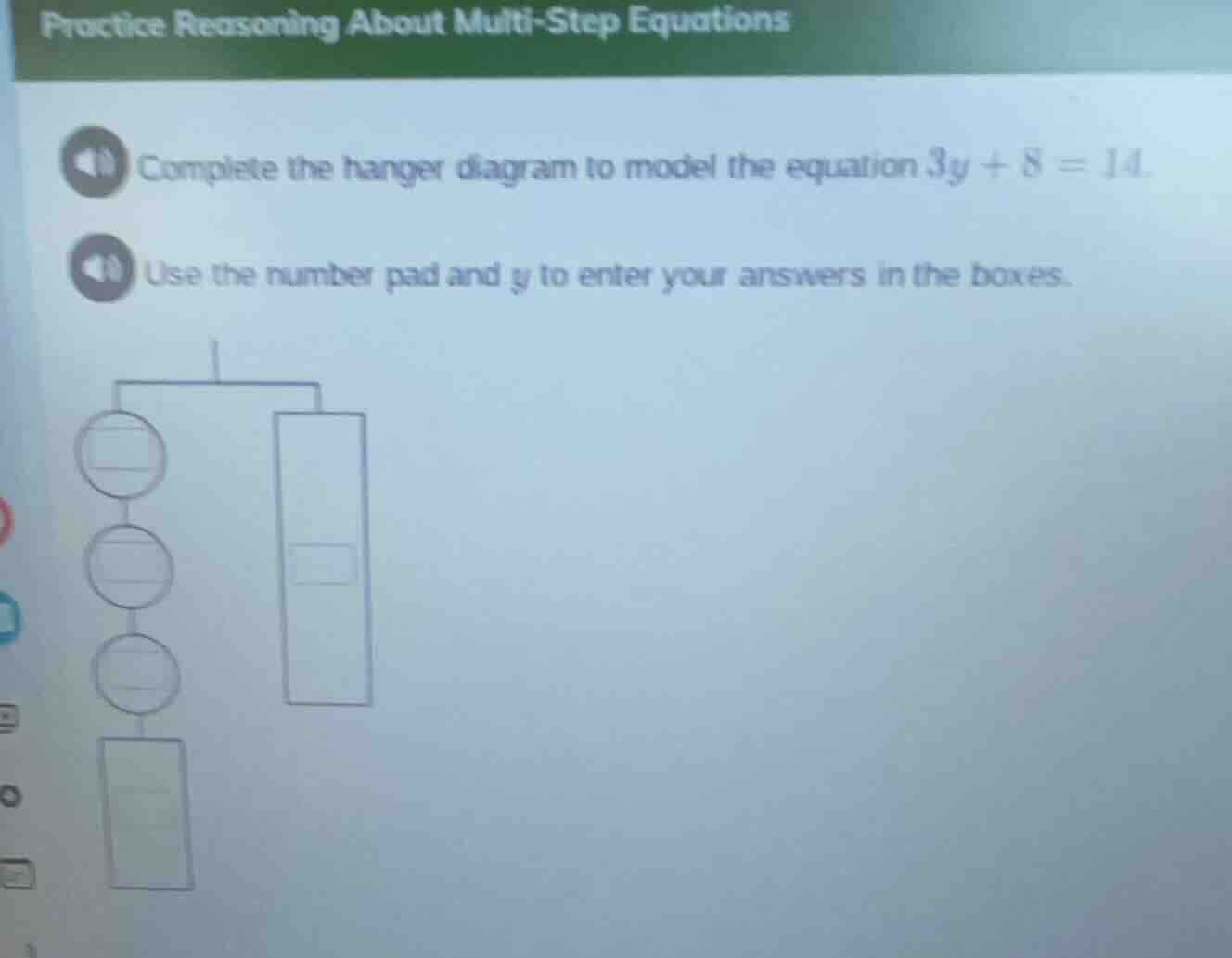
complete the hanger diagram to model the equation $3y + 8 = 14$.
use the number pad and $y$ to enter your answers in the boxes.
Step1: Analyze the equation structure
The equation is \(3y + 8 = 14\). In a hanger diagram, each side should balance. The left side has \(3y\) (three circles labeled \(y\)) and a rectangle (constant term), and the right side has a rectangle (constant term). First, identify the terms: \(3y\) means three \(y\)s, and the constant terms are \(8\) and \(14\). Wait, no—wait, the equation is \(3y + 8 = 14\), so left side: three \(y\)s and \(8\); right side: \(14\)? Wait, no, maybe the hanger has left side with three circles (each \(y\)) and a rectangle (8), and right side with a rectangle (14)? Wait, no, the hanger diagram: the left side has three circles (stacked) and a rectangle below them, and the right side has a rectangle. Wait, the equation is \(3y + 8 = 14\), so we can think of it as \(3y + 8\) on the left, \(14\) on the right. So the three circles should be labeled \(y\) each, the small rectangle (below the circles) is \(8\), and the right rectangle is \(14\)? Wait, no, maybe the left side: three circles (each \(y\)) and a rectangle (8), right side: a rectangle (14). Wait, but the problem says "complete the hanger diagram to model the equation \(3y + 8 = 14\)". So the left side has three \(y\)s (circles) and \(8\) (a rectangle), and the right side has \(14\) (a rectangle). Wait, but maybe the hanger is balanced, so left: \(3y + 8\), right: \(14\). So the three circles are \(y\) each, the small rectangle (below the circles) is \(8\), and the right rectangle is \(14\). Wait, but the diagram: left side has three circles (stacked vertically) and a rectangle below them, right side has a rectangle. So the circles should be labeled \(y\), the small rectangle (below circles) is \(8\), and the right rectangle is \(14\)? Wait, no, maybe the equation is \(3y + 8 = 14\), so we can also solve for \(y\) first? Wait, no, the task is to model the equation, not solve it. So the left side: three \(y\)s (circles) and \(8\) (rectangle), right side: \(14\) (rectangle). So the circles are \(y\), the small rectangle (below circles) is \(8\), and the right rectangle is \(14\). Wait, but the problem says "use the number pad and \(y\) to enter your answers in the boxes". So the three circles should be \(y\), the small rectangle (below circles) is \(8\), and the right rectangle is \(14\)? Wait, no, maybe the left side: three circles (each \(y\)) and a rectangle (8), right side: a rectangle (14). Wait, but let's check the equation: \(3y + 8 = 14\). So the left side has \(3y\) (three \(y\)s) and \(8\), right side has \(14\). So the three circles are \(y\), the small rectangle (below the circles) is \(8\), and the right rectangle is \(14\). Wait, but maybe the hanger is structured as left: \(3y + 8\), right: \(14\). So the circles are \(y\), the small rectangle (under circles) is \(8\), right rectangle is \(14\). So the three circles: each labeled \(y\), the small rectangle (below circles) is \(8\), and the right rectangle is \(14\). Wait, but the problem says "use the number pad and \(y\) to enter your answers in the boxes". So the circles should be \(y\), the small rectangle (below circles) is \(8\), and the right rectangle is \(14\). Wait, but maybe I misread the diagram. Alternatively, maybe the left side has three \(y\)s and \(8\), right side has \(14\). So the three circles: \(y\), \(y\), \(y\); the small rectangle (below circles): \(8\); the right rectangle: \(14\). So that's the model. So to complete the hanger: the three circles are \(y\) each, the small rectangle (under circles) is \(8\), and the right rectangle is \(14\). Wait, but maybe the equati…

Snap & solve any problem in the app
Get step-by-step solutions on Sovi AI
Photo-based solutions with guided steps
Explore more problems and detailed explanations
The three circles (top to bottom) are \(y\), \(y\), \(y\); the small rectangle (below the circles) is \(8\); the right rectangle is \(14\). So filling the boxes: each circle is \(y\), the small rectangle is \(8\), the right rectangle is \(14\). (Assuming the circles are labeled \(y\), the small rectangle (below circles) is \(8\), and the right rectangle is \(14\).)