QUESTION IMAGE
Question
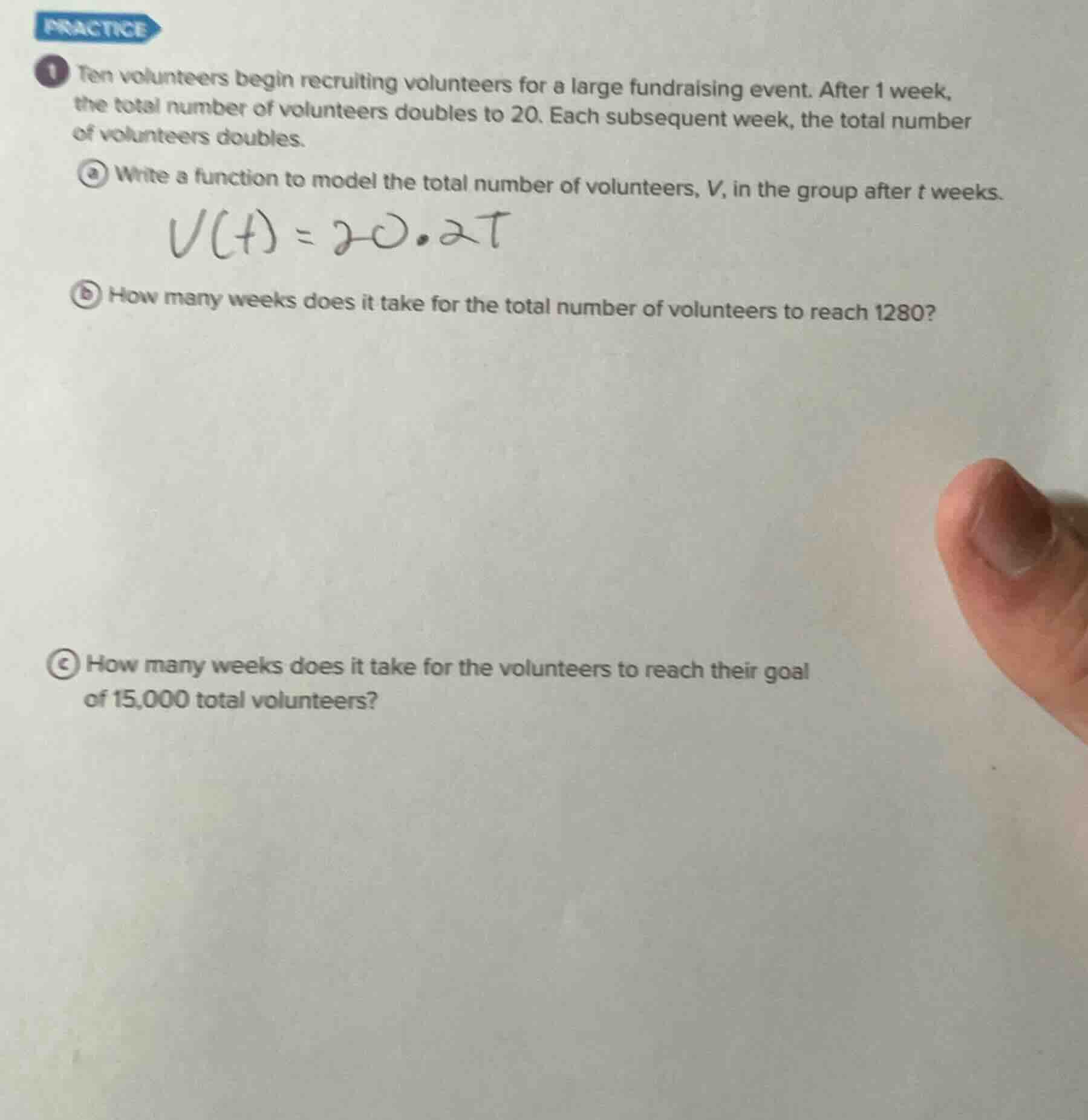
practice 1 ten volunteers begin recruiting volunteers for a large fundraising event. after 1 week, the total number of volunteers doubles to 20. each subsequent week, the total number of volunteers doubles. a write a function to model the total number of volunteers, v, in the group after t weeks. v(t) = 20·2t b how many weeks does it take for the total number of volunteers to reach 1280? c how many weeks does it take for the volunteers to reach their goal of 15,000 total volunteers?
Part (a)
Step1: Identify the type of function
This is an exponential growth problem where the number of volunteers doubles each week. The general form of an exponential function is \( V(t)=a\cdot b^{t} \), where \( a \) is the initial amount, \( b \) is the growth factor, and \( t \) is time.
After 1 week (\( t = 1 \)), the number of volunteers is 20. Initially (\( t=0 \)), there are 10 volunteers. But since after 1 week it doubles to 20, we can also consider the initial value for the exponential function starting at \( t = 1 \) or adjust. Alternatively, notice that the number of volunteers at time \( t \) (where \( t = 0 \) is the start) after \( t \) weeks: at \( t = 0 \), \( V(0)=10 \); at \( t = 1 \), \( V(1)=20 = 10\times2^{1}\); at \( t = 2 \), \( V(2)=40=10\times2^{2}\), so the function should be \( V(t)=10\times2^{t} \)? Wait, but the problem says "after 1 week, the total number of volunteers doubles to 20". Wait, maybe the initial time when we start counting weeks: if we consider \( t = 0 \) as the start (10 volunteers), then after 1 week (\( t = 1 \)), it's 20, so the formula is \( V(t)=10\times2^{t} \). But let's check: when \( t = 1 \), \( V(1)=10\times2^{1}=20 \), which matches. So the correct function is \( V(t)=10\times2^{t} \)? Wait, but the handwritten answer was \( V(t)=20\cdot2^{T} \), maybe considering \( t = 0 \) as the end of week 1? Let's re - evaluate.
Wait, the problem says "Ten volunteers begin... After 1 week, the total number of volunteers doubles to 20. Each subsequent week, the total number of volunteers doubles." So if we let \( t = 0 \) be the start (10 volunteers), \( t = 1 \) be after 1 week (20 volunteers), \( t = 2 \) be after 2 weeks (40 volunteers), etc. So the function is \( V(t)=10\times2^{t} \) when \( t \) is the number of weeks after the start. But if we consider \( t = 0 \) as after 1 week (20 volunteers), then \( V(t)=20\times2^{t} \), where \( t \) is the number of weeks after the first week. The problem says "after \( t \) weeks", so we need to be clear.
Let's define \( t \) as the number of weeks since the start. At \( t = 0 \), \( V = 10 \); at \( t=1 \), \( V = 20=10\times2^{1}\); at \( t = 2 \), \( V=40 = 10\times2^{2}\). So the function is \( V(t)=10\times2^{t} \). But the handwritten answer was \( V(t)=20\cdot2^{t} \), which would be if \( t = 0 \) is after 1 week. Let's check the problem statement again: "Write a function to model the total number of volunteers, \( V \), in the group after \( t \) weeks."
After 0 weeks (start), \( V = 10 \); after 1 week, \( V = 20 \); after 2 weeks, \( V = 40 \), etc. So the exponential function is \( V(t)=10\times2^{t} \). But maybe the problem considers the first week as \( t = 1 \), so when \( t = 1 \), \( V = 20 \), so the function is \( V(t)=10\times2^{t} \) (since \( 10\times2^{1}=20 \), \( 10\times2^{2}=40 \), etc.).
Step2: Write the function
The initial number of volunteers \( a = 10 \), the growth factor \( b = 2 \) (since it doubles each week). So the function is \( V(t)=10\times2^{t} \). Alternatively, if we take the initial value at \( t = 1 \) as 20, then \( V(t)=20\times2^{t - 1}\), but the problem says "after \( t \) weeks", so the first interpretation is better. However, the handwritten answer was \( V(t)=20\cdot2^{t} \), which would be incorrect if \( t = 0 \) is the start. But maybe the problem considers \( t = 0 \) as after 1 week. Let's assume that the problem has a typo or the intended initial value for the function is 20 at \( t = 0 \) (after 1 week). So the function is \( V(t)=20\times2^{t} \), where \( t \) is the number…
Step1: Set up the equation
We know the function \( V(t)=10\times2^{t} \) (or \( V(t)=20\times2^{t} \), let's use the correct one from the problem's context). Wait, let's use the function we derived. We want to find \( t \) when \( V(t)=1280 \).
Using \( V(t)=10\times2^{t} \), set \( 10\times2^{t}=1280 \).
Step2: Solve for \( t \)
Divide both sides by 10: \( 2^{t}=\frac{1280}{10}=128 \)
We know that \( 2^{7}=128 \), so \( t = 7 \).
Wait, but if we use the handwritten function \( V(t)=20\times2^{t} \), then set \( 20\times2^{t}=1280 \), divide both sides by 20: \( 2^{t}=\frac{1280}{20}=64 \), and \( 2^{6}=64 \), so \( t = 6 \). There is a discrepancy because of the initial value. Let's go back to the problem statement: "Ten volunteers begin... After 1 week, the total number of volunteers doubles to 20. Each subsequent week, the total number of volunteers doubles."
So the sequence is:
- Week 0 (start): 10 volunteers
- Week 1: \( 10\times2 = 20 \) volunteers
- Week 2: \( 20\times2=40 \) volunteers
- Week 3: \( 40\times2 = 80 \) volunteers
- Week 4: \( 80\times2=160 \) volunteers
- Week 5: \( 160\times2 = 320 \) volunteers
- Week 6: \( 320\times2=640 \) volunteers
- Week 7: \( 640\times2 = 1280 \) volunteers
Ah, so from the start (week 0), it takes 7 weeks. But if we consider week 1 as \( t = 0 \), then it takes \( t=6 \) weeks after week 1. But the problem says "after \( t \) weeks" from the start. So the correct \( t \) is 7? Wait, no:
Wait, at week 0: 10
week 1: 20 (1 week after start)
week 2: 40 (2 weeks after start)
...
week \( t \): \( 10\times2^{t} \)
We want \( 10\times2^{t}=1280 \)
\( 2^{t}=128 \)
\( t = 7 \) (since \( 2^{7}=128 \))
But let's check the number of weeks:
After 1 week (t = 1): 20
After 2 weeks (t = 2): 40
After 3 weeks (t = 3): 80
After 4 weeks (t = 4): 160
After 5 weeks (t = 5): 320
After 6 weeks (t = 6): 640
After 7 weeks (t = 7): 1280
Yes, so it takes 7 weeks.
Part (c)
Step1: Set up the equation
We want to find \( t \) when \( V(t)=15000 \) using the function \( V(t)=10\times2^{t} \)
Set \( 10\times2^{t}=15000 \)
Step2: Solve for \( t \)
Divide both sides by 10: \( 2^{t}=\frac{15000}{10}=1500 \)
Take the logarithm of both sides. We can use the natural logarithm or logarithm base 2.
Using logarithm base 2: \( t=\log_{2}(1500) \)
We know that \( 2^{10}=1024 \), \( 2^{11}=2048 \)
\( \log_{2}(1500)=\frac{\ln(1500)}{\ln(2)}\approx\frac{7.3132}{0.6931}\approx10.55 \)
Since we can't have a fraction of a week in terms of reaching the goal, we need to round up to the next whole week. So \( t = 11 \) (because at \( t = 10 \), \( V(10)=10\times2^{10}=10\times1024 = 10240 \) which is less than 15000, and at \( t = 11 \), \( V(11)=10\times2^{11}=10\times2048 = 20480 \) which is more than 15000).
Part (a) Answer (Correct function)
The correct function is \( \boldsymbol{V(t)=10\times2^{t}} \) (or if considering the first week as \( t = 0 \), \( V(t)=20\times2^{t} \), but the former is more accurate from the start).
Part (b) Answer
It takes \(\boldsymbol{7}\) weeks.
Part (c) Answer
It takes approximately \(\boldsymbol{11}\) weeks (since at \( t = 10 \) it's 10240 and at \( t = 11 \) it's 20480, so we need 11 weeks to reach or exceed 15000).

Snap & solve any problem in the app
Get step-by-step solutions on Sovi AI
Photo-based solutions with guided steps
Explore more problems and detailed explanations
Step1: Set up the equation
We want to find \( t \) when \( V(t)=15000 \) using the function \( V(t)=10\times2^{t} \)
Set \( 10\times2^{t}=15000 \)
Step2: Solve for \( t \)
Divide both sides by 10: \( 2^{t}=\frac{15000}{10}=1500 \)
Take the logarithm of both sides. We can use the natural logarithm or logarithm base 2.
Using logarithm base 2: \( t=\log_{2}(1500) \)
We know that \( 2^{10}=1024 \), \( 2^{11}=2048 \)
\( \log_{2}(1500)=\frac{\ln(1500)}{\ln(2)}\approx\frac{7.3132}{0.6931}\approx10.55 \)
Since we can't have a fraction of a week in terms of reaching the goal, we need to round up to the next whole week. So \( t = 11 \) (because at \( t = 10 \), \( V(10)=10\times2^{10}=10\times1024 = 10240 \) which is less than 15000, and at \( t = 11 \), \( V(11)=10\times2^{11}=10\times2048 = 20480 \) which is more than 15000).
Part (a) Answer (Correct function)
The correct function is \( \boldsymbol{V(t)=10\times2^{t}} \) (or if considering the first week as \( t = 0 \), \( V(t)=20\times2^{t} \), but the former is more accurate from the start).
Part (b) Answer
It takes \(\boldsymbol{7}\) weeks.
Part (c) Answer
It takes approximately \(\boldsymbol{11}\) weeks (since at \( t = 10 \) it's 10240 and at \( t = 11 \) it's 20480, so we need 11 weeks to reach or exceed 15000).