QUESTION IMAGE
Question
5 practice 5 (from unit 5, lesson 4)
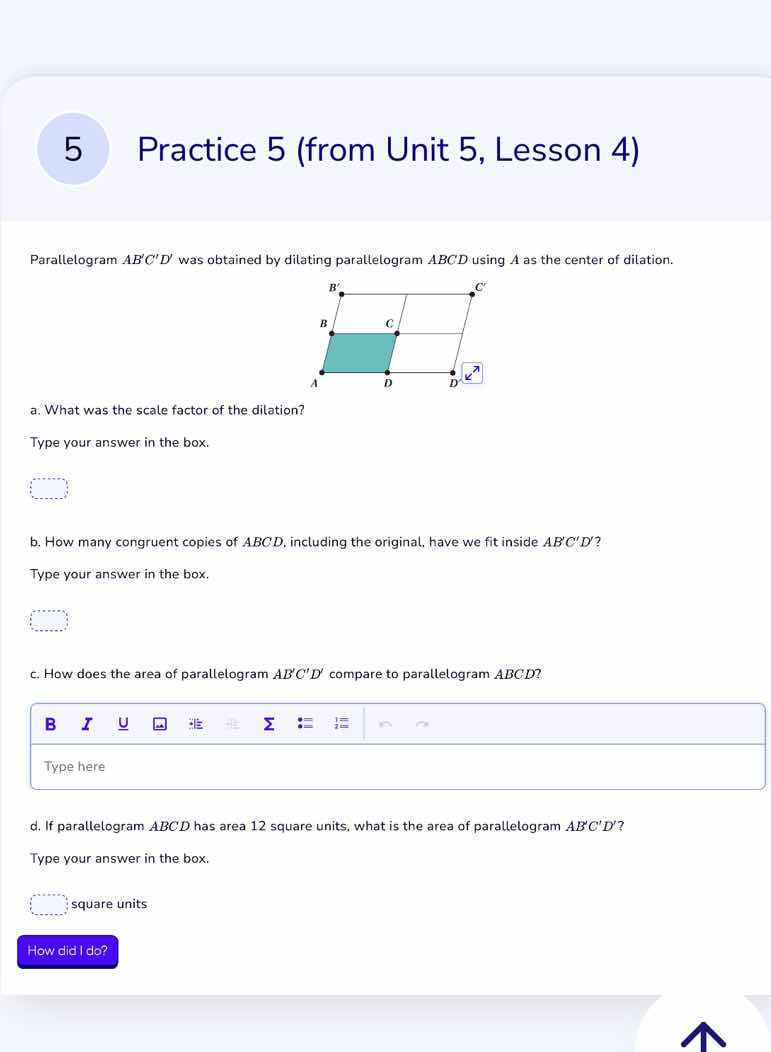
parallelogram ( abcd ) was obtained by dilating parallelogram ( abcd ) using ( a ) as the center of dilation.
a. what was the scale factor of the dilation?
type your answer in the box.
b. how many congruent copies of ( abcd ), including the original, have we fit inside ( abcd )?
type your answer in the box.
c. how does the area of parallelogram ( abcd ) compare to parallelogram ( abcd )?
type here
d. if parallelogram ( abcd ) has area 12 square units, what is the area of parallelogram ( abcd )?
type your answer in the box.
square units
how did i do?
Part (a)
Step1: Analyze Dilation from Diagram
From the diagram, we can see that the length of \( AD \) in the original parallelogram \( ABCD \) and the length of \( AD' \) in the dilated parallelogram \( AB'C'D' \). If we assume \( AD = 1 \) unit (for simplicity, since we are looking for the scale factor which is a ratio), then \( AD' \) seems to be twice that length (visually, from the diagram, the number of segments from \( A \) to \( D \) and \( A \) to \( D' \) suggests that the scale factor is 2, as the dilated figure is stretched by a factor. In dilation, the scale factor \( k \) is given by \( k=\frac{\text{length of image segment}}{\text{length of original segment}} \). If we take the horizontal side from \( A \) to \( D \) (original) and \( A \) to \( D' \) (image), we can see that \( AD' = 2\times AD \), so the scale factor \( k = 2 \).
Step1: Visualize Congruent Copies
Since the scale factor of dilation is 2 (from part a), the dilated parallelogram \( AB'C'D' \) can be thought of as being composed of congruent copies of \( ABCD \). If we look at the diagram, horizontally, we have 2 copies (since scale factor 2 in the horizontal direction) and vertically, we have 1 copy? Wait, no. Wait, actually, when you dilate a parallelogram with scale factor 2, the area scales by \( 2\times2 = 4 \)? Wait, no, wait. Wait, the original parallelogram \( ABCD \) and the dilated one \( AB'C'D' \). Wait, maybe the diagram shows that \( AB'C'D' \) is made up of 4 congruent copies? Wait, no, wait. Wait, part (a) scale factor is 2. So the linear dimensions are scaled by 2, so the number of congruent copies (area - wise) would be \( 2\times2 = 4 \)? Wait, no, wait. Wait, maybe the diagram is such that \( AB'C'D' \) has 4 congruent copies of \( ABCD \). Wait, let's think again. If the scale factor is 2, then the number of congruent copies (including original) is \( 2\times2 = 4 \)? Wait, no, maybe the diagram is a 2x2 grid? Wait, no, the original is a parallelogram, and the dilated one is twice as long and twice as tall? Wait, no, looking at the diagram, the original \( ABCD \) is a small parallelogram, and the dilated \( AB'C'D' \) has two times the length in the horizontal direction (from \( A \) to \( D' \) is twice \( A \) to \( D \)) and two times the length in the vertical direction (from \( A \) to \( B' \) is twice \( A \) to \( B \))? Wait, no, the vertical side: \( AB \) and \( AB' \). If \( AB \) is length \( l \), then \( AB' \) is \( 2l \). So the area of \( AB'C'D' \) is \( \text{base} \times \text{height} = (2 \times \text{base of } ABCD) \times (2 \times \text{height of } ABCD) = 4 \times \text{area of } ABCD \). But wait, the question is how many congruent copies of \( ABCD \) (including original) fit inside \( AB'C'D' \). Wait, maybe the diagram shows that \( AB'C'D' \) is made up of 4 congruent copies? Wait, no, maybe I made a mistake. Wait, let's re - examine. If the scale factor is 2, then the number of congruent copies (since it's a parallelogram, and the dilation is uniform) would be \( 2\times2 = 4 \)? Wait, no, maybe the diagram is such that horizontally there are 2 copies and vertically 2 copies? Wait, no, the original \( ABCD \) and the dilated \( AB'C'D' \). Wait, maybe the answer is 4? Wait, no, wait. Wait, the scale factor is 2, so the linear dimensions are doubled, so the number of congruent copies (each with the same area as \( ABCD \)) that fit into \( AB'C'D' \) is \( 2\times2=4 \)? Wait, no, maybe the diagram shows that \( AB'C'D' \) has 4 congruent copies? Wait, let's think again. If the scale factor is 2, then the area of \( AB'C'D' \) is \( 2\times2 = 4 \) times the area of \( ABCD \), so the number of congruent copies (each with area equal to \( ABCD \)) is 4.
Step1: Recall Area and Dilation Relationship
When a figure is dilated with a scale factor \( k \), the area of the dilated figure is \( k^{2}\) times the area of the original figure. From part (a), the scale factor \( k = 2 \). So the area of \( AB'C'D' \) is \( k^{2}=2^{2} = 4 \) times the area of \( ABCD \). So we can say that the area of parallelogram \( AB'C'D' \) is 4 times the area of parallelogram \( ABCD \).

Snap & solve any problem in the app
Get step-by-step solutions on Sovi AI
Photo-based solutions with guided steps
Explore more problems and detailed explanations
\( 2 \)