QUESTION IMAGE
Question
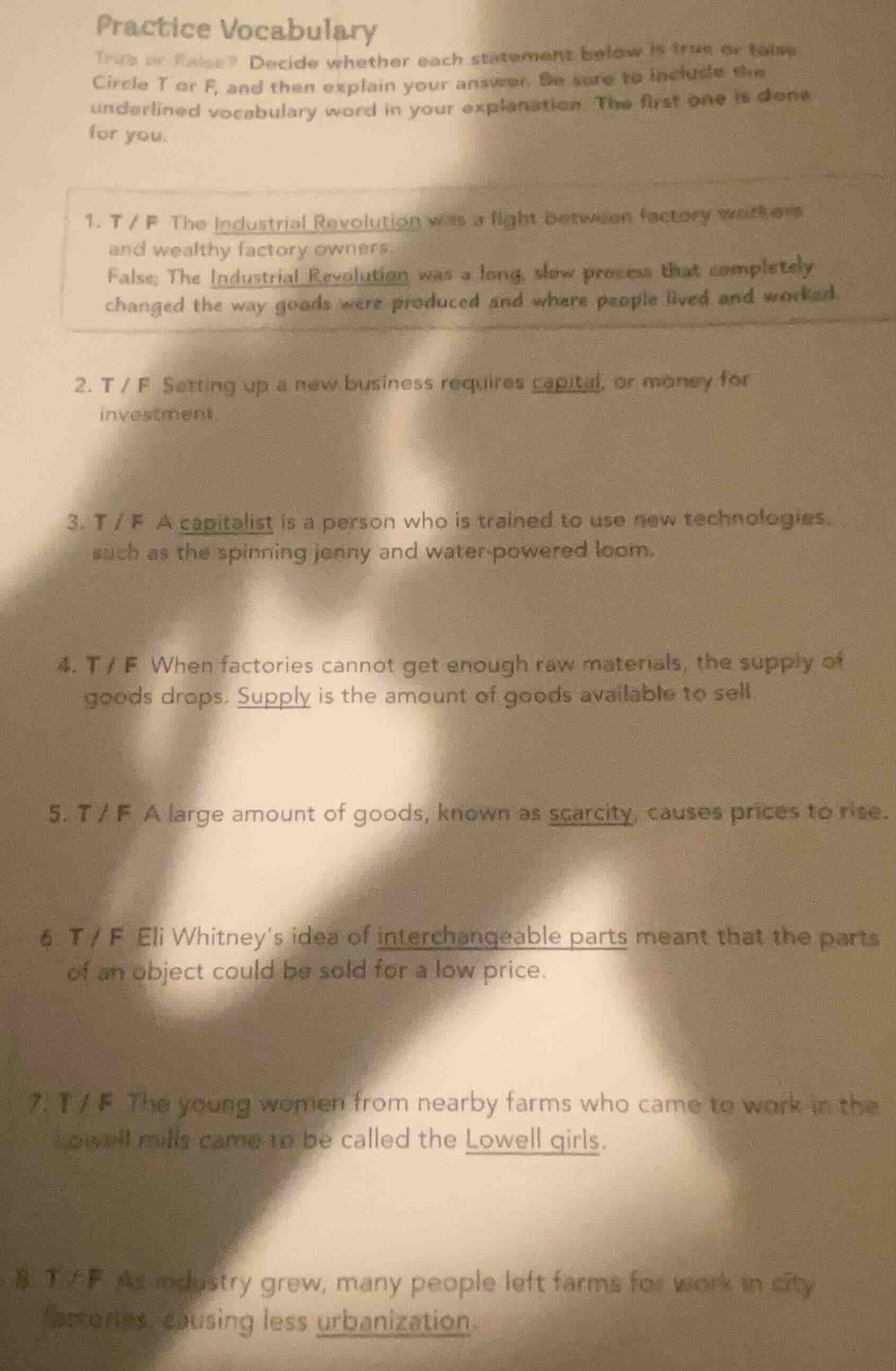
practice vocabulary
true or false? decide whether each statement below is true or false. circle t or f, and then explain your answer. be sure to include the underlined vocabulary word in your explanation. the first one is done for you.
- t/f the industrial revolution was a fight between factory workers and wealthy factory owners.
false, the industrial revolution was a long, slow process that completely changed the way goods were produced and where people lived and worked.
- t/f setting up a new business requires capital, or money for investment.
- t/f a capitalist is a person who is trained to use new technologies, such as the spinning jenny and water - powered loom.
- t/f when factories cannot get enough raw materials, the supply of goods drops. supply is the amount of goods available to sell.
- t/f a large amount of goods, known as scarcity, causes prices to rise.
- t/f eli whitney’s idea of interchangeable parts meant that the parts of an object could be sold for a low price.
- t/f the young women from nearby farms who came to work in the lowell mills came to be called the lowell girls.
- t/f as industry grew, many people left farms for work in city factories, causing less urbanization.
Brief Explanations
- Capital is defined as money/funds used for business investment, so starting a new business requires this.
- A capitalist is a person who owns capital (wealth for business), not a tech-trained worker.
- Supply refers to the quantity of goods available; insufficient raw materials reduce production, lowering supply.
- Scarcity means a shortage of goods, not a large amount; shortages drive prices up.
- Interchangeable parts are identical components that can replace each other, enabling mass production, not just low pricing.
- The young female farm workers employed at Lowell mills were indeed called Lowell girls.
- Urbanization is the growth of cities; people moving from farms to city factories increases urbanization, not reduces it.

Snap & solve any problem in the app
Get step-by-step solutions on Sovi AI
Photo-based solutions with guided steps
Explore more problems and detailed explanations
- T; True, setting up a new business requires capital, or money for investment, as capital is the necessary funds for business startup and operations.
- F; False, a capitalist is a person who owns and invests capital in businesses, not someone trained to use new industrial technologies.
- T; True, when factories lack raw materials, production decreases, so the supply (the amount of goods available to sell) drops.
- F; False, scarcity is a shortage of goods, not a large amount; scarcity causes prices to rise, not an oversupply.
- F; False, interchangeable parts are identical components that can be swapped easily, which enabled mass production, not just low-priced parts.
- T; True, the young women from nearby farms who worked in the Lowell mills were called the Lowell girls.
- F; False, as industry grew, people moving to city factories caused more urbanization, the growth of cities, not less.