QUESTION IMAGE
Question
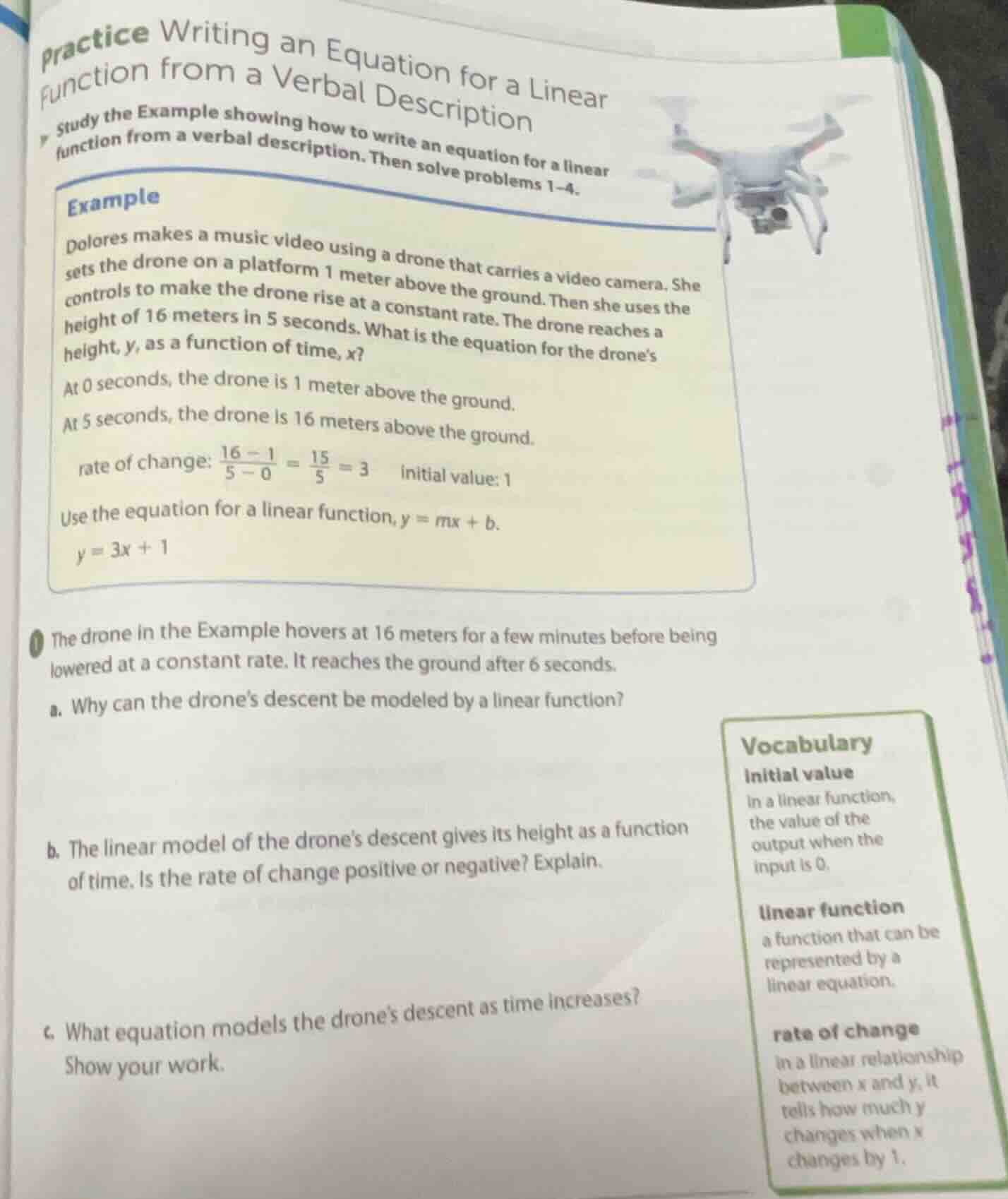
practice writing an equation for a linear function from a verbal description
study the example showing how to write an equation for a linear function from a verbal description. then solve problems 1 - 4.
example
dolores makes a music video using a drone that carries a video camera. she sets the drone on a platform 1 meter above the ground. then she uses the controls to make the drone rise at a constant rate. the drone reaches a height of 16 meters in 5 seconds. what is the equation for the drone’s height, y, as a function of time, x?
at 0 seconds, the drone is 1 meter above the ground.
at 5 seconds, the drone is 16 meters above the ground.
rate of change: \\(\frac{16 - 1}{5 - 0}=\frac{15}{5}=3\\) initial value: 1
use the equation for a linear function, \\(y = mx + b\\).
\\(y = 3x + 1\\)
1 the drone in the example hovers at 16 meters for a few minutes before being lowered at a constant rate. it reaches the ground after 6 seconds.
a. why can the drone’s descent be modeled by a linear function?
b. the linear model of the drone’s descent gives its height as a function of time. is the rate of change positive or negative? explain.
c. what equation models the drone’s descent as time increases?
show your work.
vocabulary
initial value
in a linear function, the value of the output when the input is 0.
linear function
a function that can be represented by a linear equation.
rate of change
in a linear relationship between x and y, it tells how much y changes when x changes by 1.
Part a
A linear function is appropriate when there's a constant rate of change. The drone's descent has a constant rate (since it's lowered at a constant rate), so the relationship between height and time is linear (height changes by a constant amount per unit time).
As time (input) increases, the height (output) of the drone decreases (it's descending to the ground). The rate of change in a linear function \( y = mx + b \) is \( m \), which represents the change in \( y \) per change in \( x \). Since \( y \) (height) decreases as \( x \) (time) increases, the rate of change \( m \) is negative.
Step1: Identify known values
The drone starts descending from a height of 16 meters (so when \( x = 0 \) (time = 0 for descent), \( y = 16 \), so the initial value \( b = 16 \)). It reaches the ground (\( y = 0 \)) after 6 seconds (\( x = 6 \)).
Step2: Calculate rate of change (slope \( m \))
Using the formula for slope \( m=\frac{y_2 - y_1}{x_2 - x_1} \), with \( (x_1,y_1)=(0,16) \) and \( (x_2,y_2)=(6,0) \).
\[
m=\frac{0 - 16}{6 - 0}=\frac{- 16}{6}=-\frac{8}{3}
\]
Step3: Write the linear equation
Using the linear function form \( y = mx + b \), substitute \( m = -\frac{8}{3} \) and \( b = 16 \).
\[
y=-\frac{8}{3}x + 16
\]

Snap & solve any problem in the app
Get step-by-step solutions on Sovi AI
Photo-based solutions with guided steps
Explore more problems and detailed explanations
The drone’s descent can be modeled by a linear function because it is lowered at a constant rate, meaning the rate of change (slope) of height with respect to time is constant, which is a key characteristic of a linear function.