QUESTION IMAGE
Question
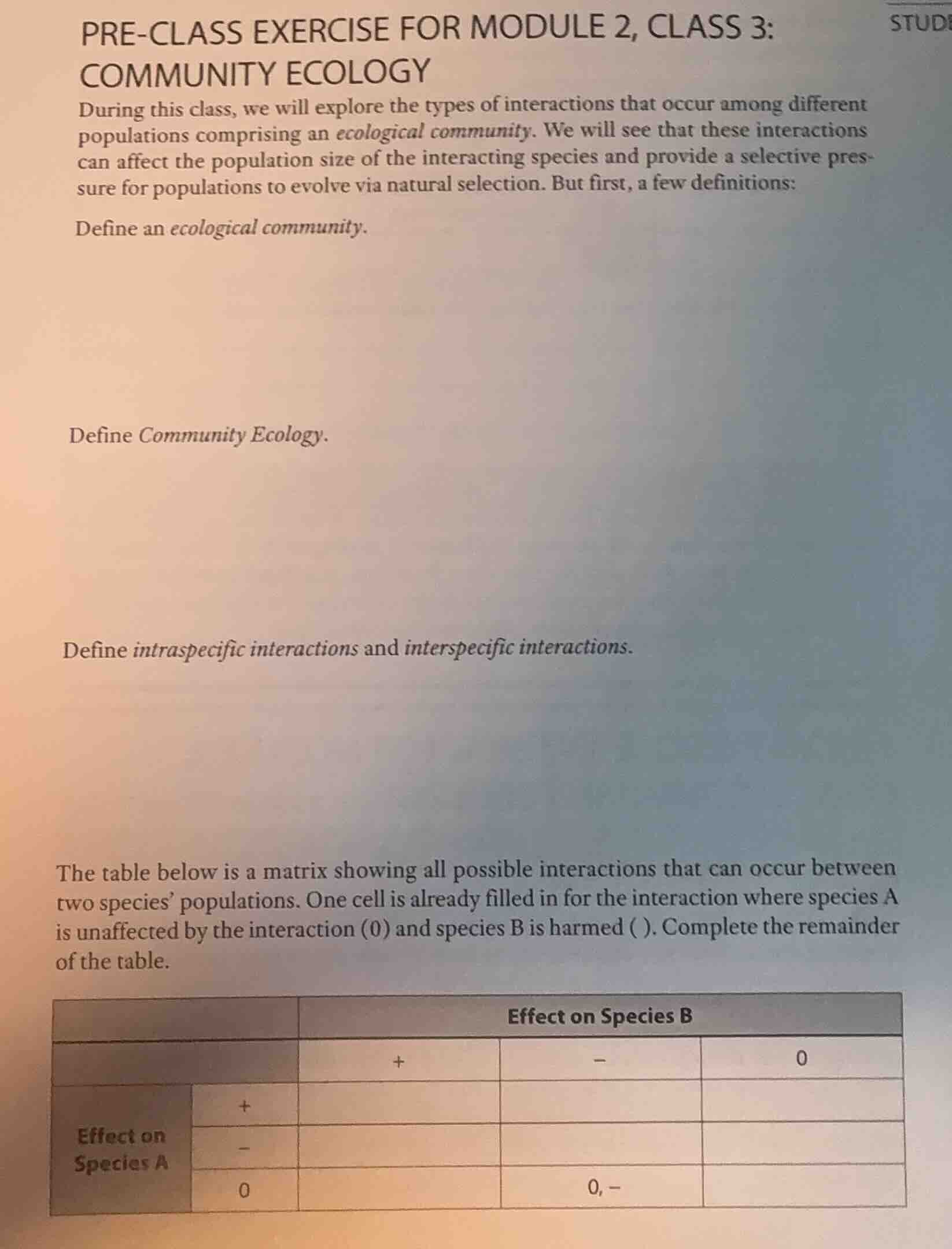
pre-class exercise for module 2, class 3:community ecologyduring this class, we will explore the types of interactions that occur among different populations comprising an ecological community. we will see that these interactions can affect the population size of the interacting species and provide a selective pressure for populations to evolve via natural selection. but first, a few definitions:define an ecological community.define community ecology.define intraspecific interactions and interspecific interactions.the table below is a matrix showing all possible interactions that can occur between two species populations. one cell is already filled in for the interaction where species a is unaffected by the interaction (0) and species b is harmed ( ). complete the remainder of the table.
- Ecological community: A group of different species populations that live and interact in the same geographic area at the same time.
- Community Ecology: A subfield of ecology focused on studying the interactions between different species within an ecological community, and how these interactions shape community structure, diversity, and dynamics.
- Intraspecific interactions: Interactions that occur between individuals of the same species (e.g., competition for mates, cooperative hunting).
Interspecific interactions: Interactions that occur between individuals of different species (e.g., predation, mutualism).
- Interaction table completion: Each cell represents the effect (+ = beneficial, - = harmful, 0 = neutral) on Species A and Species B for a standard ecological interaction:
- (+, +): Mutualism (both species benefit)
- (+, -): Predation/Parasitism (Species A benefits, Species B is harmed)
- (+, 0): Commensalism (Species A benefits, Species B is unaffected)
- (-, +): Predation/Parasitism (Species A is harmed, Species B benefits)
- (-, -): Competition (both species are harmed)
- (-, 0): Amensalism (Species A is harmed, Species B is unaffected)
- (0, +): Commensalism (Species A is unaffected, Species B benefits)
- (0, 0): Neutralism (neither species is affected)

Snap & solve any problem in the app
Get step-by-step solutions on Sovi AI
Photo-based solutions with guided steps
Explore more problems and detailed explanations
- An ecological community is an assemblage of multiple distinct species populations that coexist and interact within a shared geographic location during the same period.
- Community Ecology is the study of the patterns, processes, and interactions among different species living together in a particular ecological community, including how these factors influence community structure and function.
- Intraspecific interactions: Interactions between members of the same species.
Interspecific interactions: Interactions between members of different species.
- Completed interaction table:
| Effect on Species A | Effect on Species B | |||
|---|---|---|---|---|
| - | -, + | -, - | -, 0 | |
| 0 | 0, + | 0, - | 0, 0 |