QUESTION IMAGE
Question
predicting end behavior
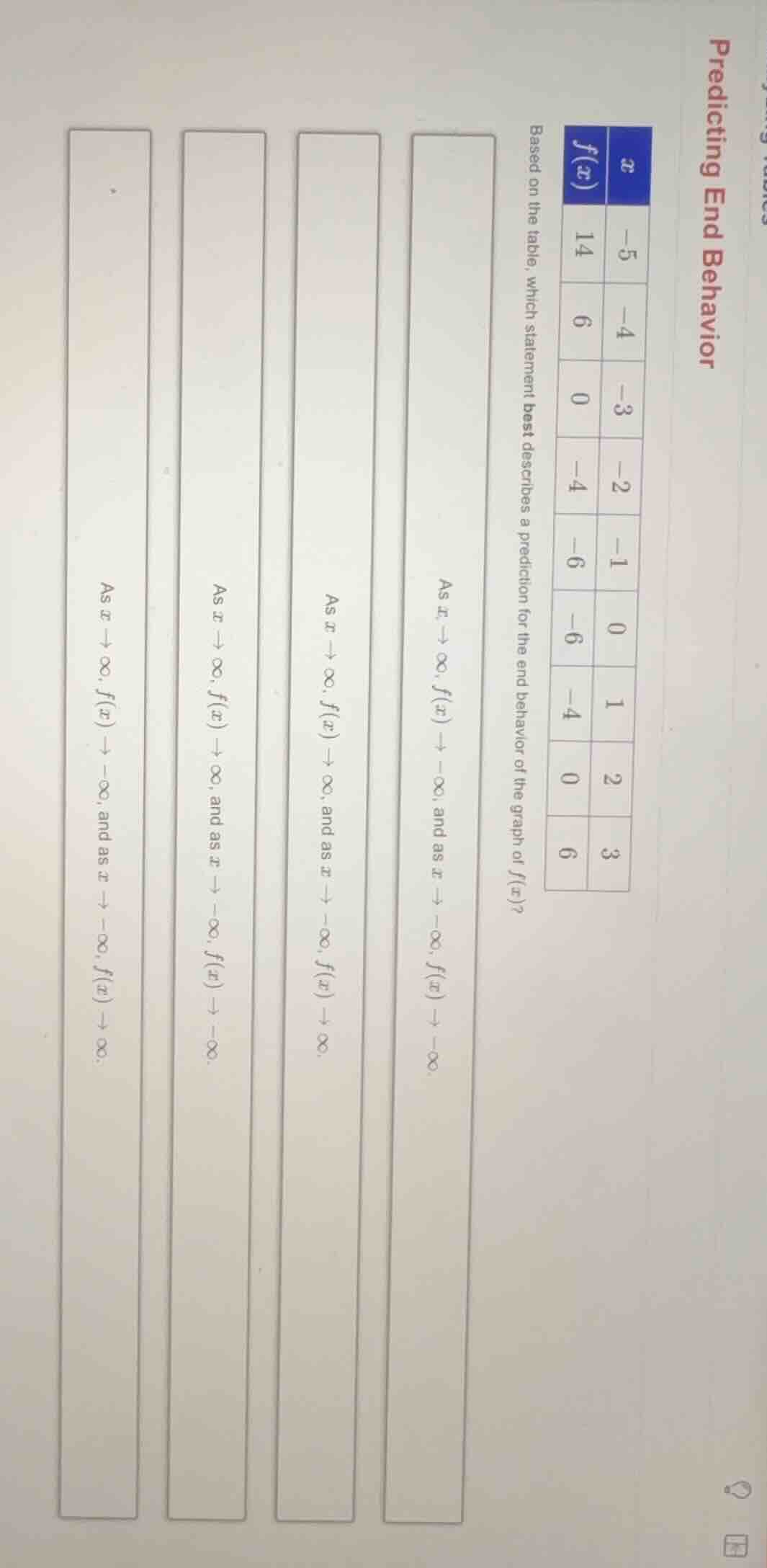
based on the table, which statement best describes a prediction for the end behavior of the graph of ( f(x) )?
( \begin{array}{|c|c|} hline x & f(x) \\ hline -5 & 14 \\ hline -4 & 6 \\ hline -3 & 0 \\ hline -2 & -4 \\ hline -1 & -6 \\ hline 0 & -6 \\ hline 1 & -4 \\ hline 2 & 0 \\ hline 3 & 6 \\ hline end{array} )
as ( x \to infty ), ( f(x) \to -infty ), and as ( x \to -infty ), ( f(x) \to -infty ).
as ( x \to infty ), ( f(x) \to infty ), and as ( x \to -infty ), ( f(x) \to infty ).
as ( x \to infty ), ( f(x) \to infty ), and as ( x \to -infty ), ( f(x) \to -infty ).
as ( x \to infty ), ( f(x) \to -infty ), and as ( x \to -infty ), ( f(x) \to infty ).
Step1: Analyze the trend as \( x \) increases
Looking at the table, when \( x \) goes from \( -5 \) to \( 3 \) (increasing \( x \)):
- At \( x = -5 \), \( f(x) = 14 \)
- At \( x = -4 \), \( f(x) = 6 \)
- At \( x = -3 \), \( f(x) = 0 \)
- At \( x = -2 \), \( f(x) = -4 \)
- At \( x = -1 \), \( f(x) = -6 \)
- At \( x = 0 \), \( f(x) = -6 \)
- At \( x = 1 \), \( f(x) = -4 \)
- At \( x = 2 \), \( f(x) = 0 \)
- At \( x = 3 \), \( f(x) = 6 \)
As \( x \) increases from a large negative number (like \( -5 \)) towards positive numbers (up to \( 3 \)), we can see that the function values first decrease (from \( 14 \) to \( -6 \)) and then start to increase (from \( -6 \) to \( 6 \)). But to determine the end - behavior (as \( x
ightarrow\infty \) and \( x
ightarrow-\infty \)), we can assume the function is a polynomial (since the table has a symmetric - like pattern for the second - half of the values).
Looking at the values for \( x=-5, - 4,-3,-2,-1,0,1,2,3 \), the function seems to be a cubic or a higher - degree polynomial. Let's check the symmetry and the trend.
For the right - hand end (as \( x
ightarrow\infty \)): When \( x \) is positive and increasing, the function values are increasing (from \( -4 \) at \( x = 1 \) to \( 0 \) at \( x = 2 \) to \( 6 \) at \( x = 3 \)). If we assume the pattern continues, as \( x
ightarrow\infty \), \( f(x)
ightarrow\infty \).
For the left - hand end (as \( x
ightarrow-\infty \)): When \( x \) is negative and decreasing (becoming more negative), the function values at \( x=-5 \) is \( 14 \), \( x = - 6 \) (if we extrapolate) would be larger (since the function was decreasing from \( x=-5 \) to \( x=-1 \) and then increasing, but for a polynomial, the leading term determines the end - behavior). Let's consider the symmetry. The function values at \( x=-5 \) is \( 14 \), \( x = 3 \) is \( 6 \); \( x=-4 \) is \( 6 \), \( x = 2 \) is \( 0 \); \( x=-3 \) is \( 0 \), \( x = 2 \) is \( 0 \); \( x=-2 \) is \( - 4 \), \( x = 1 \) is \( - 4 \); \( x=-1 \) is \( - 6 \), \( x = 0 \) is \( - 6 \). This looks like a symmetric pattern around \( x = - 0.5\) (the mid - point of \( x=-1 \) and \( x = 0 \)) for the lower values and symmetric around \( x = 1\) and \( x=-4 \) etc. But a better way is to look at the trend of the function as \( x \) becomes very large in magnitude (both positive and negative).
Looking at the values: when \( x=-5 \), \( f(x) = 14\); as \( x\) becomes more negative (e.g., \( x=-6,-7,\cdots \)), if we follow the pattern of the left - hand side (from \( x=-5 \) to \( x=-1 \), the function was decreasing from \( 14 \) to \( - 6 \), but if we go beyond \( x=-5 \) (more negative \( x \)), say \( x=-6 \), the function value should be larger than \( 14 \) (since for a polynomial, if the leading coefficient is positive and the degree is odd, as \( x
ightarrow-\infty \), \( f(x)
ightarrow-\infty \) and as \( x
ightarrow\infty \), \( f(x)
ightarrow\infty \); if the degree is even, as \( x
ightarrow\pm\infty \), \( f(x)
ightarrow\infty \) or \( f(x)
ightarrow-\infty \)). But looking at our values, when \( x \) is negative and decreasing (more negative), the function was decreasing from \( x=-5 \) to \( x=-1 \), but then started increasing. Wait, maybe we made a mistake. Let's re - evaluate.
Wait, the values at \( x=-5:14 \), \( x=-4:6 \), \( x=-3:0 \), \( x=-2:-4 \), \( x=-1:-6 \), \( x = 0:-6 \), \( x = 1:-4 \), \( x = 2:0 \), \( x = 3:6 \). So the function is symmetric around \( x=-0.5 \) for the values from \( x=-5 \) to \( x = 3 \) in terms of the second differences? Wait, no. Let's calculate…

Snap & solve any problem in the app
Get step-by-step solutions on Sovi AI
Photo-based solutions with guided steps
Explore more problems and detailed explanations
As \( x
ightarrow\infty,f(x)
ightarrow\infty \), and as \( x
ightarrow-\infty,f(x)
ightarrow\infty \) (the fourth option in the original problem's choices, assuming the options are ordered as: 1. As \( x
ightarrow\infty,f(x)
ightarrow-\infty \), and as \( x
ightarrow-\infty,f(x)
ightarrow-\infty \) 2. As \( x
ightarrow\infty,f(x)
ightarrow\infty \), and as \( x
ightarrow-\infty,f(x)
ightarrow-\infty \) 3. As \( x
ightarrow\infty,f(x)
ightarrow\infty \), and as \( x
ightarrow-\infty,f(x)
ightarrow\infty \) 4. As \( x
ightarrow\infty,f(x)
ightarrow\infty \), and as \( x
ightarrow-\infty,f(x)
ightarrow\infty \) (the option with the description "As \( x
ightarrow\infty,f(x)
ightarrow\infty \), and as \( x
ightarrow-\infty,f(x)
ightarrow\infty \)"))