QUESTION IMAGE
Question
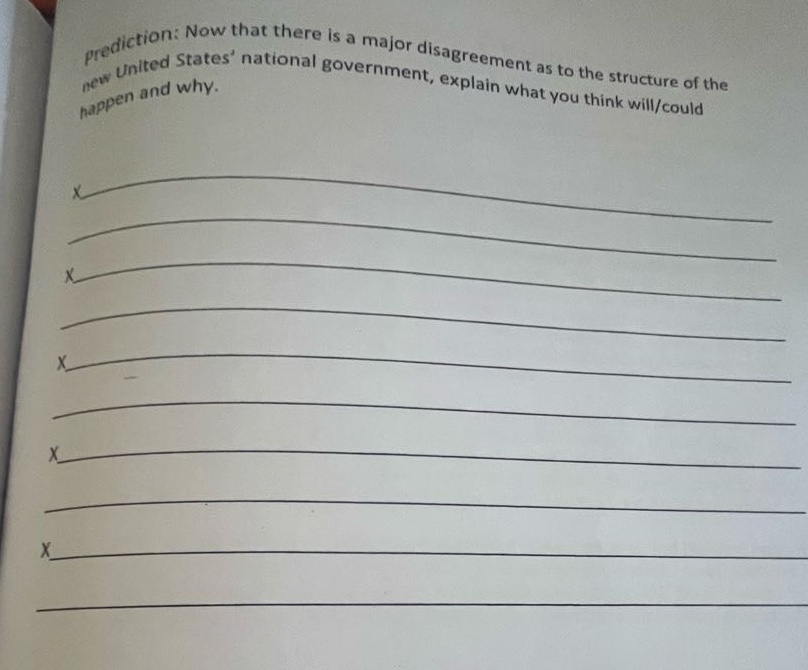
prediction: now that there is a major disagreement as to the structure of the new united states national government, explain what you think will/could happen and why.
Brief Explanations
- Compromise on Structure: Given the U.S. system of checks and balances and the need for governance, political actors (e.g., legislators, executive, judiciary proponents) may negotiate. Historical precedents like the Great Compromise (Connecticut Compromise) show that disagreements over government structure (e.g., legislative representation) can lead to compromises to form a functional government. The incentive to avoid political gridlock or instability pushes for middle - ground solutions, such as adjusting the distribution of power between branches or levels of government.
- Increased Partisanship - Driven Policies: If the disagreement is along partisan lines, each party may try to push its vision of government structure. For example, one party might advocate for a more centralized federal government, while the other for more state autonomy. This could lead to partisan - driven legislation or executive actions to reshape the government structure, as seen in debates over federalism (e.g., Obamacare implementation disputes, where states' rights and federal power clashed). The desire to advance party ideology and gain electoral advantage fuels this.
- Judicial Intervention: The judiciary, especially the Supreme Court, may get involved. If the disagreement leads to constitutional - level disputes (e.g., over the separation of powers or federal - state relations), the courts can interpret the Constitution to resolve the structure - related issues. For instance, in cases like Marbury v. Madison, the Court established its power of judicial review, which can be used to settle disputes about government structure. The judiciary's role as the interpreter of the Constitution makes it a key player in resolving such disagreements.
- Public Pressure - Driven Reforms: Public opinion can influence the outcome. If the disagreement causes public dissatisfaction (e.g., due to inefficiency or perceived unfairness in the government structure), there may be calls for reform. Grassroots movements or public protests could push for changes, like electoral reform to change the legislative structure or demands for more transparent governance structures. The public's desire for a responsive and effective government can drive politicians to address the structural issues.
- International Influence - Shaped Changes: The United States' position in the international arena can also play a role. For example, if the global economic or security situation requires a more unified or agile government structure, external pressures (e.g., from allies, trade partners, or security threats) could prompt changes. In times of war or economic crises, the government often restructures (e.g., creating new agencies or centralizing decision - making), and international factors can accelerate or direct such structural changes.

Snap & solve any problem in the app
Get step-by-step solutions on Sovi AI
Photo-based solutions with guided steps
Explore more problems and detailed explanations
- Compromise on Structure: Political actors will likely negotiate a middle - ground government structure to avoid gridlock, as seen in historical compromises like the Great Compromise.
- Increased Partisanship - Driven Policies: Partisan groups will push their vision of government structure to advance ideology and electoral goals, as in federalism - related disputes.
- Judicial Intervention: The judiciary, especially the Supreme Court, will interpret the Constitution to resolve structural disputes, as in Marbury v. Madison - type cases.
- Public Pressure - Driven Reforms: Public dissatisfaction will drive reform demands, leading to changes in government structure to meet public expectations.
- International Influence - Shaped Changes: External pressures (economic, security) will prompt changes to the government structure to meet global demands.