QUESTION IMAGE
Question
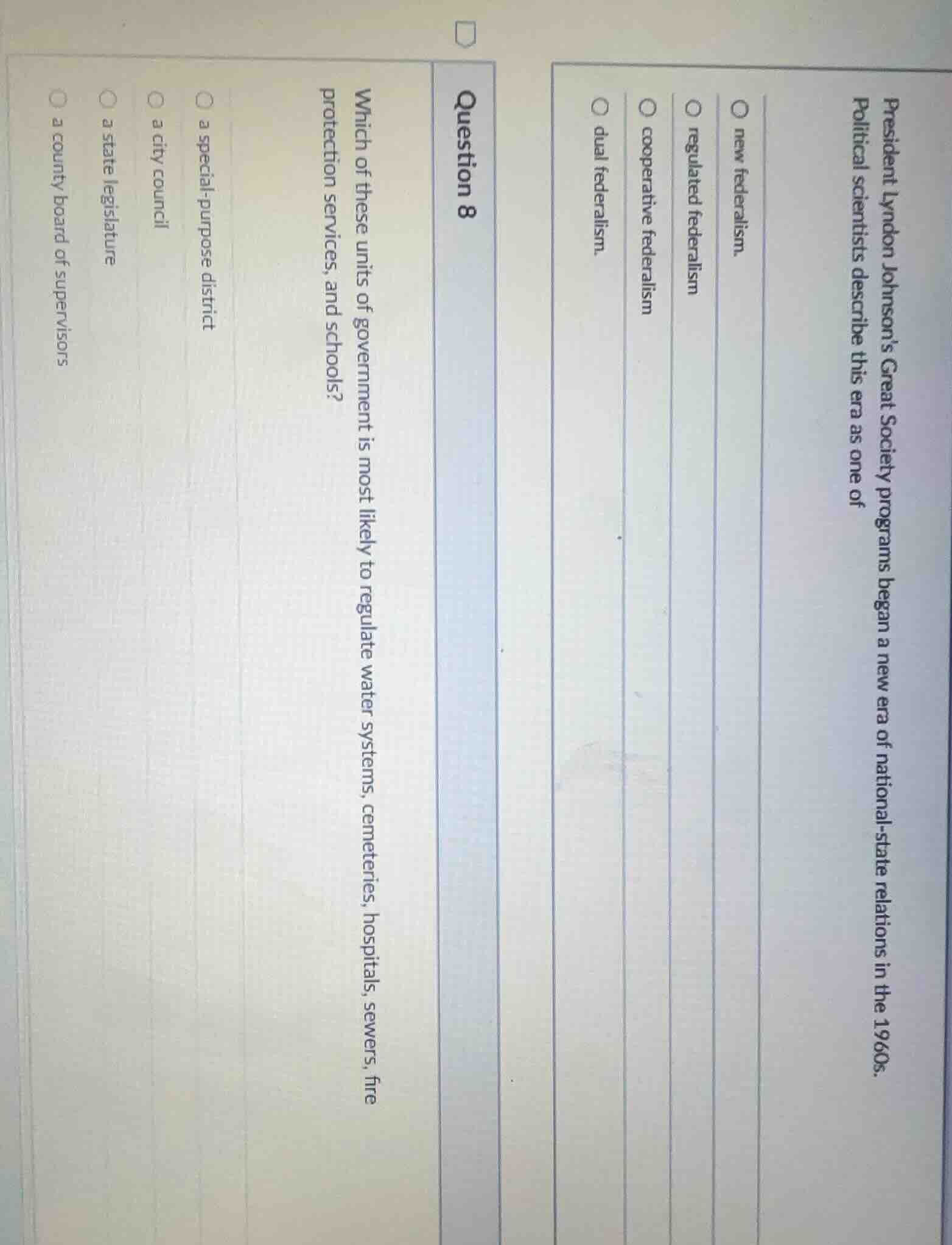
president lyndon johnsons great society programs began a new era of national - state relations in the 1960s. political scientists describe this era as one of
○ new federalism.
○ regulated federalism
○ cooperative federalism
○ dual federalism.
question 8
which of these units of government is most likely to regulate water systems, cemeteries, hospitals, sewers, fire protection services, and schools?
○ a special - purpose district
○ a city council
○ a state legislature
○ a county board of supervisors
For the first question: Lyndon B. Johnson's Great Society programs expanded federal involvement in state-level social and domestic policies, which is characteristic of regulated federalism (also called coercive federalism), where the federal government sets rules and standards that states must follow, often with funding tied to compliance.
For Question 8: County governments (governed by a county board of supervisors) are general-purpose local governments that oversee a broad range of services including water systems, cemeteries, hospitals, sewers, fire protection, and public schools for their jurisdiction. Special-purpose districts handle single specific functions, city councils manage municipal services, and state legislatures handle state-level laws.

Snap & solve any problem in the app
Get step-by-step solutions on Sovi AI
Photo-based solutions with guided steps
Explore more problems and detailed explanations
- regulated federalism
- a county board of supervisors