QUESTION IMAGE
Question
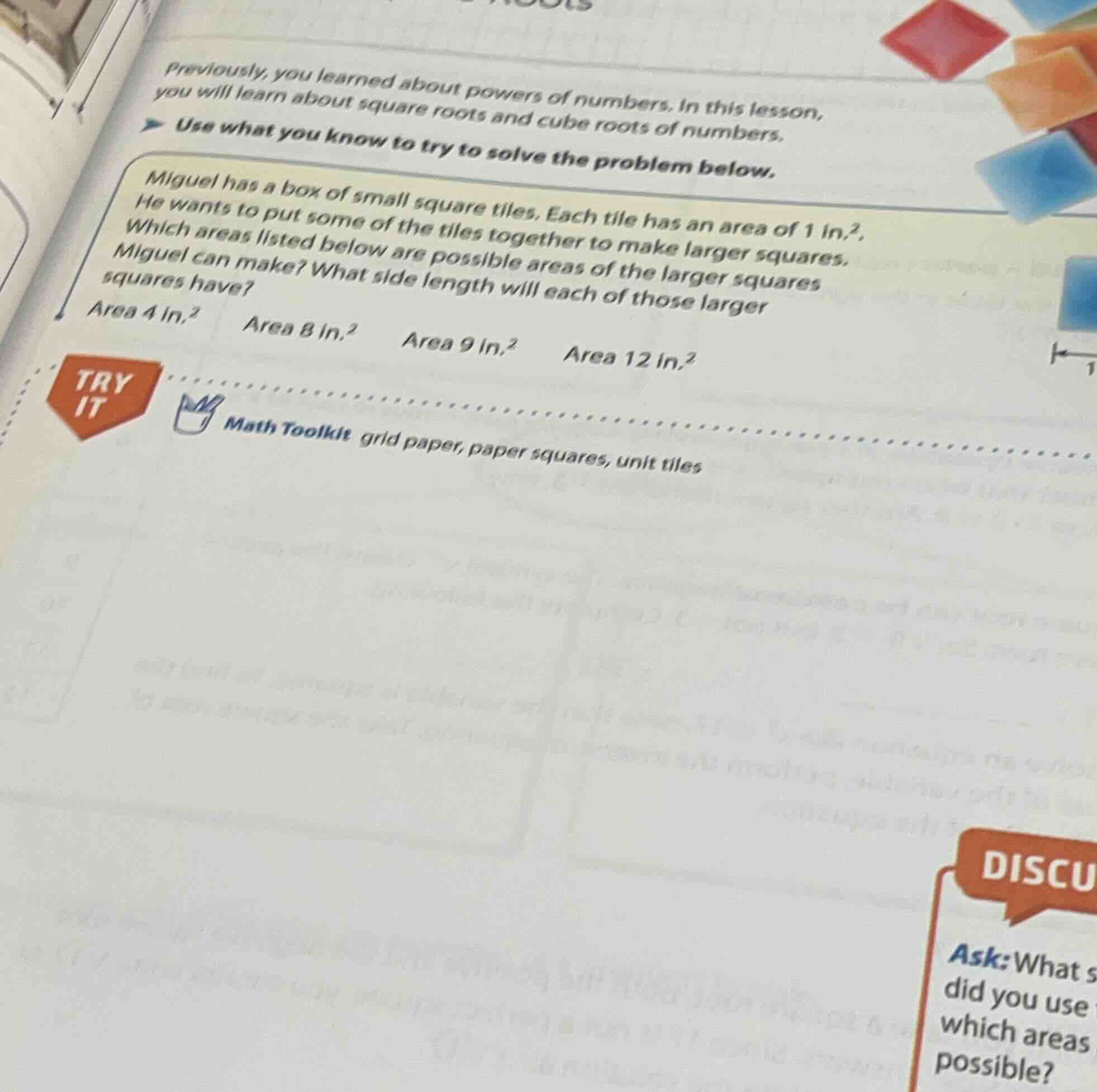
previously, you learned about powers of numbers. in this lesson, you will learn about square roots and cube roots of numbers. use what you know to try to solve the problem below. miguel has a box of small square tiles. each tile has an area of 1 in.². he wants to put some of the tiles together to make larger squares. which areas listed below are possible areas of the larger squares miguel can make? what side length will each of those larger squares have? area 4 in.² area 8 in.² area 9 in.² area 12 in.² try it math toolkit grid paper, paper squares, unit tiles
Step1: Recall the formula for the area of a square
The area of a square is given by \( A = s^2 \), where \( s \) is the side length. To find the side length from the area, we use \( s=\sqrt{A} \). Also, since we are using square tiles with area \( 1\ \text{in}^2 \), the number of tiles (and thus the area) must be a perfect square for the side length to be an integer (since we can only use whole tiles to form a square).
Step2: Check Area \( 4\ \text{in}^2 \)
For \( A = 4\ \text{in}^2 \), we calculate \( s=\sqrt{4} \). Since \( 2\times2 = 4 \), \( \sqrt{4}=2 \). So the side length is \( 2\ \text{in} \), and \( 4 \) is a perfect square ( \( 2^2 \) ), so this area is possible.
Step3: Check Area \( 8\ \text{in}^2 \)
For \( A = 8\ \text{in}^2 \), we calculate \( s=\sqrt{8} \). Simplify \( \sqrt{8}=\sqrt{4\times2} = 2\sqrt{2}\approx2.83 \), which is not an integer. Also, \( 8 \) is not a perfect square (there is no integer \( n \) such that \( n^2 = 8 \)), so we can't form a square with whole tiles for this area.
Step4: Check Area \( 9\ \text{in}^2 \)
For \( A = 9\ \text{in}^2 \), we calculate \( s=\sqrt{9} \). Since \( 3\times3 = 9 \), \( \sqrt{9}=3 \). So the side length is \( 3\ \text{in} \), and \( 9 \) is a perfect square ( \( 3^2 \) ), so this area is possible.
Step5: Check Area \( 12\ \text{in}^2 \)
For \( A = 12\ \text{in}^2 \), we calculate \( s=\sqrt{12} \). Simplify \( \sqrt{12}=\sqrt{4\times3}=2\sqrt{3}\approx3.46 \), which is not an integer. Also, \( 12 \) is not a perfect square (there is no integer \( n \) such that \( n^2 = 12 \)), so we can't form a square with whole tiles for this area.

Snap & solve any problem in the app
Get step-by-step solutions on Sovi AI
Photo-based solutions with guided steps
Explore more problems and detailed explanations
The possible areas are \( 4\ \text{in}^2 \) (with side length \( 2\ \text{in} \)) and \( 9\ \text{in}^2 \) (with side length \( 3\ \text{in} \)). The areas \( 8\ \text{in}^2 \) and \( 12\ \text{in}^2 \) are not possible.