QUESTION IMAGE
Question
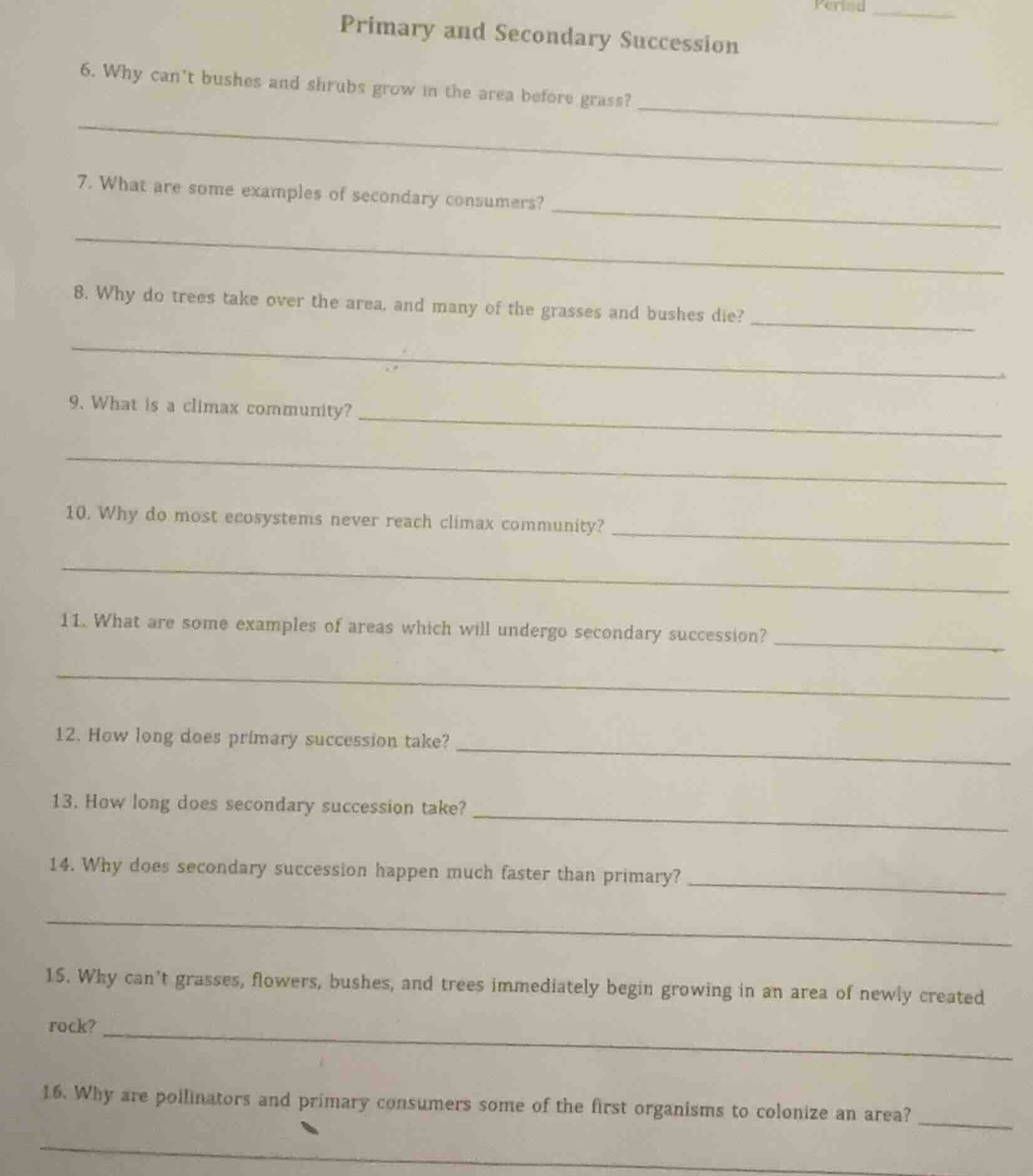
primary and secondary succession
- why cant bushes and shrubs grow in the area before grass?
- what are some examples of secondary consumers?
- why do trees take over the area, and many of the grasses and bushes die?
- what is a climax community?
- why do most ecosystems never reach climax community?
- what are some examples of areas which will undergo secondary succession?
- how long does primary succession take?
- how long does secondary succession take?
- why does secondary succession happen much faster than primary?
- why cant grasses, flowers, bushes, and trees immediately begin growing in an area of newly created rock?
- why are pollinators and primary consumers some of the first organisms to colonize an area?
Brief Explanations
- Bushes/shrubs need established soil (with nutrients, organic matter) that grasses first build by breaking down the substrate, trapping sediment, and adding organic material when they die and decompose.
- Secondary consumers are animals that eat primary consumers (herbivores); they are carnivores or omnivores.
- Trees are taller, so they outcompete grasses and bushes for sunlight, shading them out. They also have more extensive root systems that compete better for water and soil nutrients.
- A climax community is a stable, mature ecological community that remains relatively unchanged over time, as it is in balance with the local environmental conditions.
- Most ecosystems face regular disturbances (like fires, floods, human activity, or disease outbreaks) that reset the succession process before it can reach a stable climax state.
- Secondary succession occurs in areas where soil and some biological remnants already exist, after a disturbance that removed most existing vegetation.
- Primary succession takes hundreds to thousands of years, as it starts from bare rock and requires time to form soil and establish complex communities.
- Secondary succession takes decades (typically 50-100 years, depending on the ecosystem), since soil and some biological components are already present.
- Secondary succession is faster because the area already has existing soil (with nutrients and organic matter), and may have leftover seeds, roots, or other biological material from the previous community, eliminating the need to build soil from scratch.
- Newly created rock has no soil, organic nutrients, or moisture-retaining capacity. Grasses, flowers, bushes, and trees need soil to anchor roots and access water and nutrients, which takes time to form via weathering and the activity of pioneer species.
- Pollinators and primary consumers rely on the first colonizing plants (pioneer species like grasses, mosses, and small flowers) for food (nectar, pollen, plant tissue), so they arrive soon after these plants establish to utilize the available resources.

Snap & solve any problem in the app
Get step-by-step solutions on Sovi AI
Photo-based solutions with guided steps
Explore more problems and detailed explanations
- Bushes/shrubs need soil grasses first form.
- Examples: Foxes, hawks, snakes, frogs, and omnivorous bears.
- Trees outcompete for sunlight, water, nutrients.
- A stable, mature, unchanging ecological community.
- Regular disturbances reset succession early.
- Examples: Forest fire sites, abandoned farmland, logged forests, and flood-damaged areas.
- Hundreds to thousands of years.
- 50-100 years (decades, ecosystem-dependent).
- Soil and biological remnants already exist.
- No soil, nutrients, or moisture for root growth.
- They feed on early colonizing plant life.