QUESTION IMAGE
Question
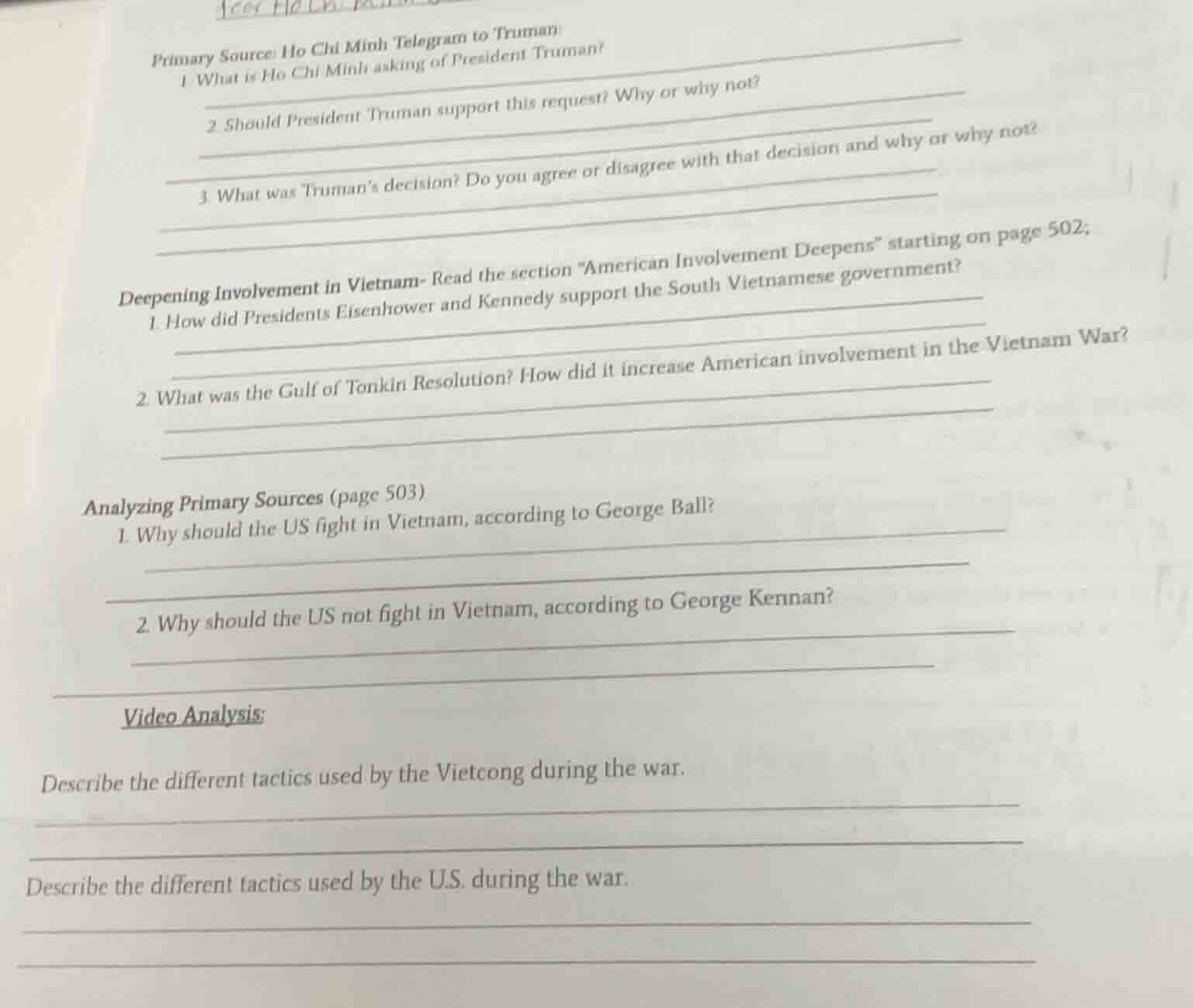
primary source: ho chi minh telegram to truman
1 what is ho chi minh asking of president truman?
2 should president truman support this request? why or why not?
- what was trumans decision? do you agree or disagree with that decision and why or why not?
deepening involvement in vietnam- read the section \american involvement deepens\ starting on page 502;
- how did presidents eisenhower and kennedy support the south vietnamese government?
- what was the gulf of tonkin resolution? how did it increase american involvement in the vietnam war?
analyzing primary sources (page 503)
- why should the us fight in vietnam, according to george ball?
- why should the us not fight in vietnam, according to george kennan?
video analysis:
describe the different tactics used by the vietcong during the war.
describe the different tactics used by the u.s. during the war.
Brief Explanations
Primary Source: Ho Chi Minh Telegram to Truman
- Ho Chi Minh asked President Truman for formal recognition of Vietnamese independence and financial/technical aid to rebuild Vietnam, framing it as aligning with the Atlantic Charter's self-determination principles.
- Arguments for support: Upholding self-determination, opposing colonialism, building an ally. Arguments against: Prioritizing European allies (France, a colonial power in Vietnam), Cold War fears of communist expansion in Southeast Asia.
- Truman rejected direct support for Ho Chi Minh, instead backing French efforts to re-establish colonial control in Vietnam. Agreement/disagreement depends on perspective: Agree if prioritizing Cold War containment; disagree if prioritizing anti-colonial self-determination.
Deepening Involvement in Vietnam
- Eisenhower provided military advisors and financial aid to the South Vietnamese government under the "domino theory" framework. Kennedy expanded military advisor numbers, sent special forces, and supported South Vietnamese counterinsurgency operations.
- The Gulf of Tonkin Resolution was a 1964 congressional resolution that granted President Johnson broad authority to use military force in Southeast Asia without a formal declaration of war, allowing a massive escalation of U.S. troop deployments and direct combat involvement.
Analyzing Primary Sources
- George Ball argued the U.S. should fight to uphold the credibility of its commitments to contain communism, prevent the "domino effect" of Southeast Asian nations falling to communism, and support an ally in South Vietnam.
- George Kennan argued the U.S. should not fight because Vietnam was not strategically vital to U.S. national security, the conflict was a civil war rather than a Soviet-directed communist takeover, and U.S. military involvement would be costly and ineffective.
Video Analysis
- Vietcong tactics included guerrilla warfare (ambushes, hit-and-run attacks), tunnel networks for shelter and supply, blending with civilian populations, using booby traps, and relying on local support for intelligence and supplies.
- U.S. tactics included search-and-destroy missions, carpet bombing (like Operation Rolling Thunder), chemical warfare (Agent Orange to destroy vegetation), strategic hamlets to isolate Vietcong from civilians, and heavy reliance on air power and firepower.

Snap & solve any problem in the app
Get step-by-step solutions on Sovi AI
Photo-based solutions with guided steps
Explore more problems and detailed explanations
Primary Source: Ho Chi Minh Telegram to Truman
- Formal recognition of Vietnamese independence and post-war aid.
- Example answer: No, because Truman prioritized backing France (a Cold War ally) over anti-colonial self-determination, fearing communist expansion.
- Truman backed French colonial reoccupation. Example answer: Disagree, as it ignored Vietnamese self-determination and laid groundwork for future conflict.
Deepening Involvement in Vietnam
- Eisenhower: Military advisors, financial aid; Kennedy: More advisors, special forces, counterinsurgency support.
- A congressional resolution granting Johnson war powers; allowed large-scale U.S. troop deployments.
Analyzing Primary Sources
- To uphold Cold War containment credibility and stop the domino effect.
- Vietnam lacked strategic U.S. importance, and the conflict was a civil war.
Video Analysis
- Guerrilla warfare, tunnel networks, booby traps, blending with civilians.
- Search-and-destroy missions, carpet bombing, chemical warfare, strategic hamlets.