QUESTION IMAGE
Question
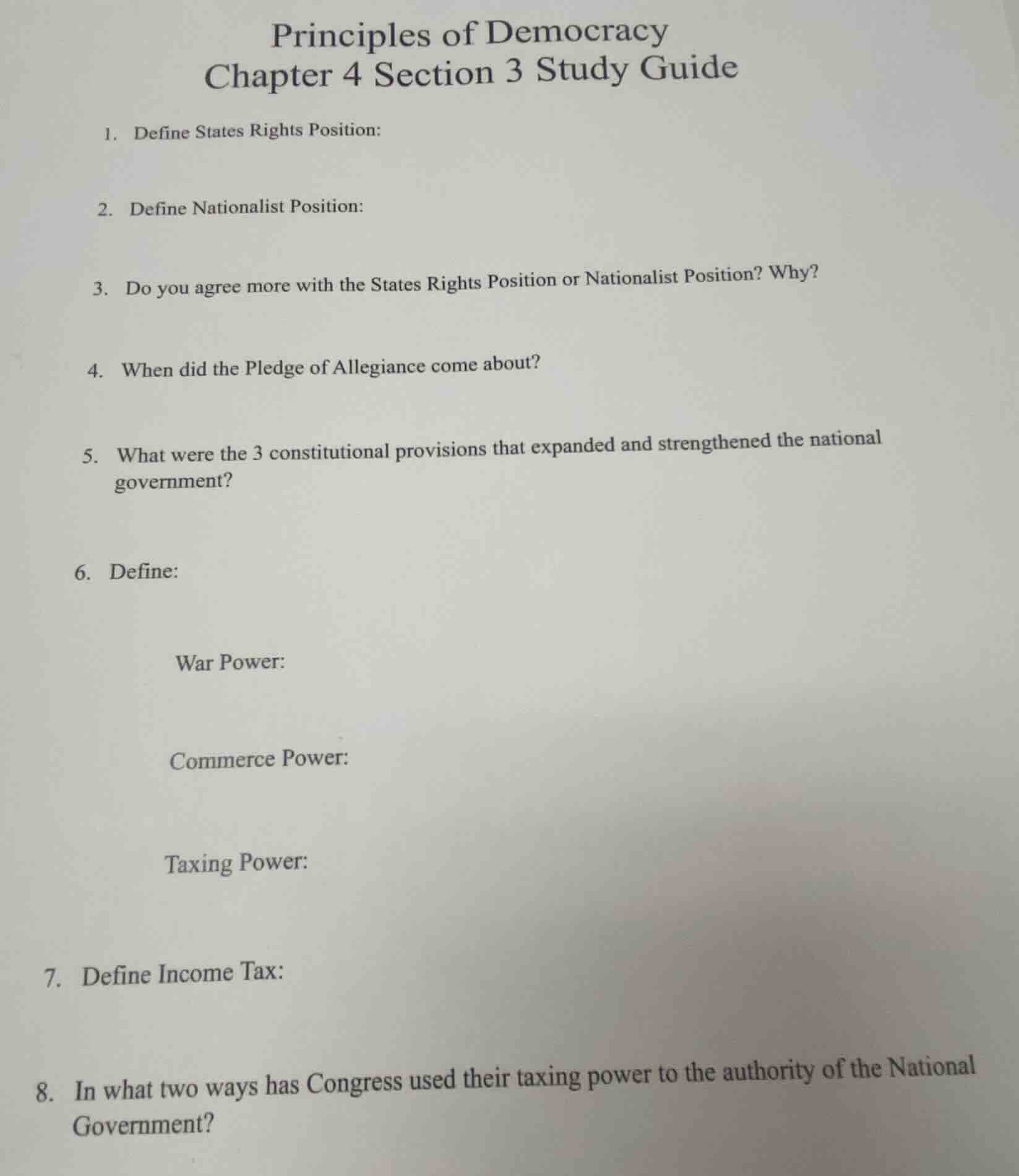
principles of democracy
chapter 4 section 3 study guide
- define states rights position:
- define nationalist position:
- do you agree more with the states rights position or nationalist position? why?
- when did the pledge of allegiance come about?
- what were the 3 constitutional provisions that expanded and strengthened the national
government?
- define:
war power:
commerce power:
taxing power:
- define income tax:
- in what two ways has congress used their taxing power to the authority of the national
government?
Question 1: Define States Rights Position
The States Rights Position (also known as the states' rights doctrine) emphasizes that the powers of the state governments are supreme within their respective spheres (usually related to local governance, reserved powers under the Tenth Amendment of the U.S. Constitution) and that the national government's powers are limited to those explicitly granted by the Constitution. States' rights advocates argue that states should have significant autonomy, especially in areas not delegated to the federal government, and that states can act as a check on federal overreach.
The Nationalist Position (or nationalist doctrine) emphasizes the supremacy of the national (federal) government's authority over state governments, especially in matters affecting the nation as a whole. Nationalists argue that the federal government has implied powers (via the Necessary and Proper Clause) to carry out its enumerated powers, that the national government should play a leading role in governance (e.g., economic regulation, civil rights, national security), and that a strong federal government is necessary for national unity, stability, and addressing issues that transcend state boundaries.
This is a subjective question, but a common reasoning framework:
- States Rights Argument: Agreeing with states' rights might stem from valuing local autonomy, diversity in governance, and a belief that states are more responsive to local needs (e.g., state-level policies on education, social issues). It also aligns with concerns about federal overreach and preserving state sovereignty as a check on centralized power.
- Nationalist Argument: Agreeing with nationalism might stem from recognizing the need for a unified national policy (e.g., civil rights, interstate commerce, national security) to address issues that states cannot handle alone. A strong federal government can ensure consistency, equity, and efficiency in governance across the nation.
For example, choosing Nationalist: "I agree more with the Nationalist Position because many issues (e.g., climate change, civil rights, interstate trade) require a unified national response. States acting alone may struggle to address cross - state problems, and a strong federal government ensures consistency and equity (e.g., enforcing civil rights laws uniformly, regulating national markets). The Necessary and Proper Clause also allows the federal government to adapt to modern challenges, which states’ limited resources or fragmented policies might not."
Or choosing States Rights: "I agree more with the States Rights Position because states are closer to their citizens and can tailor policies to local values and needs (e.g., education curricula, environmental regulations based on regional ecosystems). A strong states’ rights framework also prevents federal overreach, preserving a balance of power and allowing diverse governance models that reflect local priorities."

Snap & solve any problem in the app
Get step-by-step solutions on Sovi AI
Photo-based solutions with guided steps
Explore more problems and detailed explanations
The States Rights Position holds that state governments have supreme authority in matters reserved to them (by the Tenth Amendment or historical/constitutional interpretation) and that the federal government's powers are limited to those explicitly granted; states should have broad autonomy to govern local affairs and check federal overreach.