QUESTION IMAGE
Question
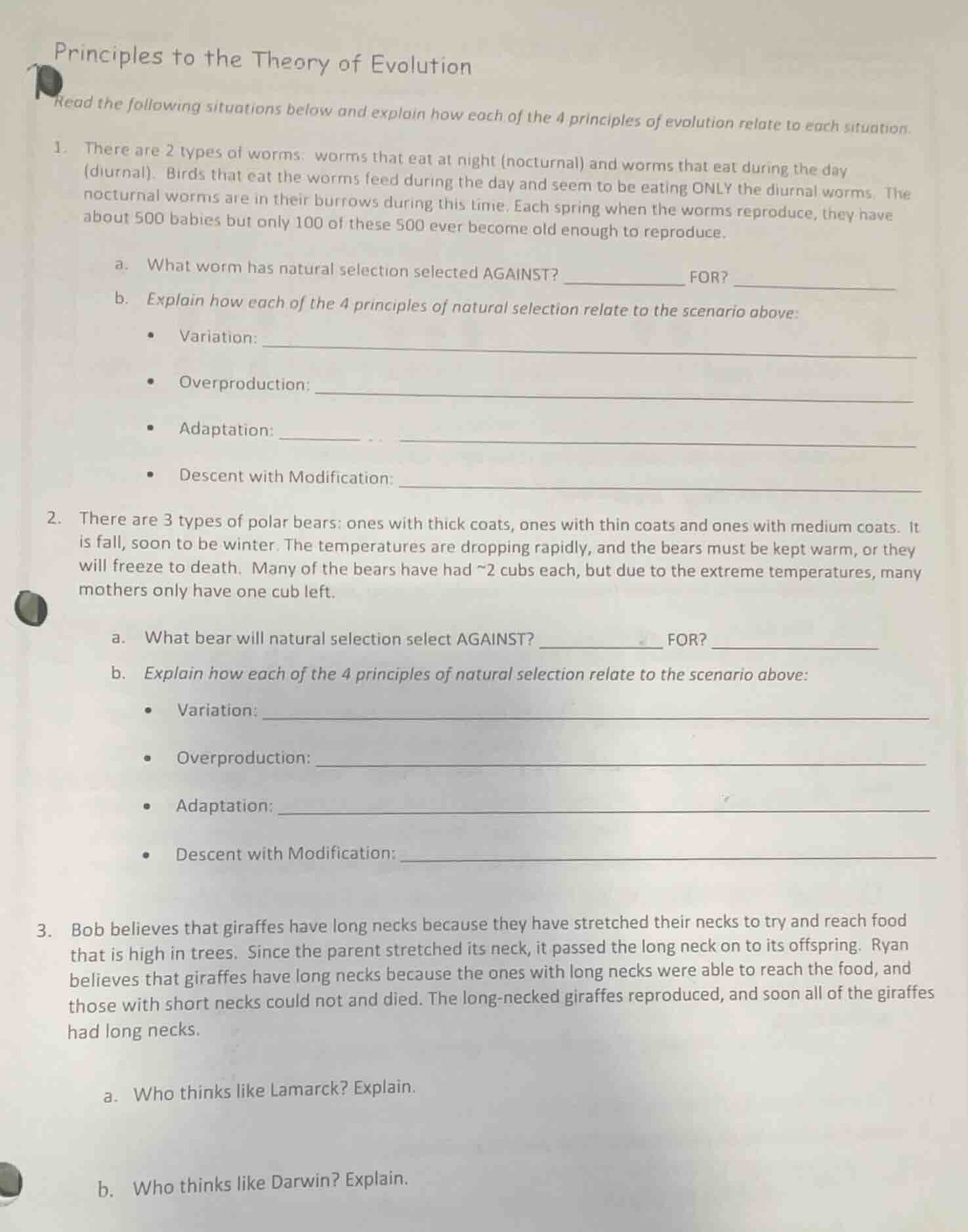
principles to the theory of evolution
read the following situations below and explain how each of the 4 principles of evolution relate to each situation.
- there are 2 types of worms: worms that eat at night (nocturnal) and worms that eat during the day (diurnal). birds that eat the worms feed during the day and seem to be eating only the diurnal worms. the nocturnal worms are in their burrows during this time. each spring when the worms reproduce, they have about 500 babies but only 100 of these 500 ever become old enough to reproduce.
a. what worm has natural selection selected against? ___________ for? _____________
b. explain how each of the 4 principles of natural selection relate to the scenario above:
- variation: ______________________________________________________________
- overproduction: _________________________________________________________
- adaptation: _____________________________________________________________
- descent with modification: _______________________________________________
- there are 3 types of polar bears: ones with thick coats, ones with thin coats and ones with medium coats. it is fall, soon to be winter. the temperatures are dropping rapidly, and the bears must be kept warm, or they will freeze to death. many of the bears have had ~2 cubs each, but due to the extreme temperatures, many mothers only have one cub left.
a. what bear will natural selection select against? ___________ for? _____________
b. explain how each of the 4 principles of natural selection relate to the scenario above:
- variation: ______________________________________________________________
- overproduction: _________________________________________________________
- adaptation: _____________________________________________________________
- descent with modification: _______________________________________________
- bob believes that giraffes have long necks because they have stretched their necks to try and reach food that is high in trees. since the parent stretched its neck, it passed the long neck on to its offspring. ryan believes that giraffes have long necks because the ones with long necks were able to reach the food, and those with short necks could not and died. the long - necked giraffes reproduced, and soon all of the giraffes had long necks.
a. who thinks like lamarck? explain.
b. who thinks like darwin? explain.
Scenario 1 (Worms)
a. Natural selection acts against diurnal worms (eaten by daytime birds) and for nocturnal worms (safe in burrows during the day).
b.
- Variation: Two worm types exist: diurnal (day-feeding) and nocturnal (night-feeding).
- Overproduction: Each worm pair produces ~500 babies, far more than the 100 that survive to reproduce.
- Adaptation: Nocturnal worms have the trait of feeding at night, which lets them avoid bird predators and survive to reproduce.
- Descent with Modification: Surviving nocturnal worms pass their night-feeding trait to offspring, so the population becomes more nocturnal over time.
Scenario 2 (Polar Bears)
a. Natural selection acts against bears with thin coats (cannot survive dropping temperatures) and for bears with thick coats (stay warm and survive).
b.
- Variation: Three coat thickness types exist: thick, medium, and thin.
- Overproduction: Most bears have ~2 cubs, but many only keep 1 due to harsh conditions.
- Adaptation: Thick coats are a trait that lets bears retain heat and avoid freezing in cold temperatures.
- Descent with Modification: Surviving thick-coated bears pass their thick coat trait to offspring, so the population shifts to more thick-coated bears over time.
Scenario 3 (Giraffes)
a. Lamarck proposed that acquired traits (developed during an organism's lifetime) are passed to offspring. Bob thinks giraffes stretched their necks (an acquired trait) and passed this to their young, which matches Lamarck's ideas.
b. Darwin proposed natural selection: individuals with favorable heritable traits survive and reproduce, passing those traits to offspring. Ryan thinks long-necked giraffes (with a favorable heritable trait) survived to reproduce, while short-necked ones died, which matches Darwin's ideas.

Snap & solve any problem in the app
Get step-by-step solutions on Sovi AI
Photo-based solutions with guided steps
Explore more problems and detailed explanations
1. Worms
a. AGAINST: Diurnal worms; FOR: Nocturnal worms
b.
- Variation: Diurnal and nocturnal worm types exist
- Overproduction: ~500 babies per pair, only 100 reproduce
- Adaptation: Nocturnal worms avoid daytime bird predators
- Descent with Modification: Nocturnal trait becomes more common over generations
2. Polar Bears
a. AGAINST: Bears with thin coats; FOR: Bears with thick coats
b.
- Variation: Thick, medium, thin coat types exist
- Overproduction: ~2 cubs per bear, only 1 often survives
- Adaptation: Thick coats prevent freezing in cold
- Descent with Modification: Thick coat trait becomes more common over generations
3. Giraffes
a. Bob. He claims giraffes acquired long necks by stretching and passed this acquired trait to offspring, which aligns with Lamarck's theory of inheritance of acquired characteristics.
b. Ryan. He claims long-necked giraffes (with a heritable favorable trait) survived to reproduce, while short-necked giraffes died, which aligns with Darwin's theory of natural selection.