QUESTION IMAGE
Question
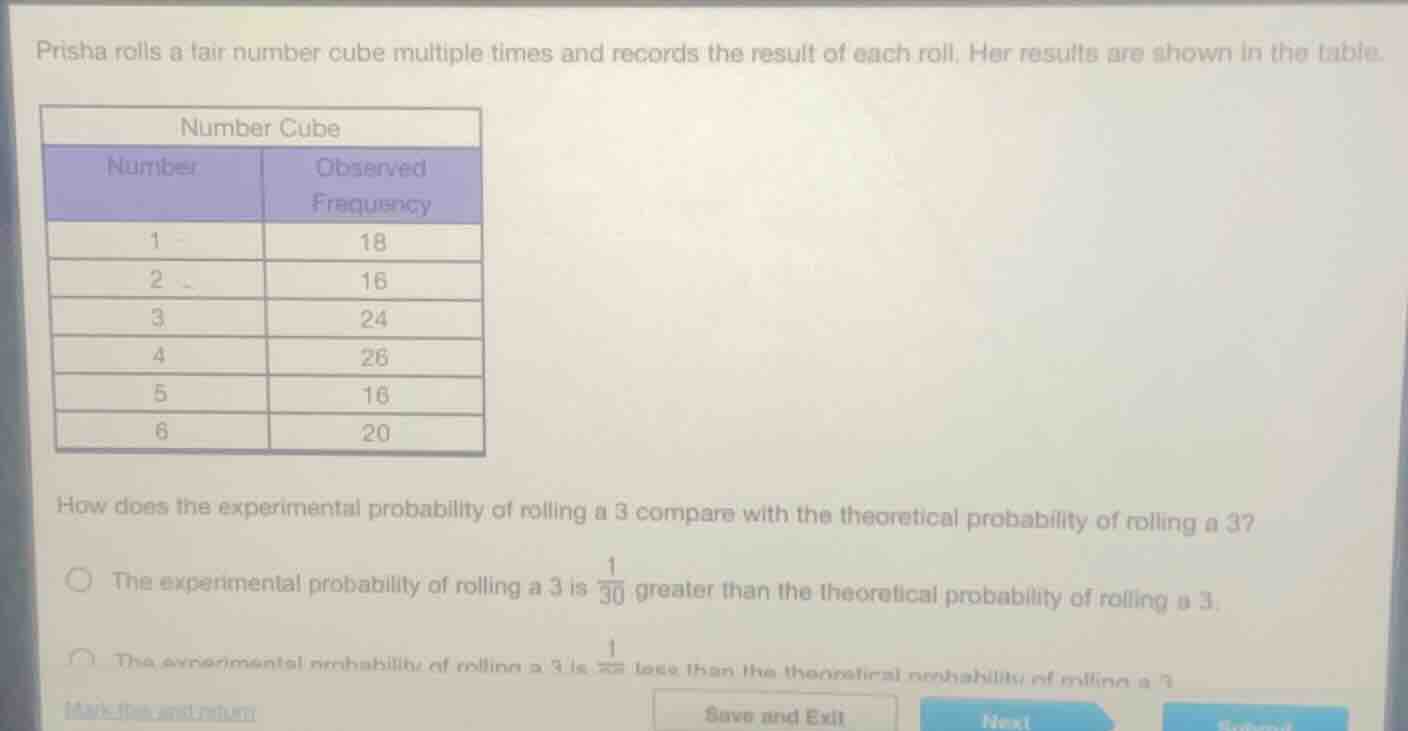
prisha rolls a fair number cube multiple times and records the result of each roll. her results are shown in the table.
number cube
| number | observed frequency |
|---|---|
| 2 | 16 |
| 3 | 24 |
| 4 | 26 |
| 5 | 16 |
| 6 | 20 |
how does the experimental probability of rolling a 3 compare with the theoretical probability of rolling a 3?
- the experimental probability of rolling a 3 is \\(\frac{1}{30}\\) greater than the theoretical probability of rolling a 3.
- the experimental probability of rolling a 3 is... less than the theoretical probability of rolling a 3.
mark for review (will be highlighted on the review page)
save and exit
next
Step1: Calculate total rolls
Add all observed frequencies:
$18 + 16 + 24 + 26 + 16 + 20 = 120$
Step2: Find experimental probability
Divide frequency of 3 by total rolls:
$\text{Experimental Probability} = \frac{24}{120} = \frac{1}{5}$
Step3: Identify theoretical probability
For a fair cube, $P(3) = \frac{1}{6}$
Step4: Compute the difference
Subtract theoretical from experimental:
$\frac{1}{5} - \frac{1}{6} = \frac{6 - 5}{30} = \frac{1}{30}$

Snap & solve any problem in the app
Get step-by-step solutions on Sovi AI
Photo-based solutions with guided steps
Explore more problems and detailed explanations
The experimental probability of rolling a 3 is $\frac{1}{30}$ greater than the theoretical probability of rolling a 3.