QUESTION IMAGE
Question
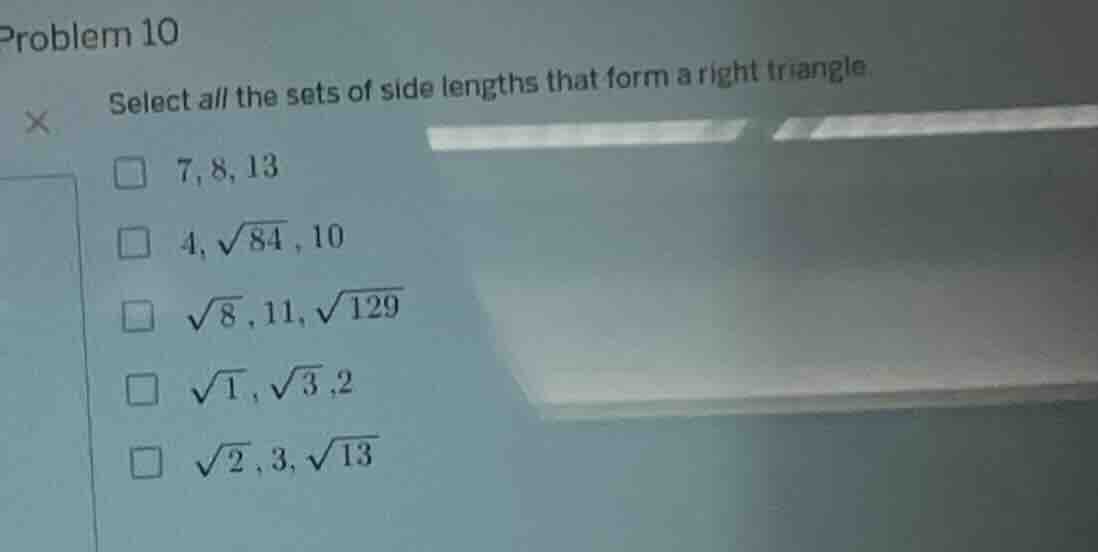
problem 10
select all the sets of side lengths that form a right triangle.
□ 7,8,13
□ 4,√84,10
□ √8,11,√129
□ √1,√3,2
□ √2,3,√13
To determine if a set of side lengths forms a right triangle, we use the Pythagorean theorem, which states that for a right triangle with side lengths \(a\), \(b\) (the legs), and \(c\) (the hypotenuse, the longest side), \(a^2 + b^2 = c^2\). We will check each set of side lengths:
Step 1: Check \(7, 8, 13\)
First, identify the longest side, which is \(13\). Now, check if \(7^2 + 8^2 = 13^2\).
Calculate \(7^2 = 49\), \(8^2 = 64\), and \(13^2 = 169\).
Then, \(49 + 64 = 113\), and \(113
eq 169\). So, this set does not form a right triangle.
Step 2: Check \(4, \sqrt{84}, 10\)
The longest side is \(10\). Check if \(4^2 + (\sqrt{84})^2 = 10^2\).
Calculate \(4^2 = 16\), \((\sqrt{84})^2 = 84\), and \(10^2 = 100\).
Then, \(16 + 84 = 100\), and \(100 = 100\). So, this set forms a right triangle.
Step 3: Check \(\sqrt{8}, 11, \sqrt{129}\)
The longest side is \(11\) (since \(\sqrt{129} \approx 11.36\), wait, actually \(\sqrt{129} \approx 11.36\) which is longer than \(11\), so the longest side is \(\sqrt{129}\). Check if \((\sqrt{8})^2 + 11^2 = (\sqrt{129})^2\).
Calculate \((\sqrt{8})^2 = 8\), \(11^2 = 121\), and \((\sqrt{129})^2 = 129\).
Then, \(8 + 121 = 129\), and \(129 = 129\). So, this set forms a right triangle.
Step 4: Check \(\sqrt{1}, \sqrt{3}, 2\)
The longest side is \(2\). Check if \((\sqrt{1})^2 + (\sqrt{3})^2 = 2^2\).
Calculate \((\sqrt{1})^2 = 1\), \((\sqrt{3})^2 = 3\), and \(2^2 = 4\).
Then, \(1 + 3 = 4\), and \(4 = 4\). So, this set forms a right triangle.
Step 5: Check \(\sqrt{2}, 3, \sqrt{13}\)
The longest side is \(\sqrt{13}\) (since \(\sqrt{13} \approx 3.605\) which is longer than \(3\)). Check if \((\sqrt{2})^2 + 3^2 = (\sqrt{13})^2\).
Calculate \((\sqrt{2})^2 = 2\), \(3^2 = 9\), and \((\sqrt{13})^2 = 13\).
Then, \(2 + 9 = 11\), and \(11
eq 13\). So, this set does not form a right triangle.

Snap & solve any problem in the app
Get step-by-step solutions on Sovi AI
Photo-based solutions with guided steps
Explore more problems and detailed explanations
The sets of side lengths that form a right triangle are:
- \(4, \sqrt{84}, 10\)
- \(\sqrt{8}, 11, \sqrt{129}\)
- \(\sqrt{1}, \sqrt{3}, 2\)