QUESTION IMAGE
Question
problem 12
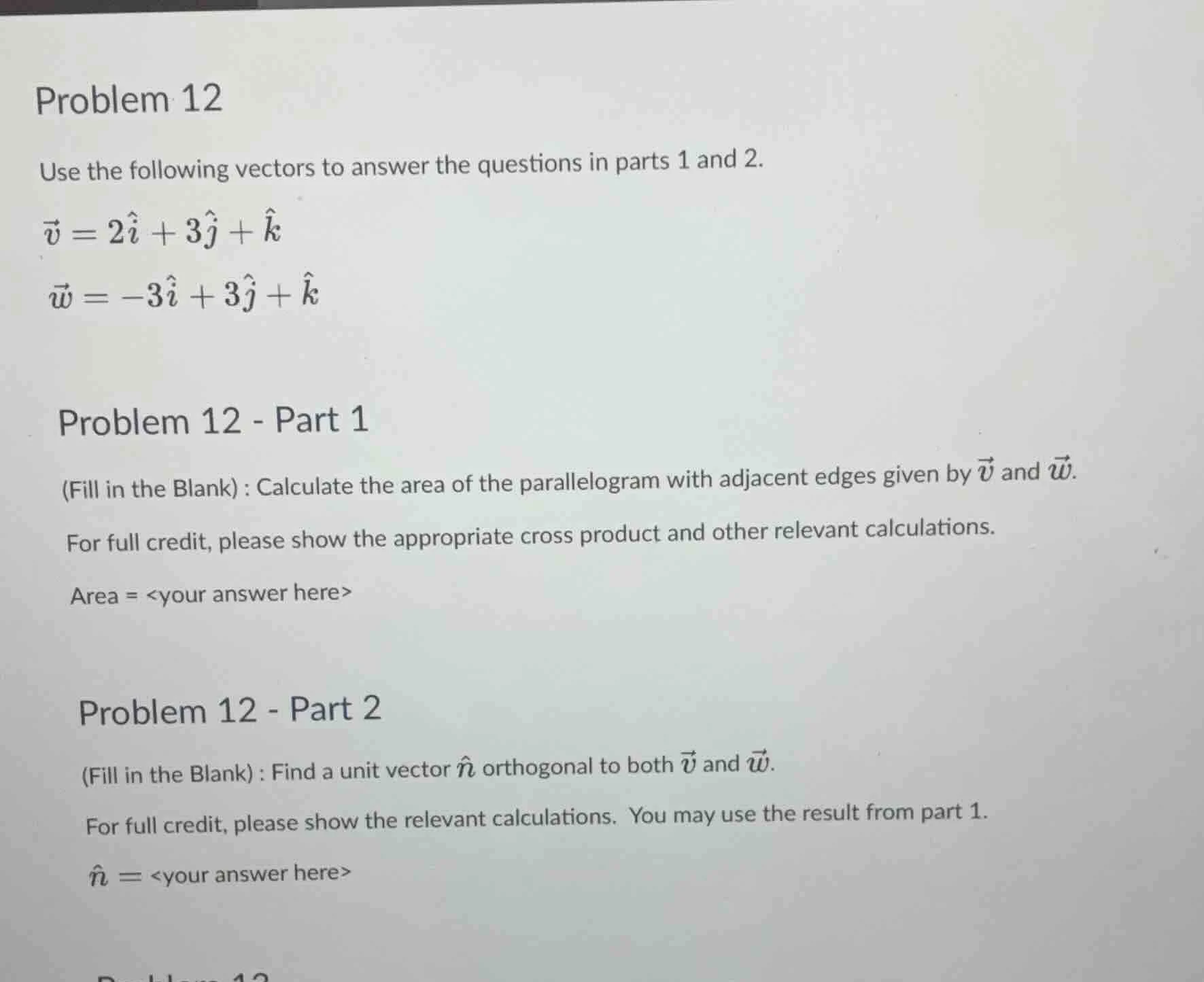
use the following vectors to answer the questions in parts 1 and 2.
\\(\vec{v} = 2\hat{i} + 3\hat{j} + \hat{k}\\)
\\(\vec{w} = -3\hat{i} + 3\hat{j} + \hat{k}\\)
problem 12 - part 1
(fill in the blank) : calculate the area of the parallelogram with adjacent edges given by \\(\vec{v}\\) and \\(\vec{w}\\).
for full credit, please show the appropriate cross product and other relevant calculations.
area = <your answer here>
problem 12 - part 2
(fill in the blank) : find a unit vector \\(\hat{n}\\) orthogonal to both \\(\vec{v}\\) and \\(\vec{w}\\).
for full credit, please show the relevant calculations. you may use the result from part 1.
\\(\hat{n} = \\) <your answer here>
Step1: Compute cross product $\vec{v} \times \vec{w}$
Step2: Calculate magnitude for area
Step3: Find unit vector for Part 2
(Note: $-\hat{n}$ is also a valid orthogonal unit vector)

Snap & solve any problem in the app
Get step-by-step solutions on Sovi AI
Photo-based solutions with guided steps
Explore more problems and detailed explanations
Part 1: $5\sqrt{10}$
Part 2: $-\frac{1}{\sqrt{10}}\hat{j} + \frac{3}{\sqrt{10}}\hat{k}$ (or $\frac{1}{\sqrt{10}}\hat{j} - \frac{3}{\sqrt{10}}\hat{k}$)