QUESTION IMAGE
Question
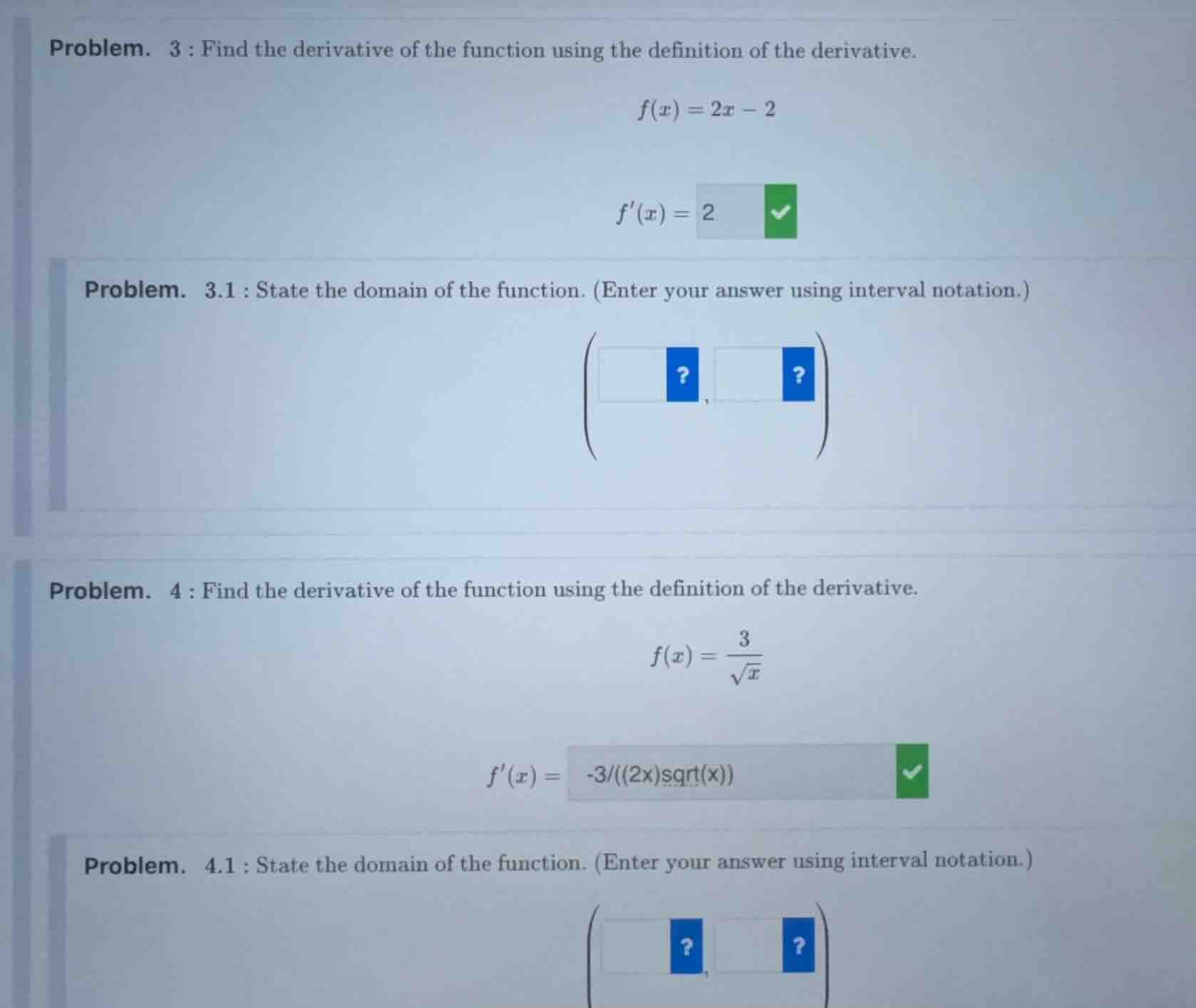
problem. 3 : find the derivative of the function using the definition of the derivative.
$f(x) = 2x - 2$
$f(x) = 2$
problem. 3.1 : state the domain of the function. (enter your answer using interval notation.)
(?, ?)
problem. 4 : find the derivative of the function using the definition of the derivative.
$f(x) = \frac{3}{\sqrt{x}}$
$f(x) = -3/((2x)sqrt(x))$
problem. 4.1 : state the domain of the function. (enter your answer using interval notation.)
(?, ?)
Problem 3.1
Step1: Analyze the function type
The function \( f(x) = 2x - 2 \) is a linear function (in the form \( y = mx + b \), where \( m = 2 \) and \( b = -2 \)). For linear functions (and all polynomial functions, which linear functions are a subset of), there are no restrictions on the input \( x \) from the function's form itself (no division by zero, no square roots of negative numbers, etc.).
Step2: Determine the domain
Since \( x \) can be any real number, the domain in interval notation is all real numbers, which is written as \( (-\infty, \infty) \).
Step1: Analyze the function's restrictions
The function \( f(x) = \frac{3}{\sqrt{x}} \) has two types of restrictions to consider for its domain:
- The expression under the square root (the radicand) must be non - negative, so \( x\geq0 \).
- We cannot have division by zero, so \( \sqrt{x}
eq0 \), which implies \( x
eq0 \).
Combining these two conditions, we get that \( x > 0 \).
Step2: Write the domain in interval notation
The interval notation for all real numbers greater than 0 is \( (0, \infty) \).

Snap & solve any problem in the app
Get step-by-step solutions on Sovi AI
Photo-based solutions with guided steps
Explore more problems and detailed explanations
\( (-\infty, \infty) \)