QUESTION IMAGE
Question
problem 3
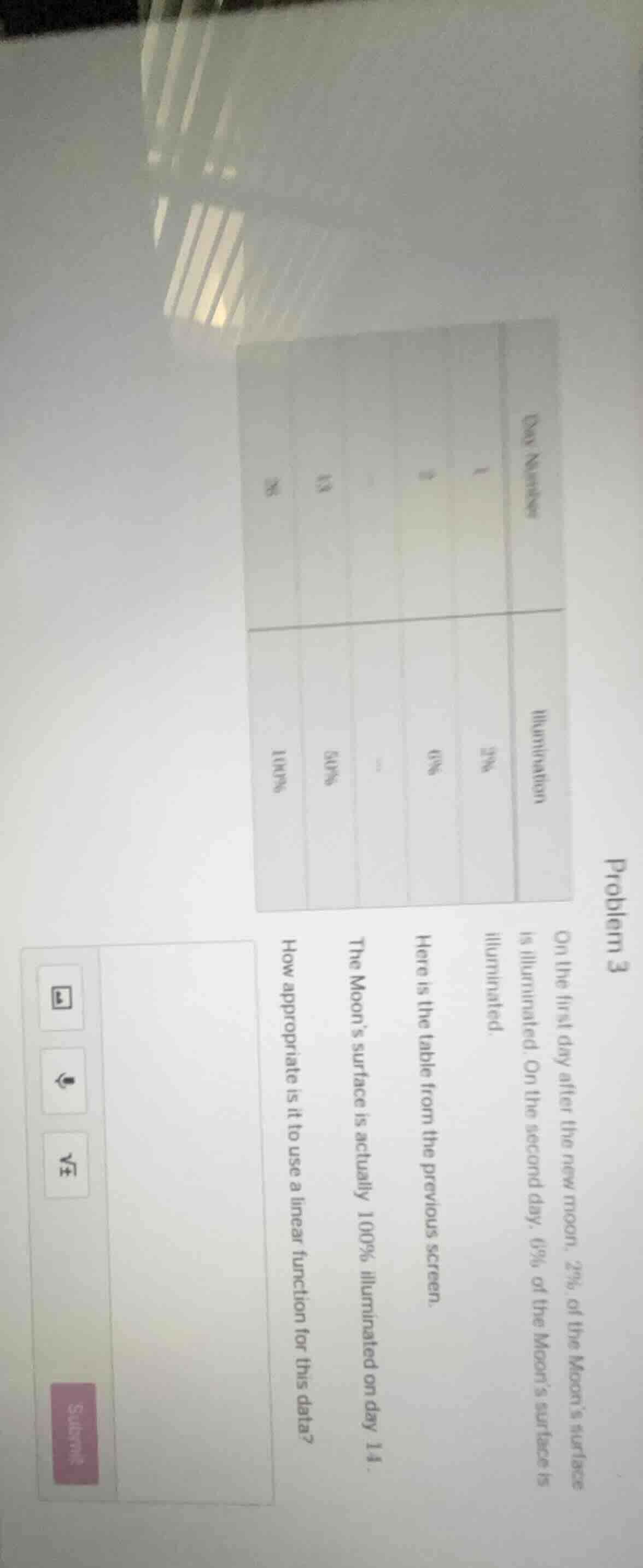
on the first day after the new moon, 2% of the moon’s surface is illuminated. on the second day, 6% of the moon’s surface is illuminated.
here is the table from the previous screen.
the moon’s surface is actually 100% illuminated on day 14.
how appropriate is it to use a linear function for this data?
Step1: Analyze the data trend
The data points are: Day 1 (2%), Day 8 (47%), Day 14 (50%? Wait, no, the table says Day 14? Wait, the text says "The Moon’s surface is actually 100% illuminated on day 14"? Wait, maybe the table has Day 1 (2%), Day 8 (47%), Day 13 (50%? No, the table shows Day 1: 2%, Day 8: 47%, Day 13: 50%? Wait, no, the user's table: Day Number 1, 8, 13, 28; Illumination 2%, 47%, 50%? Wait, no, the text says "On the first day after the new moon, 2% of the Moon’s surface is illuminated. On the second day, 0%? Wait, no, the table: Day 1: 2%, Day 8: 47%, Day 13: 50%? Wait, maybe the actual data: Let's check the linearity. Let's assume the days and illuminations: Day 1: 2%, Day 8: 47%, Day 13: 50%? Wait, no, the text says "The Moon’s surface is actually 100% illuminated on day 14". Wait, maybe the table is Day 1: 2%, Day 8: 47%, Day 13: 50%? No, maybe the table is Day 1: 2%, Day 8: 47%, Day 13: 50%? Wait, no, let's calculate the slope between Day 1 (x=1, y=2) and Day 8 (x=8, y=47). Slope $m = \frac{47 - 2}{8 - 1} = \frac{45}{7} \approx 6.43$. Then between Day 8 (x=8, y=47) and Day 13 (x=13, y=50): slope $m = \frac{50 - 47}{13 - 8} = \frac{3}{5} = 0.6$. Between Day 13 (x=13, y=50) and Day 28 (x=28, y=100): slope $m = \frac{100 - 50}{28 - 13} = \frac{50}{15} \approx 3.33$. The slopes are not constant (6.43, 0.6, 3.33), so the data is not linear. Also, the actual moon illumination follows a lunar cycle, which is approximately sinusoidal (since the moon's phases are due to the orbital motion, which is periodic, so the illumination is a periodic function, not linear). So a linear function would not be appropriate because the moon's illumination follows a cyclic (sinusoidal) pattern, not a straight line. Also, the slopes between the data points are not constant, indicating non-linearity.
Step2: Conclusion on linear function appropriateness
A linear function assumes a constant rate of change (slope). But the moon's illumination is due to its orbital position, which follows a periodic (sinusoidal) pattern, not a linear one. Also, calculating the slopes between the given data points (Day 1 to 8: slope ~6.43, Day 8 to 13: slope 0.6, Day 13 to 28: slope ~3.33) shows varying slopes, so the rate of illumination change is not constant. Thus, a linear function is not appropriate.

Snap & solve any problem in the app
Get step-by-step solutions on Sovi AI
Photo-based solutions with guided steps
Explore more problems and detailed explanations
A linear function is not appropriate for this data. The moon’s illumination follows a periodic (sinusoidal) pattern due to its orbital motion, not a constant - rate (linear) change. Also, calculating the slopes between the given data points (e.g., from day 1 to 8, day 8 to 13, day 13 to 28) shows non - constant slopes, indicating the rate of illumination change is not linear.