QUESTION IMAGE
Question
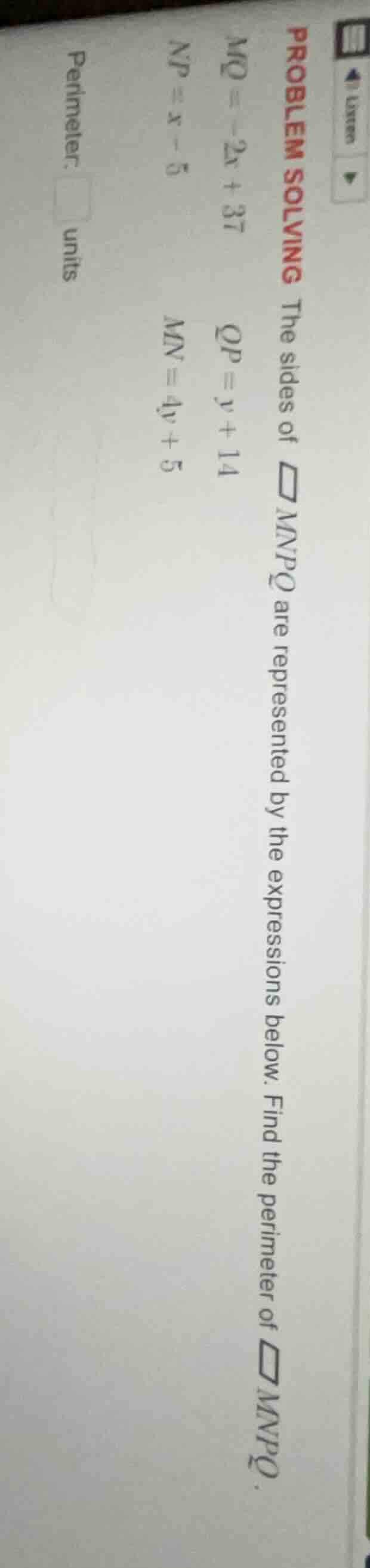
problem solving the sides of \\(\square mnpq\\) are represented by the expressions below. find the perimeter of \\(\square mnpq\\).\\(mq = -2x + 37\\)\\(np = x - 5\\)\\(qp = y + 14\\)\\(mn = 4y + 5\\)perimeter: \\(\square\\) units
Step1: Recall properties of parallelogram
In a parallelogram, opposite sides are equal. So, \( MQ = NP \) and \( QP = MN \).
First, solve for \( x \) using \( MQ = NP \):
\( -2x + 37 = x - 5 \)
Add \( 2x \) to both sides: \( 37 = 3x - 5 \)
Add \( 5 \) to both sides: \( 42 = 3x \)
Divide by \( 3 \): \( x = 14 \)
Then, solve for \( y \) using \( QP = MN \):
\( y + 14 = 4y + 5 \)
Subtract \( y \) from both sides: \( 14 = 3y + 5 \)
Subtract \( 5 \) from both sides: \( 9 = 3y \)
Divide by \( 3 \): \( y = 3 \)
Step2: Find lengths of sides
Find \( MQ \) (and \( NP \)): Substitute \( x = 14 \) into \( MQ = -2x + 37 \)
\( MQ = -2(14) + 37 = -28 + 37 = 9 \), so \( NP = 9 \)
Find \( QP \) (and \( MN \)): Substitute \( y = 3 \) into \( QP = y + 14 \)
\( QP = 3 + 14 = 17 \), so \( MN = 17 \)
Step3: Calculate perimeter of parallelogram
Perimeter of a parallelogram is \( 2\times ( \text{sum of adjacent sides} ) \). So, \( P = 2(MQ + QP) \)
Substitute \( MQ = 9 \) and \( QP = 17 \):
\( P = 2(9 + 17) = 2(26) = 52 \)

Snap & solve any problem in the app
Get step-by-step solutions on Sovi AI
Photo-based solutions with guided steps
Explore more problems and detailed explanations
52