QUESTION IMAGE
Question
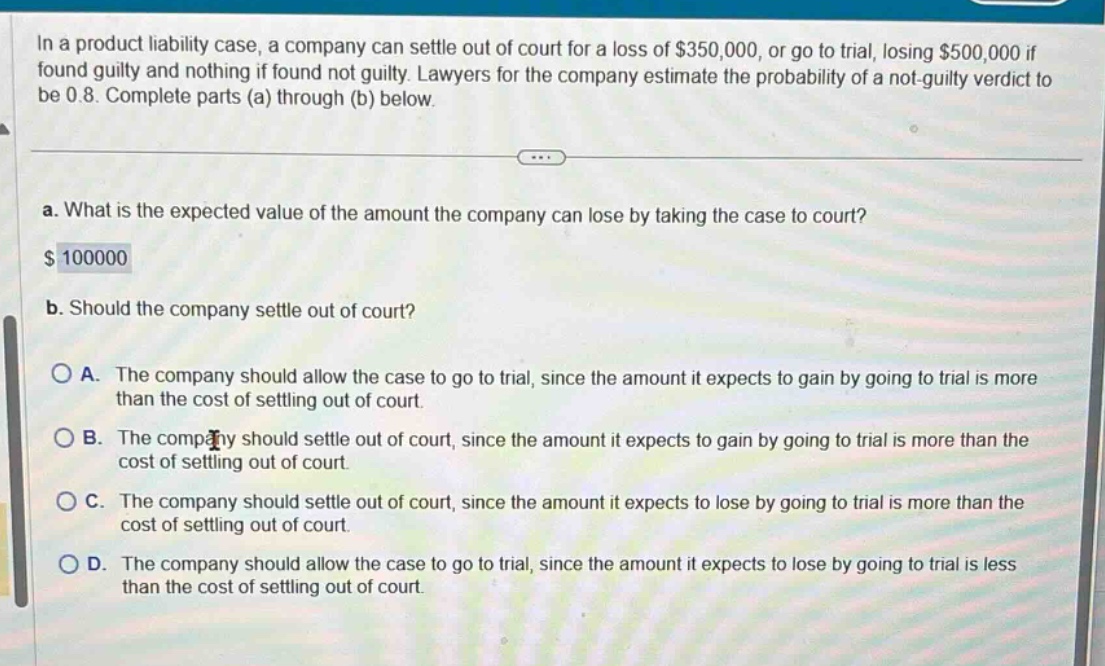
in a product liability case, a company can settle out of court for a loss of $350,000, or go to trial, losing $500,000 if found guilty and nothing if found not guilty. lawyers for the company estimate the probability of a not - guilty verdict to be 0.8. complete parts (a) through (b) below.
a. what is the expected value of the amount the company can lose by taking the case to court?
$ 100000
b. should the company settle out of court?
a. the company should allow the case to go to trial, since the amount it expects to gain by going to trial is more than the cost of settling out of court.
b. the company should settle out of court, since the amount it expects to gain by going to trial is more than the cost of settling out of court.
c. the company should settle out of court, since the amount it expects to lose by going to trial is more than the cost of settling out of court.
d. the company should allow the case to go to trial, since the amount it expects to lose by going to trial is less than the cost of settling out of court.
Part (a)
Step1: Define the outcomes and probabilities
The two possible outcomes when going to trial: not - guilty (probability \(P(\text{not - guilty}) = 0.8\)) with loss \(0\) dollars, and guilty (probability \(P(\text{guilty})=1 - 0.8 = 0.2\)) with loss \(500000\) dollars.
Step2: Use the expected - value formula
The expected value \(E(X)\) of a discrete random variable is given by \(E(X)=\sum_{i}x_{i}P(x_{i})\), where \(x_{i}\) are the possible values and \(P(x_{i})\) are their corresponding probabilities.
For this case, \(E(X)=(0\times0.8)+(500000\times0.2)\)
\(E(X)=0 + 100000\)
The cost of settling out of court is \(\$350000\), and the expected loss by going to trial is \(\$100000\). Since \(100000<350000\), the amount the company expects to lose by going to trial is less than the cost of settling out of court. So the company should allow the case to go to trial.

Snap & solve any problem in the app
Get step-by-step solutions on Sovi AI
Photo-based solutions with guided steps
Explore more problems and detailed explanations
\(100000\)