QUESTION IMAGE
Question
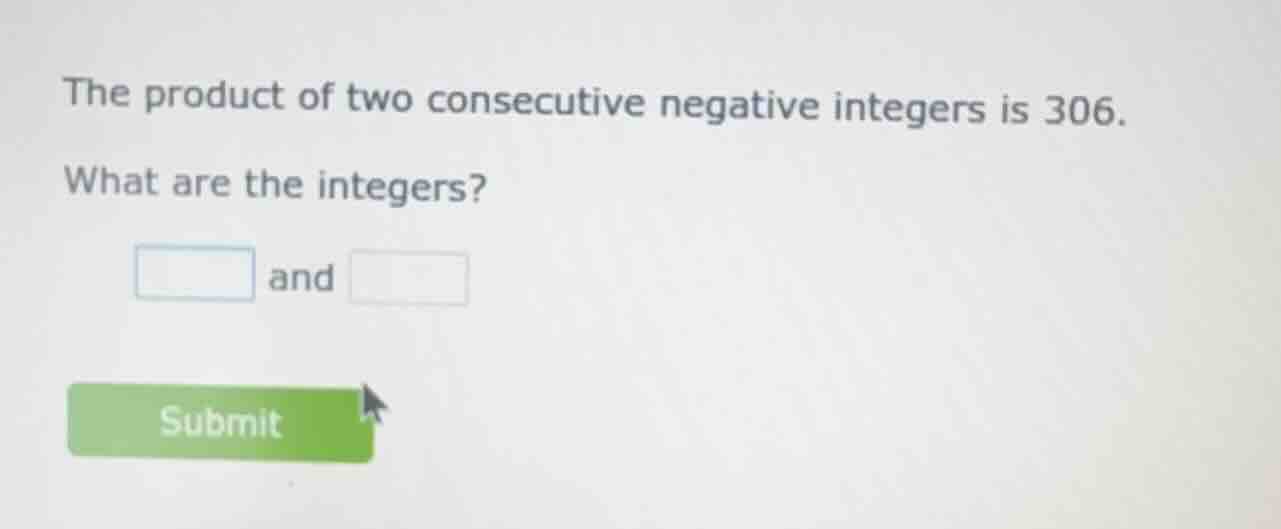
the product of two consecutive negative integers is 306. what are the integers? and submit
Step1: Define variables
Let the first negative integer be \( x \), then the next consecutive negative integer is \( x + 1 \) (since consecutive integers differ by 1). But since they are negative, we can also think of them as \( -n \) and \( -n + 1 \) where \( n \) is a positive integer, but maybe it's easier to let the first integer be \( x \) (negative) and the second be \( x + 1 \) (also negative, so \( x+1<0 \) implies \( x < - 1\)). The product of the two integers is 306, so we have the equation:
\( x(x + 1)=306 \)
Step2: Rearrange into quadratic equation
Expanding the left side: \( x^{2}+x = 306 \)
Subtract 306 from both sides to set the equation to zero: \( x^{2}+x - 306=0 \)
Step3: Factor the quadratic equation
We need two numbers that multiply to - 306 and add up to 1. Let's factor 306: \( 306 = 2\times3\times3\times17 \). We need two numbers \( a \) and \( b \) such that \( a\times b=-306 \) and \( a + b = 1 \). Let's try 18 and - 17: \( 18\times(- 17)=-306 \) and \( 18+( - 17)=1 \). So we can factor the quadratic as:
\( (x + 18)(x - 17)=0 \)
Step4: Solve for x
Setting each factor equal to zero:
- \( x+18 = 0\) gives \( x=-18 \)
- \( x - 17=0\) gives \( x = 17 \)
But we are looking for negative integers, so we discard \( x = 17 \). So \( x=-18 \), and the next consecutive negative integer is \( x + 1=-18 + 1=-17 \)
We can check: \( (-18)\times(-17)=306 \), which is correct.

Snap & solve any problem in the app
Get step-by-step solutions on Sovi AI
Photo-based solutions with guided steps
Explore more problems and detailed explanations
-18 and -17