QUESTION IMAGE
Question
professor donald liu
dept. applied
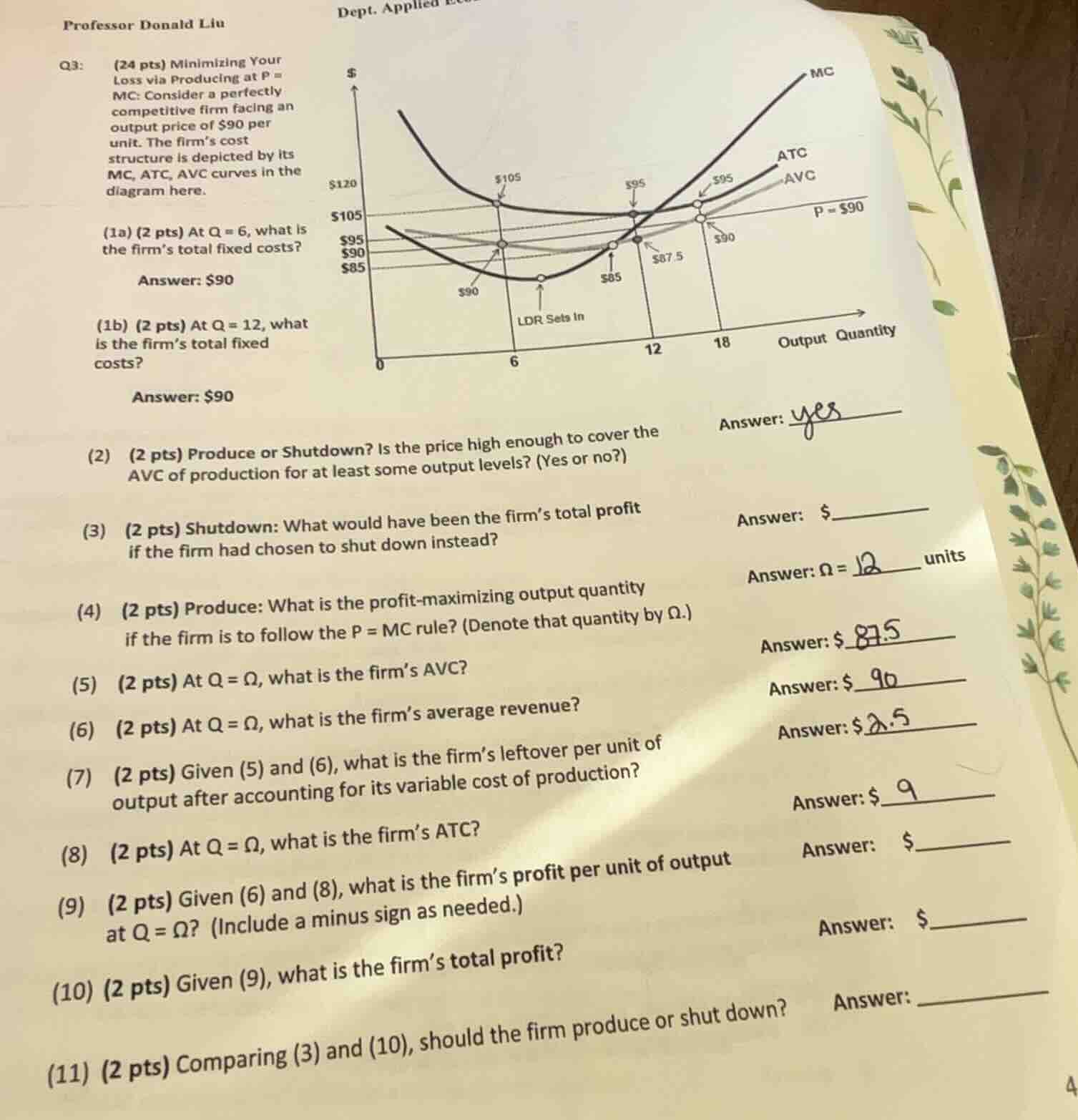
q3: (24 pts) minimizing your
loss via producing at p =
mc: consider a perfectly
competitive firm facing an
output price of $90 per
unit. the firm’s cost
structure is depicted by its
mc, atc, avc curves in the
diagram here.
(1a) (2 pts) at q = 6, what is
the firm’s total fixed costs?
answer: $90
(1b) (2 pts) at q = 12, what
is the firm’s total fixed
costs?
answer: $90
(2) (2 pts) produce or shutdown? is the price high enough to cover the
avc of production for at least some output levels? (yes or no?)
answer:
(3) (2 pts) shutdown: what would have been the firm’s total profit
if the firm had chosen to shut down instead?
answer: $
(4) (2 pts) produce: what is the profit - maximizing output quantity
if the firm is to follow the p = mc rule? (denote that quantity by ω.)
answer: ω = units
(5) (2 pts) at q = ω, what is the firm’s avc?
answer: $
(6) (2 pts) at q = ω, what is the firm’s average revenue?
answer: $
(7) (2 pts) given (5) and (6), what is the firm’s leftover per unit of
output after accounting for its variable cost of production?
answer: $
(8) (2 pts) at q = ω, what is the firm’s atc?
answer: $
(9) (2 pts) given (6) and (8), what is the firm’s profit per unit of output
at q = ω? (include a minus sign as needed.)
answer: $
(10) (2 pts) given (9), what is the firm’s total profit?
answer: $
(11) (2 pts) comparing (3) and (10), should the firm produce or shut down?
answer:
the diagram has mc, atc, avc curves, with price p = $90, and output quantity on the x - axis, price on the y - axis, with some marked points like at q = 6, 12, 18 with corresponding price values like $105, $95, $90 etc.
(3) Shutdown: What would have been the firm’s total profit if the firm had chosen to shut down instead?
Step1: Recall shutdown profit
When a firm shuts down, it produces \( Q = 0 \). Total revenue (\( TR \)) is \( P \times Q = 90 \times 0 = 0 \). Total fixed cost (\( TFC \)) is still incurred, and total variable cost (\( TVC \)) is \( 0 \) (since no production). From part (1a), \( TFC = 90 \). So total cost (\( TC \)) = \( TFC + TVC = 90 + 0 = 90 \). Profit is \( TR - TC = 0 - 90 = -90 \).
Step1: Find \( P = MC \) quantity
In perfect competition, profit - maximization occurs where \( P = MC \). The price \( P=\$90 \). Looking at the graph, we find the quantity where \( MC = 90 \). From the diagram, when \( P = 90 \), the quantity \( \Omega \) (where \( P = MC \)) is 12 units (by looking at the intersection of \( P = 90 \) and \( MC \) curve and the corresponding quantity on the x - axis).
Step1: Read AVC at \( Q = 12 \)
From the graph, at \( Q = 12 \), the AVC (Average Variable Cost) is given as \( \$87.5 \) (by looking at the AVC curve at \( Q = 12 \)).

Snap & solve any problem in the app
Get step-by-step solutions on Sovi AI
Photo-based solutions with guided steps
Explore more problems and detailed explanations
\(-90\)