QUESTION IMAGE
Question
prompt background
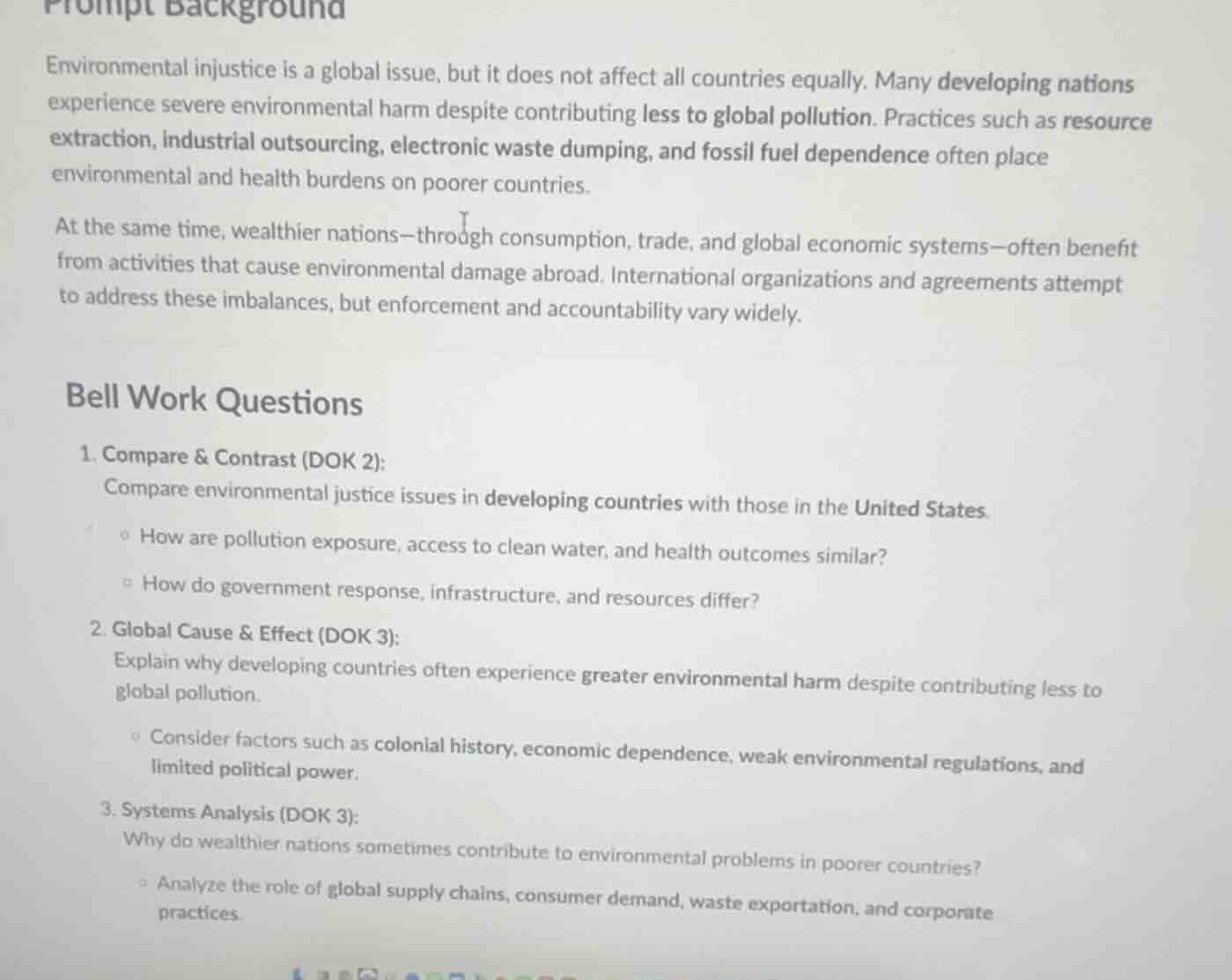
environmental injustice is a global issue, but it does not affect all countries equally. many developing nations experience severe environmental harm despite contributing less to global pollution. practices such as resource extraction, industrial outsourcing, electronic waste dumping, and fossil fuel dependence often place environmental and health burdens on poorer countries.
at the same time, wealthier nations—through consumption, trade, and global economic systems—often benefit from activities that cause environmental damage abroad. international organizations and agreements attempt to address these imbalances, but enforcement and accountability vary widely.
bell work questions
- compare & contrast (dok 2):
compare environmental justice issues in developing countries with those in the united states.
- how are pollution exposure, access to clean water, and health outcomes similar?
- how do government response, infrastructure, and resources differ?
- global cause & effect (dok 3):
explain why developing countries often experience greater environmental harm despite contributing less to global pollution.
- consider factors such as colonial history, economic dependence, weak environmental regulations, and limited political power.
- systems analysis (dok 3):
why do wealthier nations sometimes contribute to environmental problems in poorer countries?
- analyze the role of global supply chains, consumer demand, waste exportation, and corporate practices.
Sub - Question 1: Compare & Contrast
Similarities (Pollution Exposure, Clean Water, Health Outcomes)
- Pollution Exposure: In both developing countries and the US, marginalized communities (e.g., low - income neighborhoods in the US, rural or slum areas in developing countries) often face higher pollution exposure. For example, in the US, areas near industrial zones with minority populations may have high levels of air pollution. In developing countries, areas near industrial outsourcing sites or resource extraction areas also have poor air quality.
- Access to Clean Water: In both, there are disparities. In the US, some rural or low - income urban areas may have issues with clean water access (e.g., Flint, Michigan water crisis). In developing countries, many rural and urban slum areas lack access to clean water due to poor infrastructure.
- Health Outcomes: Exposure to pollution and lack of clean water can lead to respiratory diseases, water - borne illnesses, etc. in both. For instance, children in polluted areas in both contexts may be at risk of asthma (from air pollution) or diarrhea (from unclean water).
Differences (Government Response, Infrastructure, Resources)
- Government Response: The US has more established environmental regulatory agencies (e.g., EPA) with more resources for enforcement. Developing countries often have weaker regulatory frameworks due to limited funding and political will. For example, the US can impose strict emissions standards on industries, while a developing country may lack the capacity to monitor and enforce such standards.
- Infrastructure: The US has a more developed infrastructure for waste management, water treatment, and pollution control. Developing countries often have inadequate infrastructure, like open sewage systems and lack of proper waste disposal facilities.
- Resources: The US has more financial and technological resources to address environmental issues, such as advanced water treatment technologies. Developing countries struggle with limited resources, relying more on international aid for environmental projects.
Sub - Question 2: Global Cause & Effect
- Colonial History: Many developing countries were colonized, and colonial powers exploited their natural resources, leaving them with degraded environments and a lack of capacity to manage resources sustainably. For example, colonizers in Africa extracted minerals without concern for environmental restoration.
- Economic Dependence: Developing countries often depend on exporting raw materials or engaging in industrial outsourcing (due to low labor costs) to wealthier nations. This economic dependence forces them to prioritize economic growth over environmental protection. For instance, a country may allow unregulated resource extraction to earn foreign currency.
- Weak Environmental Regulations: Due to limited resources and political pressure from industries (often foreign - owned or linked to foreign markets), developing countries have weak environmental regulations. This allows industries to pollute more freely.
- Limited Political Power: In global environmental agreements, developing countries have less political power. They are often at the mercy of wealthier nations' decisions, which may not prioritize their environmental concerns. For example, in climate change negotiations, developing countries' demands for financial and technological support for environmental protection are often not fully met.
Sub - Question 3: Systems Analysis
- Global Supply Chains: W…

Snap & solve any problem in the app
Get step-by-step solutions on Sovi AI
Photo-based solutions with guided steps
Explore more problems and detailed explanations
Sub - Question 1: Compare & Contrast
Similarities (Pollution Exposure, Clean Water, Health Outcomes)
- Pollution Exposure: In both developing countries and the US, marginalized communities (e.g., low - income neighborhoods in the US, rural or slum areas in developing countries) often face higher pollution exposure. For example, in the US, areas near industrial zones with minority populations may have high levels of air pollution. In developing countries, areas near industrial outsourcing sites or resource extraction areas also have poor air quality.
- Access to Clean Water: In both, there are disparities. In the US, some rural or low - income urban areas may have issues with clean water access (e.g., Flint, Michigan water crisis). In developing countries, many rural and urban slum areas lack access to clean water due to poor infrastructure.
- Health Outcomes: Exposure to pollution and lack of clean water can lead to respiratory diseases, water - borne illnesses, etc. in both. For instance, children in polluted areas in both contexts may be at risk of asthma (from air pollution) or diarrhea (from unclean water).
Differences (Government Response, Infrastructure, Resources)
- Government Response: The US has more established environmental regulatory agencies (e.g., EPA) with more resources for enforcement. Developing countries often have weaker regulatory frameworks due to limited funding and political will. For example, the US can impose strict emissions standards on industries, while a developing country may lack the capacity to monitor and enforce such standards.
- Infrastructure: The US has a more developed infrastructure for waste management, water treatment, and pollution control. Developing countries often have inadequate infrastructure, like open sewage systems and lack of proper waste disposal facilities.
- Resources: The US has more financial and technological resources to address environmental issues, such as advanced water treatment technologies. Developing countries struggle with limited resources, relying more on international aid for environmental projects.
Sub - Question 2: Global Cause & Effect
- Colonial History: Many developing countries were colonized, and colonial powers exploited their natural resources, leaving them with degraded environments and a lack of capacity to manage resources sustainably. For example, colonizers in Africa extracted minerals without concern for environmental restoration.
- Economic Dependence: Developing countries often depend on exporting raw materials or engaging in industrial outsourcing (due to low labor costs) to wealthier nations. This economic dependence forces them to prioritize economic growth over environmental protection. For instance, a country may allow unregulated resource extraction to earn foreign currency.
- Weak Environmental Regulations: Due to limited resources and political pressure from industries (often foreign - owned or linked to foreign markets), developing countries have weak environmental regulations. This allows industries to pollute more freely.
- Limited Political Power: In global environmental agreements, developing countries have less political power. They are often at the mercy of wealthier nations' decisions, which may not prioritize their environmental concerns. For example, in climate change negotiations, developing countries' demands for financial and technological support for environmental protection are often not fully met.
Sub - Question 3: Systems Analysis
- Global Supply Chains: Wealthier nations' consumer demand drives global supply chains. For example, the demand for cheap clothing in the US leads to textile factories in developing countries with poor environmental practices (e.g., water pollution from dyeing processes) to meet production needs.
- Consumer Demand: Consumers in wealthier nations want low - cost products, which encourages corporations to outsource production to developing countries with lax environmental regulations. This leads to environmental degradation in those countries as industries prioritize cost - cutting over environmental protection.
- Waste Exportation: Wealthier nations often export electronic and other waste to developing countries. These countries lack proper waste management facilities, so the waste is dumped, polluting land, water, and air. For example, electronic waste from Europe is often sent to Ghana, where it is burned, releasing toxic chemicals.
- Corporate Practices: Multinational corporations often take advantage of weak environmental regulations in developing countries. They set up polluting industries (e.g., textile, electronics manufacturing) with little regard for the local environment, as they can operate at lower costs there.