QUESTION IMAGE
Question
prompt
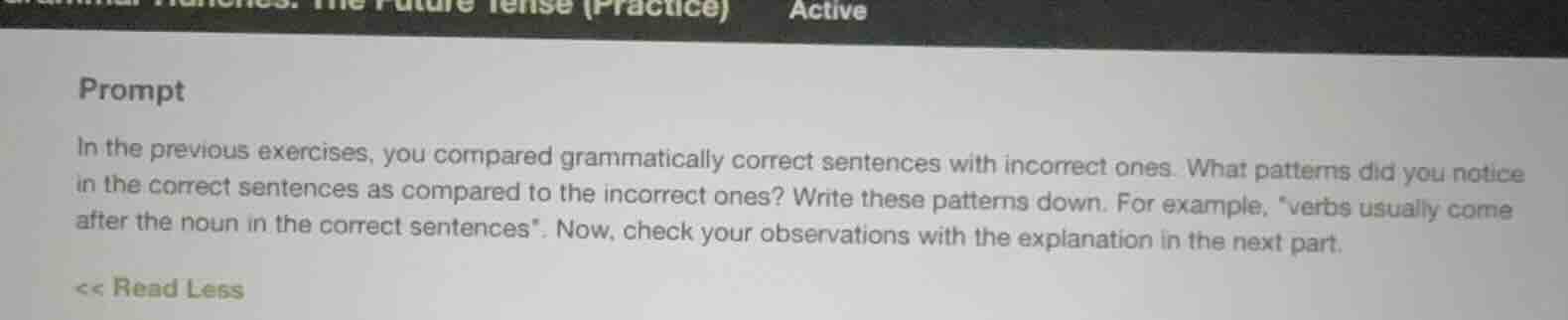
in the previous exercises, you compared grammatically correct sentences with incorrect ones. what patterns did you notice in the correct sentences as compared to the incorrect ones? write these patterns down. for example, \verbs usually come after the noun in the correct sentences\. now, check your observations with the explanation in the next part.
This problem is about identifying patterns in grammatically correct sentences (specifically future tense, from the title) compared to incorrect ones. In language - related studies (under Arts, subfield Linguistics or Grammar - related subfields like Syntax), common patterns in correct future - tense sentences (assuming the context is future - tense grammar practice) could be:
- For simple future (using "will"), the structure is usually "Subject + will + base form of verb + (object/other elements)". For example, "I will go to school" is correct, while "I go will to school" is incorrect.
- In the case of "be going to" for future tense, the correct structure is "Subject + am/is/are + going to + base form of verb + (object/other elements)". Like "She is going to play football" is correct, and "She going to is play football" is incorrect.
- Subject - verb agreement in future - tense structures: If the subject is singular (e.g., "He"), the appropriate form of "be" (in "be going to") is "is", and for plural subjects (e.g., "They"), it's "are". Incorrect sentences might have mismatches like "He are going to...".
- In correct future - tense sentences, auxiliary verbs ("will", "be" in "be going to") are placed before the main verb (in base form), while incorrect sentences often misplace these auxiliary verbs.

Snap & solve any problem in the app
Get step-by-step solutions on Sovi AI
Photo-based solutions with guided steps
Explore more problems and detailed explanations
Some patterns in correct future - tense (assuming the context) sentences compared to incorrect ones are:
- In "will" - based future tense, the structure is "Subject + will + base - form - verb + (other elements)" (e.g., "I will study" is correct; "I study will" is incorrect).
- In "be going to" - based future tense, the structure is "Subject + am/is/are + going to + base - form - verb + (other elements)" (e.g., "We are going to travel" is correct; "We going to are travel" is incorrect).
- Subject - verb agreement is maintained in auxiliary verbs (e.g., "He is going to..." not "He are going to...").
- Auxiliary verbs (like "will", "be" in "be going to") are placed before the main verb (in base form) in correct sentences, while incorrect sentences misplace them.