QUESTION IMAGE
Question
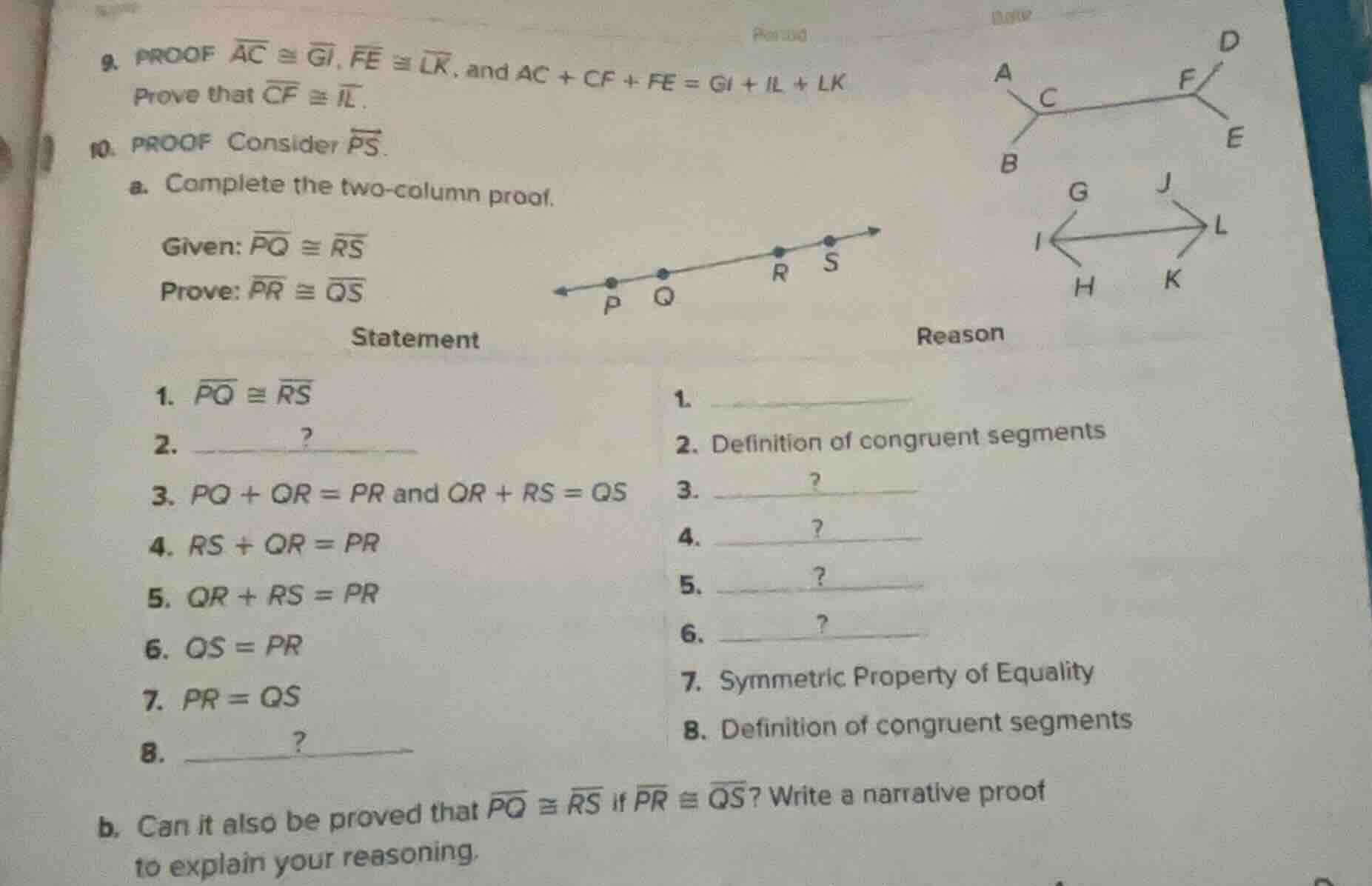
- proof $overline{ac} cong overline{gi}$, $overline{fe} cong overline{lk}$, and $ac + cf + fe = gi + il + lk$
prove that $overline{cf} cong overline{il}$.
- proof consider $overline{ps}$.
a. complete the two - column proof.
given: $overline{pq} cong overline{rs}$
prove: $overline{pr} cong overline{qs}$
| statement | reason |
|---|---|
| 2. ? | 2. definition of congruent segments |
| 3. $pq + qr = pr$ and $qr + rs = qs$ | 3. ? |
| 4. $rs + qr = pr$ | 4. ? |
| 5. $qr + rs = pr$ | 5. ? |
| 6. $qs = pr$ | 6. ? |
| 7. $pr = qs$ | 7. symmetric property of equality |
| 8. ? | 8. definition of congruent segments |
b. can it also be proved that $overline{pq} cong overline{rs}$ if $overline{pr} cong overline{qs}$? write a narrative proof to explain your reasoning.
Part 10a: Two - Column Proof
Step 1: Identify the given
The first statement is given as $\overline{PQ}\cong\overline{RS}$, so the reason for statement 1 is "Given".
Step 2: Use the definition of congruent segments
By the definition of congruent segments, if $\overline{PQ}\cong\overline{RS}$, then $PQ = RS$. So the statement for step 2 is $PQ=RS$.
Step 3: Identify the postulate for segment addition
The equations $PQ + QR=PR$ and $QR + RS = QS$ come from the Segment Addition Postulate, which states that if a point $Q$ is between $P$ and $R$, then $PQ+QR = PR$ (and similarly for $Q$, $R$, $S$). So the reason for step 3 is "Segment Addition Postulate".
Step 4: Substitute $PQ$ with $RS$
Since we know from step 2 that $PQ = RS$, we can substitute $PQ$ with $RS$ in the equation $PQ+QR = PR$. So we get $RS + QR=PR$. The reason for this step is "Substitution Property of Equality".
Step 5: Use the Commutative Property of Addition
The Commutative Property of Addition states that $a + b=b + a$. So $RS+QR = QR + RS$. So the reason for step 5 is "Commutative Property of Addition".
Step 6: Substitute and use transitive property
From step 3, we have $QR + RS=QS$, and from step 5 we have $QR + RS = PR$. By the Transitive Property of Equality (if $a = b$ and $b=c$, then $a = c$), we get $QS=PR$. The reason for step 6 is "Transitive Property of Equality".
Step 7: Symmetric Property of Equality
The Symmetric Property of Equality states that if $a = b$, then $b=a$. So from $QS = PR$, we get $PR = QS$.
Step 8: Use the definition of congruent segments
If $PR = QS$, then by the definition of congruent segments, $\overline{PR}\cong\overline{QS}$. So the statement for step 8 is $\overline{PR}\cong\overline{QS}$.
Filling in the two - column proof:
| Statement | Reason |
|---|---|
| 2. $PQ = RS$ | 2. Definition of congruent segments |
| 3. $PQ + QR=PR$ and $QR + RS = QS$ | 3. Segment Addition Postulate |
| 4. $RS + QR=PR$ | 4. Substitution Property of Equality |
| 5. $QR + RS=PR$ | 5. Commutative Property of Addition |
| 6. $QS = PR$ | 6. Transitive Property of Equality |
| 7. $PR = QS$ | 7. Symmetric Property of Equality |
| 8. $\overline{PR}\cong\overline{QS}$ | 8. Definition of congruent segments |
Part 10b: Narrative Proof
To prove that $\overline{PQ}\cong\overline{RS}$ given that $\overline{PR}\cong\overline{QS}$:
- Since $\overline{PR}\cong\overline{QS}$, by the definition of congruent segments, $PR = QS$.
- By the Segment Addition Postulate, we know that $PR=PQ + QR$ and $QS=QR + RS$.
- Substitute $PR$ and $QS$ in the equation $PR = QS$: $PQ+QR=QR + RS$.
- Subtract $QR$ from both sides of the equation $PQ + QR=QR + RS$. By the Subtraction Property of Equality (if $a + b=c + b$, then $a=c$), we get $PQ=RS$.
- Since $PQ = RS$, by the definition of congruent segments, $\overline{PQ}\cong\overline{RS}$.

Snap & solve any problem in the app
Get step-by-step solutions on Sovi AI
Photo-based solutions with guided steps
Explore more problems and detailed explanations
(10a two - column proof filled):
| Statement | Reason |
|---|---|
| 2. $PQ = RS$ | 2. Definition of congruent segments |
| 3. $PQ + QR=PR$ and $QR + RS = QS$ | 3. Segment Addition Postulate |
| 4. $RS + QR=PR$ | 4. Substitution Property of Equality |
| 5. $QR + RS=PR$ | 5. Commutative Property of Addition |
| 6. $QS=PR$ | 6. Transitive Property of Equality |
| 7. $PR = QS$ | 7. Symmetric Property of Equality |
| 8. $\overline{PR}\cong\overline{QS}$ | 8. Definition of congruent segments |