QUESTION IMAGE
Question
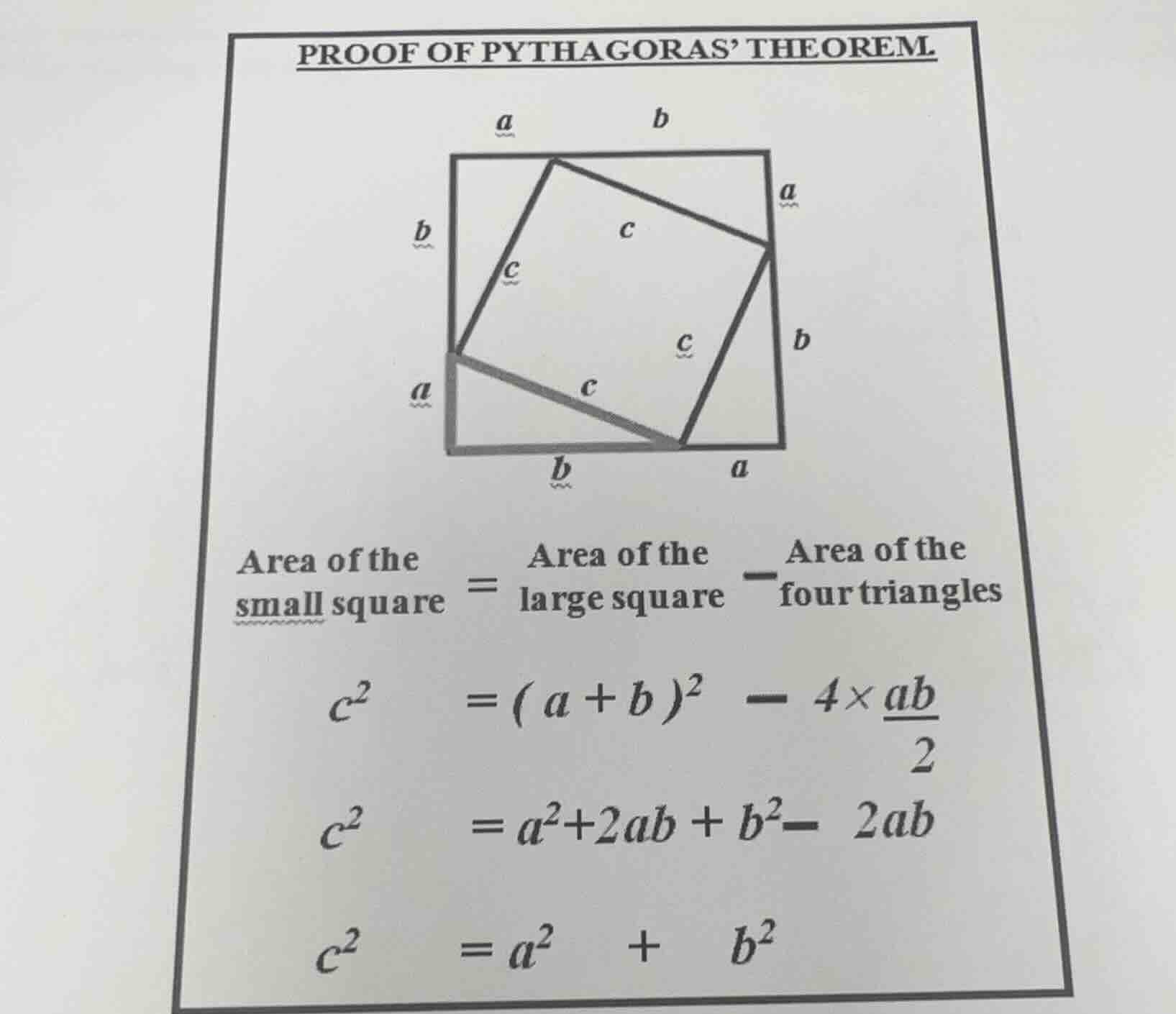
proof of pythagoras’ theorem
area of the small square = area of the large square − area of the four triangles
$c^2 = (a + b)^2 - 4 \times \frac{ab}{2}$
$c^2 = a^2 + 2ab + b^2 - 2ab$
$c^2 = a^2 + b^2$
Step1: Expand the square of sum
We know that \((a + b)^2\) can be expanded using the formula \((x + y)^2 = x^2 + 2xy + y^2\). Here \(x=a\) and \(y = b\), so \((a + b)^2=a^{2}+2ab + b^{2}\). And the area of four triangles is \(4\times\frac{ab}{2}=2ab\).
So the equation \(c^{2}=(a + b)^{2}-4\times\frac{ab}{2}\) becomes \(c^{2}=a^{2}+2ab + b^{2}-2ab\).
Step2: Simplify the equation
Simplify the right - hand side of the equation \(a^{2}+2ab + b^{2}-2ab\). The \(2ab\) and \(- 2ab\) terms cancel out, and we are left with \(a^{2}+b^{2}\). So we get \(c^{2}=a^{2}+b^{2}\), which proves the Pythagorean theorem.

Snap & solve any problem in the app
Get step-by-step solutions on Sovi AI
Photo-based solutions with guided steps
Explore more problems and detailed explanations
The proof shows that for a right - triangle with legs of length \(a\) and \(b\) and hypotenuse of length \(c\), \(c^{2}=a^{2}+b^{2}\) (Pythagorean theorem is proved).