QUESTION IMAGE
Question
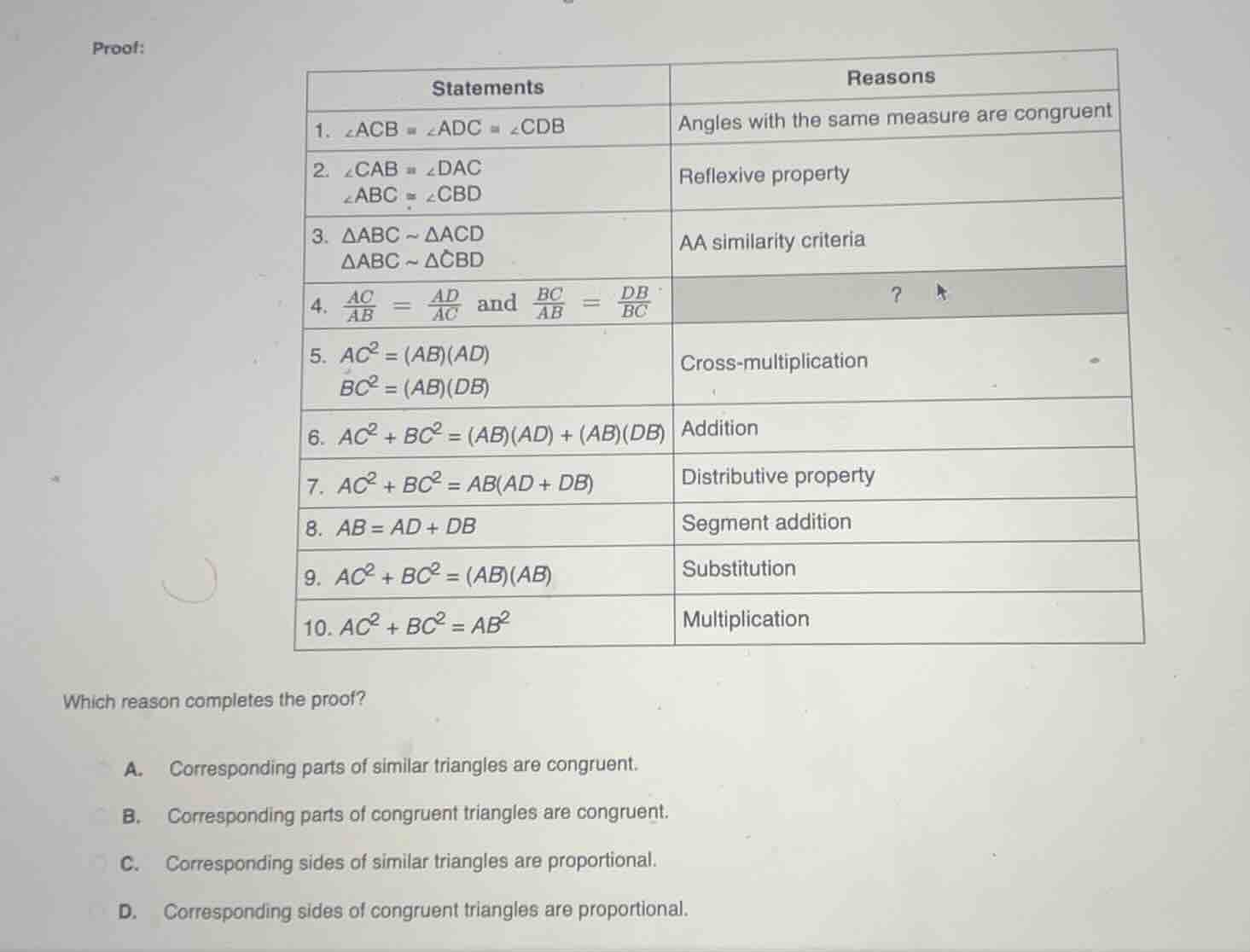
proof:
| statements | reasons |
|---|---|
| 2. $\angle cab \cong \angle dac$ <br> $\angle abc \cong \angle cbd$ | reflexive property |
| 3. $\triangle abc \sim \triangle acd$ <br> $\triangle abc \sim \triangle cbd$ | aa similarity criteria |
| 4. $\frac{ac}{ab} = \frac{ad}{ac}$ and $\frac{bc}{ab} = \frac{db}{bc}$ | ? |
| 5. $ac^2 = (ab)(ad)$ <br> $bc^2 = (ab)(db)$ | cross - multiplication |
| 6. $ac^2 + bc^2 = (ab)(ad)+(ab)(db)$ | addition |
| 7. $ac^2 + bc^2 = ab(ad + db)$ | distributive property |
| 8. $ab = ad + db$ | segment addition |
| 9. $ac^2 + bc^2 = (ab)(ab)$ | substitution |
| 10. $ac^2 + bc^2 = ab^2$ | multiplication |
which reason completes the proof?
a. corresponding parts of similar triangles are congruent.
b. corresponding parts of congruent triangles are congruent.
c. corresponding sides of similar triangles are proportional.
d. corresponding sides of congruent triangles are proportional.
Brief Explanations
Step 3 established that pairs of triangles are similar. The proportions in step 4 are ratios of corresponding sides of these similar triangles, which follows the core property of similar triangles regarding their side lengths.

Snap & solve any problem in the app
Get step-by-step solutions on Sovi AI
Photo-based solutions with guided steps
Explore more problems and detailed explanations
C. Corresponding sides of similar triangles are proportional.