QUESTION IMAGE
Question
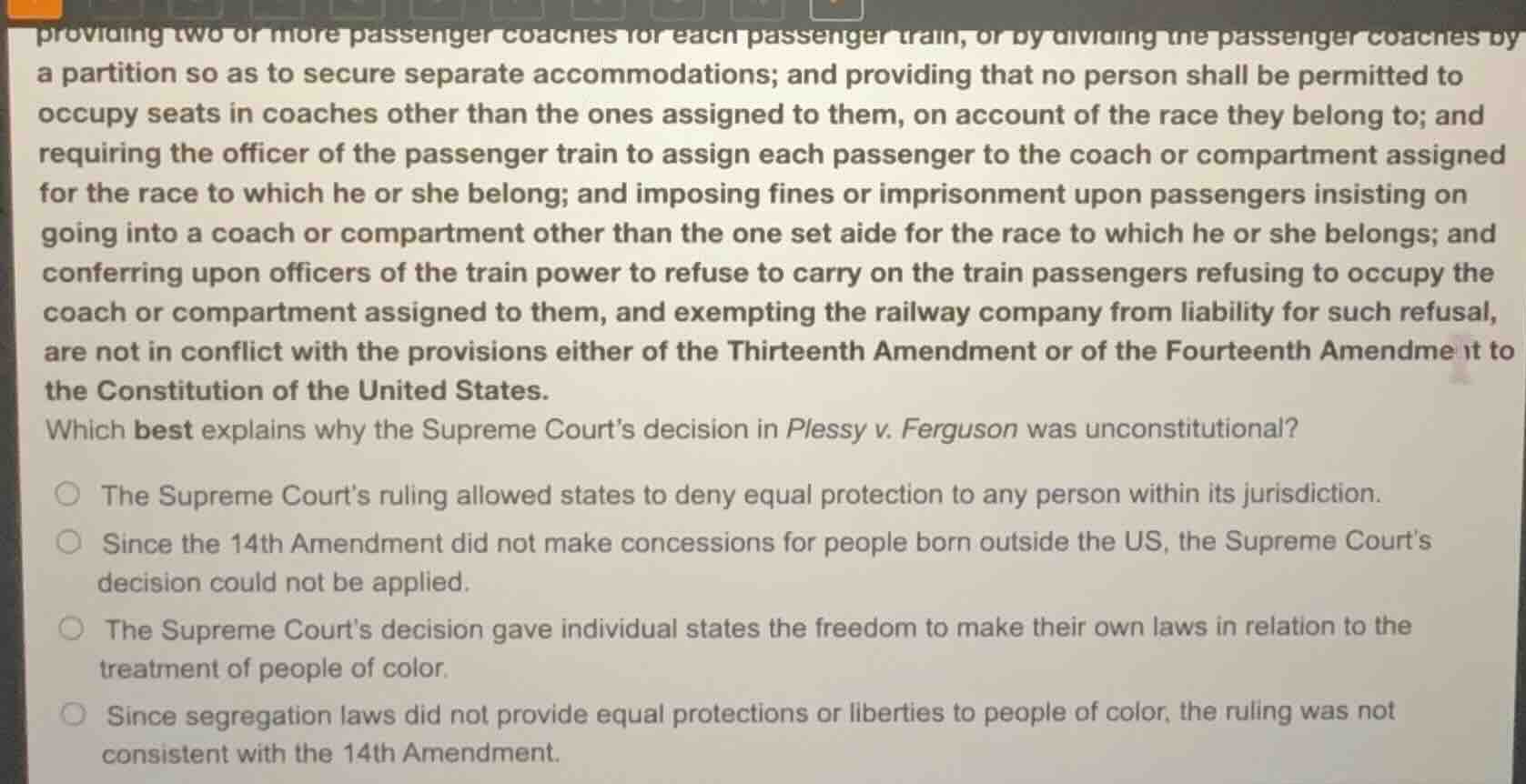
providing two or more passenger coaches for each passenger train, or by dividing the passenger coaches by a partition so as to secure separate accommodations; and providing that no person shall be permitted to occupy seats in coaches other than the ones assigned to them, on account of the race they belong to; and requiring the officer of the passenger train to assign each passenger to the coach or compartment assigned for the race to which he or she belong; and imposing fines or imprisonment upon passengers insisting on going into a coach or compartment other than the one set aide for the race to which he or she belongs; and conferring upon officers of the train power to refuse to carry on the train passengers refusing to occupy the coach or compartment assigned to them, and exempting the railway company from liability for such refusal, are not in conflict with the provisions either of the thirteenth amendment or of the fourteenth amendment to the constitution of the united states. which best explains why the supreme courts decision in plessy v. ferguson was unconstitutional? \\(\circ\\) the supreme courts ruling allowed states to deny equal protection to any person within its jurisdiction. \\(\circ\\) since the 14th amendment did not make concessions for people born outside the us, the supreme courts decision could not be applied. \\(\circ\\) the supreme courts decision gave individual states the freedom to make their own laws in relation to the treatment of people of color. \\(\circ\\) since segregation laws did not provide equal protections or liberties to people of color, the ruling was not consistent with the 14th amendment.
The 14th Amendment guarantees equal protection under the law to all persons in the U.S. The Plessy v. Ferguson ruling upheld "separate but equal" segregation, but in reality, segregated facilities never provided equal protections or liberties to Black Americans, violating the 14th Amendment's core requirement. The other options are incorrect: the first overstates the ruling's scope, the second is irrelevant as the 14th Amendment applies to all persons in U.S. jurisdiction, and the third misframes the issue (the problem is the unequal treatment, not state lawmaking freedom itself).

Snap & solve any problem in the app
Get step-by-step solutions on Sovi AI
Photo-based solutions with guided steps
Explore more problems and detailed explanations
D. Since segregation laws did not provide equal protections or liberties to people of color, the ruling was not consistent with the 14th Amendment.