QUESTION IMAGE
Question
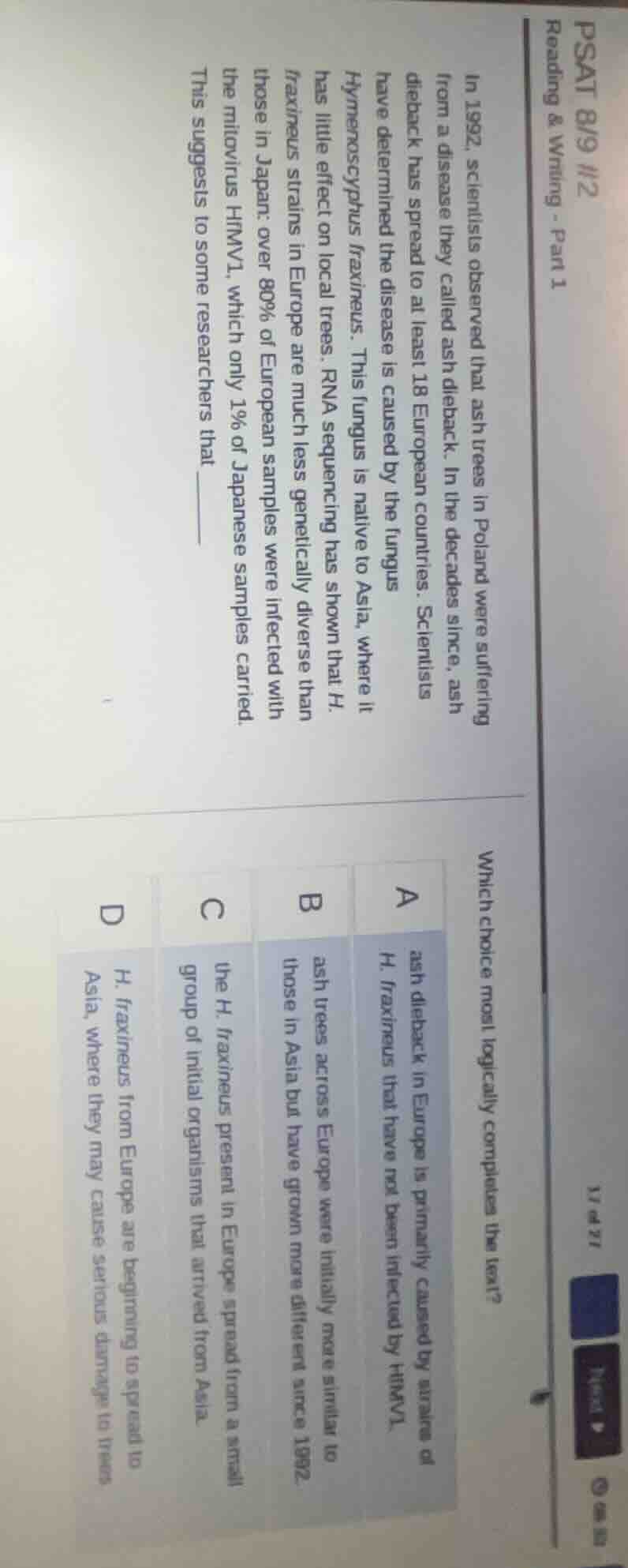
psat 8/9 #2 reading & writing - part 1 in 1992, scientists observed that ash trees in poland were suffering from a disease they called ash dieback. in the decades since, ash dieback has spread to at least 18 european countries. scientists have determined the disease is caused by the fungus hymenoscyphus fraxineus. this fungus is native to asia, where it has little effect on local trees. rna sequencing has shown that h. fraxineus strains in europe are much less genetically diverse than those in japan: over 80% of european samples were infected with the mitovirus hfmv1, which only 1% of japanese samples carried. this suggests to some researchers that ______ which choice most logically completes the text? a ash dieback in europe is primarily caused by strains of h. fraxineus that have not been infected by hfmv1. b ash trees across europe were initially more similar to those in asia but have grown more different since 1992. c the h. fraxineus present in europe spread from a small group of initial organisms that arrived from asia. d h. fraxineus from europe are beginning to spread to asia, where they may cause serious damage to trees
The text notes European H. fraxineus has low genetic diversity, unlike Japanese samples, and most European samples carry the mitovirus HfMV1 (rare in Japan). This implies the European fungus population came from a small initial group from Asia, as a small founding population would have low genetic diversity, and the widespread mitovirus points to a shared origin. Option A is incorrect because the text states ash dieback is caused by the fungus, not uninfected strains. Option B is incorrect as the text does not compare European and Asian ash tree similarity or change over time. Option D is incorrect because the text says the fungus is native to Asia and has little effect on local trees there.

Snap & solve any problem in the app
Get step-by-step solutions on Sovi AI
Photo-based solutions with guided steps
Explore more problems and detailed explanations
C. the H. fraxineus present in Europe spread from a small group of initial organisms that arrived from Asia.