QUESTION IMAGE
Question
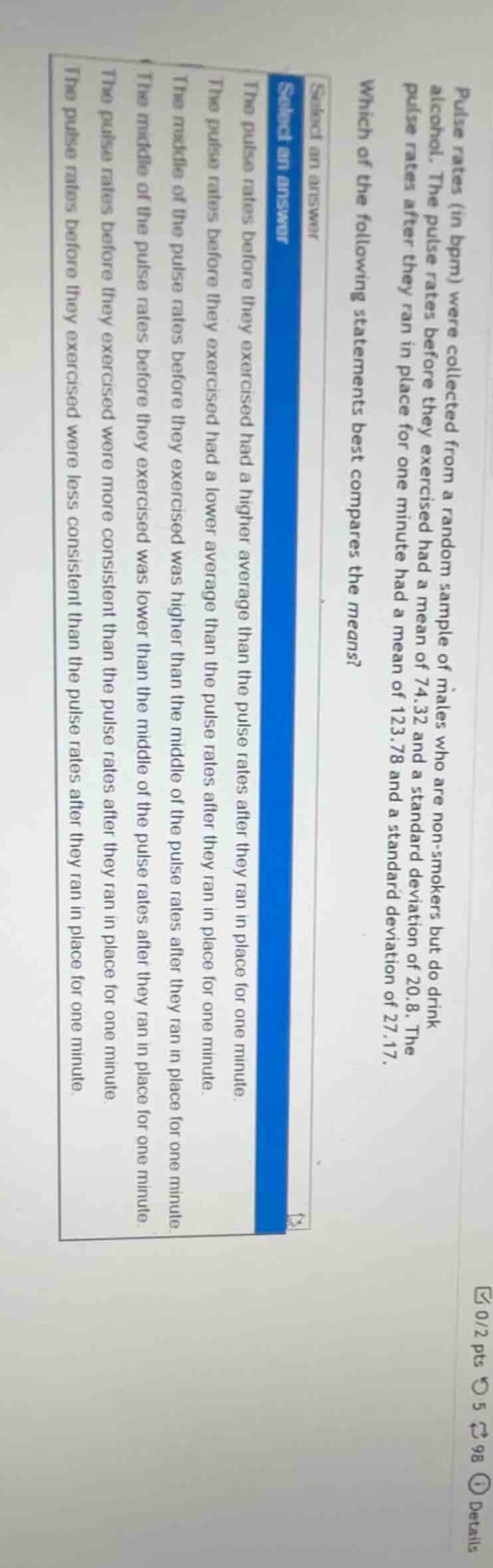
pulse rates (in bpm) were collected from a random sample of males who are non - smokers but do drink alcohol. the pulse rates before they exercised had a mean of 74.32 and a standard deviation of 20.8. the pulse rates after they ran in place for one minute had a mean of 123.78 and a standard deviation of 27.17. which of the following statements best compares the means? select an answer the pulse rates before they exercised had a higher average than the pulse rates after they ran in place for one minute. the pulse rates before they exercised had a lower average than the pulse rates after they ran in place for one minute. the middle of the pulse rates before they exercised was higher than the middle of the pulse rates after they ran in place for one minute. the middle of the pulse rates before they exercised was lower than the middle of the pulse rates after they ran in place for one minute. the pulse rates before they exercised were more consistent than the pulse rates after they ran in place for one minute. the pulse rates before they exercised were less consistent than the pulse rates after they ran in place for one minute.
Step1: Identify the means
The mean (average) pulse rate before exercise is \( 74.32 \) bpm, and the mean pulse rate after running in place for one minute is \( 123.78 \) bpm.
Step2: Compare the means
We compare \( 74.32 \) (before) with \( 123.78 \) (after). Since \( 74.32 < 123.78 \), the pulse rates before exercise had a lower average than the pulse rates after running in place for one minute. Wait, no—wait, the first option says "higher average", the second says "lower average". Wait, \( 74.32 \) is less than \( 123.78 \), so before is lower than after. Wait, let's check the options:
- The pulse rates before they exercised had a higher average than the pulse rates after they ran in place for one minute. (74.32 vs 123.78: 74.32 is lower, so this is false)
- The pulse rates before they exercised had a lower average than the pulse rates after they ran in place for one minute. (74.32 < 123.78: this is true)
- The middle (median) of the pulse rates before... We don't have median data, only mean and standard deviation. So we can't compare medians.
- The middle... Same as above, no median data.
- Consistency: standard deviation before is 20.8, after is 27.17. Lower standard deviation means more consistent. So before (20.8) is more consistent than after (27.17)? Wait, the third option says "more consistent", fourth says "less consistent". Wait, the third option: "The pulse rates before they exercised were more consistent than the pulse rates after they ran in place for one minute." Since standard deviation before (20.8) is less than after (27.17), lower standard deviation means data is more clustered, more consistent. So that's true, but the question is which statement best compares the means. Oh, the question says "which of the following statements best compares the means". So we need to compare the means (averages). So the mean before is 74.32, after is 123.78. So before is lower than after. So the second option: "The pulse rates before they exercised had a lower average than the pulse rates after they ran in place for one minute."

Snap & solve any problem in the app
Get step-by-step solutions on Sovi AI
Photo-based solutions with guided steps
Explore more problems and detailed explanations
The pulse rates before they exercised had a lower average than the pulse rates after they ran in place for one minute. (The option corresponding to this statement, likely the second option in the list, e.g., if the options are labeled, say, A to F, but from the text, the second statement is "The pulse rates before they exercised had a lower average than the pulse rates after they ran in place for one minute.")