QUESTION IMAGE
Question
put it all together!
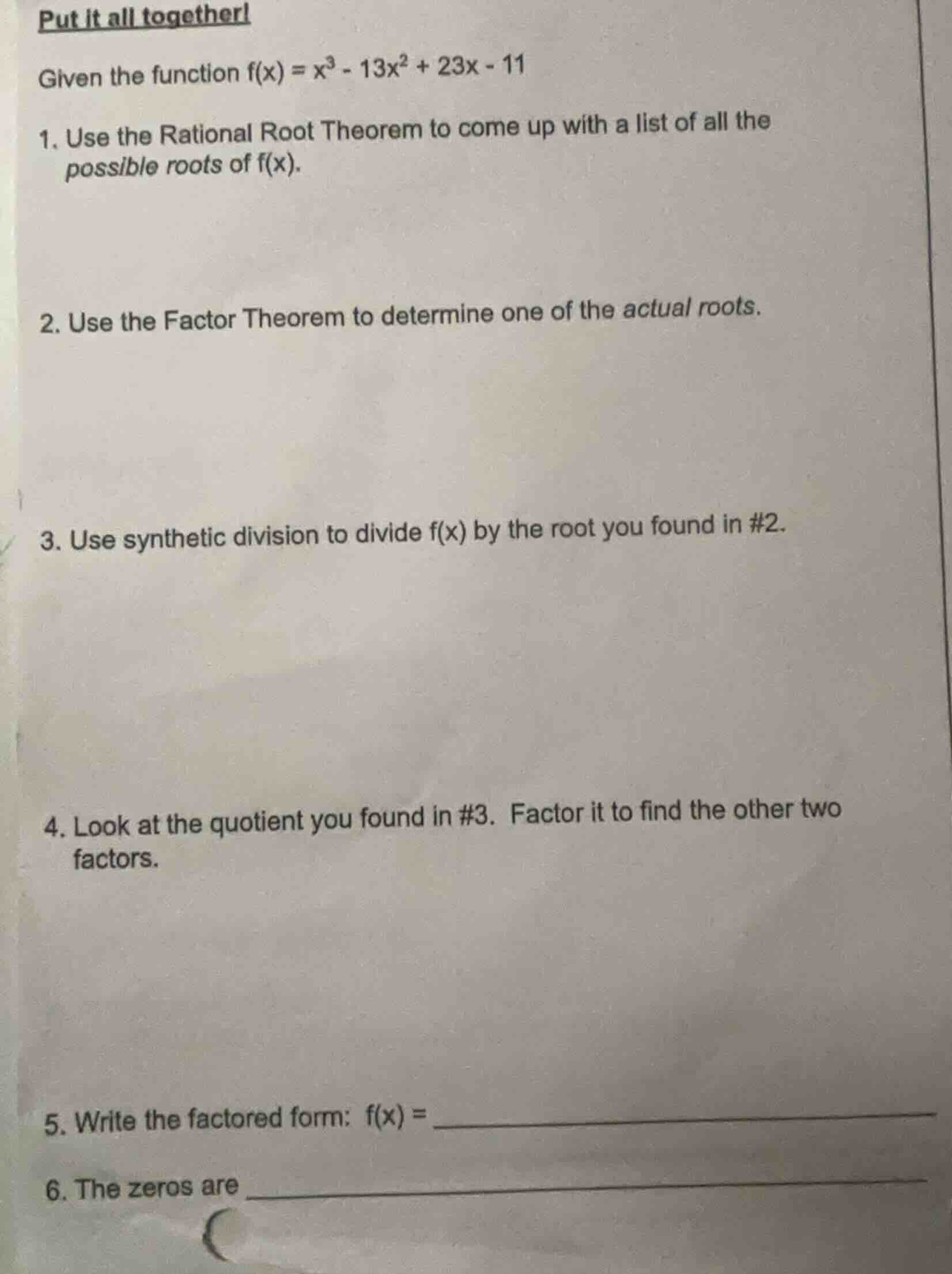
given the function $f(x) = x^3 - 13x^2 + 23x - 11$
- use the rational root theorem to come up with a list of all the possible roots of $f(x)$.
- use the factor theorem to determine one of the actual roots.
- use synthetic division to divide $f(x)$ by the root you found in #2.
- look at the quotient you found in #3. factor it to find the other two factors.
- write the factored form: $f(x) = $
- the zeros are
Step1: List possible rational roots
By Rational Root Theorem, possible roots are $\pm1, \pm11$.
Step2: Test for actual root
Test $x=1$: $f(1)=1^3 -13(1)^2 +23(1)-11=1-13+23-11=0$. So $x=1$ is a root.
Step3: Synthetic division with $x=1$
Set up synthetic division:
$$\begin{array}{r|rrrr}
1 & 1 & -13 & 23 & -11 \\
& & 1 & -12 & 11 \\
\hline
& 1 & -12 & 11 & 0
\end{array}$$
Quotient: $x^2-12x+11$.
Step4: Factor the quadratic quotient
Factor $x^2-12x+11$: find two numbers that multiply to 11 and add to -12, which are -1 and -11. So $x^2-12x+11=(x-1)(x-11)$.
Step5: Write factored form
Combine the linear factors: $f(x)=(x-1)(x-1)(x-11)=(x-1)^2(x-11)$.
Step6: Identify all zeros
Set each factor equal to 0: $x-1=0$ gives $x=1$ (double root), $x-11=0$ gives $x=11$.

Snap & solve any problem in the app
Get step-by-step solutions on Sovi AI
Photo-based solutions with guided steps
Explore more problems and detailed explanations
- Possible roots: $\pm1, \pm11$
- Actual root: $x=1$
- Quotient from synthetic division: $x^2-12x+11$
- Factored quadratic: $(x-1)(x-11)$
- Factored form: $f(x)=(x-1)^2(x-11)$
- Zeros: $x=1$ (multiplicity 2), $x=11$