QUESTION IMAGE
Question
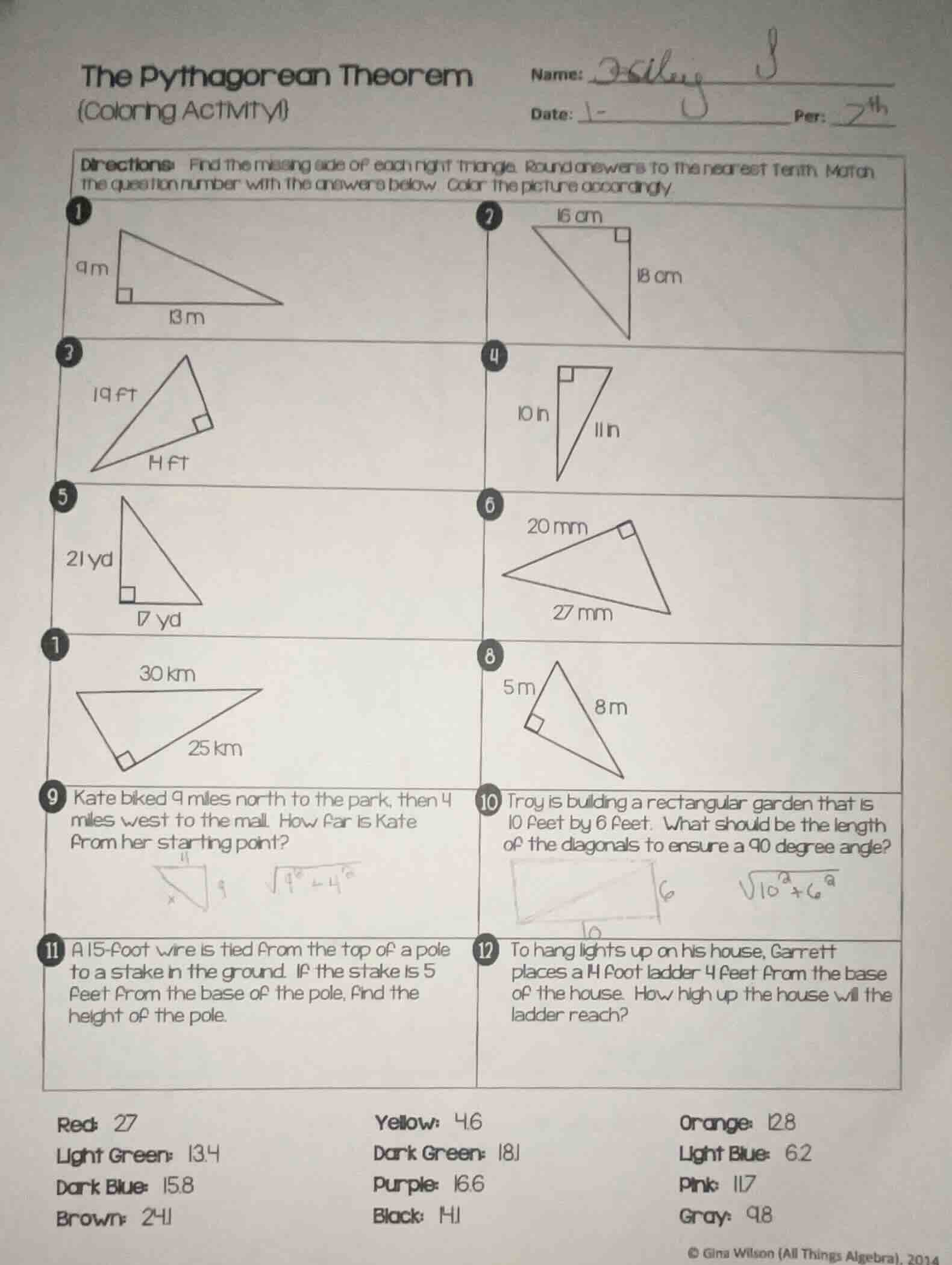
the pythagorean theorem (coloring activity)
name:
date:
per:
directions: find the missing side of each right triangle. round answers to the nearest tenth. match the question number with the answers below. color the picture accordingly.
1
9 m
13 m
2
16 cm
18 cm
3
19 ft
14 ft
4
10 n
11 n
5
21 yd
17 yd
6
20 mm
27 mm
7
30 km
25 km
8
5 m
8 m
9 kate biked 9 miles north to the park, then 4 miles west to the mall. how far is kate from her starting point?
10 troy is building a rectangular garden that is 10 feet by 6 feet. what should be the length of the diagonals to ensure a 90 degree angle?
11 a 15 - foot wire is tied from the top of a pole to a stake in the ground. if the stake is 5 feet from the base of the pole, find the height of the pole.
12 to hang lights up on his house, garrett places a 14 foot ladder 4 feet from the base of the house. how high up the house will the ladder reach?
red: 27
yellow: 4.6
orange: 12.8
light green: 13.4
dark green: 18.1
light blue: 6.2
dark blue: 15.8
purple: 16.6
pink: 11.7
brown: 24.1
black: 14.1
gray: 9.8
© gina wilson (all things algebra), 2014
Let's solve problem 1 first (finding the missing side of the right triangle with legs 9m and 13m).
Step1: Recall Pythagorean Theorem
For a right triangle with legs \(a\), \(b\) and hypotenuse \(c\), \(c^{2}=a^{2}+b^{2}\). Here, \(a = 9\), \(b = 13\), we need to find \(c\).
\[c=\sqrt{a^{2}+b^{2}}=\sqrt{9^{2}+13^{2}}\]
Step2: Calculate the squares
\[9^{2}=81\], \[13^{2}=169\]
Step3: Sum the squares
\[81 + 169=250\]
Step4: Take the square root
\[c=\sqrt{250}\approx15.8\] (rounded to the nearest tenth)
Now problem 2 (legs 16 cm and 18 cm):
Step1: Apply Pythagorean Theorem
\(c=\sqrt{16^{2}+18^{2}}\)
Step2: Calculate squares
\(16^{2}=256\), \(18^{2}=324\)
Step3: Sum
\(256 + 324 = 580\)
Step4: Square root
\(c=\sqrt{580}\approx24.1\)
Problem 3 (hypotenuse 19 ft, leg 14 ft, find the other leg \(a\)):
Step1: Rearrange Pythagorean Theorem
\(a^{2}=c^{2}-b^{2}\), where \(c = 19\), \(b = 14\)
\[a=\sqrt{19^{2}-14^{2}}\]
Step2: Calculate squares
\(19^{2}=361\), \(14^{2}=196\)
Step3: Subtract
\(361-196 = 165\)
Step4: Square root
\(a=\sqrt{165}\approx12.8\)
Problem 4 (hypotenuse 11 in, leg 10 in, find the other leg \(a\)):
Step1: Rearrange formula
\(a=\sqrt{11^{2}-10^{2}}\)
Step2: Calculate squares
\(11^{2}=121\), \(10^{2}=100\)
Step3: Subtract
\(121 - 100=21\)
Step4: Square root
\(a=\sqrt{21}\approx4.6\)
Problem 5 (legs 21 yd and 17 yd, find hypotenuse \(c\)):
Step1: Apply Pythagorean Theorem
\(c=\sqrt{21^{2}+17^{2}}\)
Step2: Calculate squares
\(21^{2}=441\), \(17^{2}=289\)
Step3: Sum
\(441+289 = 730\)
Step4: Square root
\(c=\sqrt{730}\approx27.0\) (but 27 is in the color list)
Problem 6 (legs 20 mm and 27 mm, find hypotenuse \(c\)): Wait, no, it's a right triangle with legs 20 and 27? Wait, the diagram shows legs 20 mm and 27 mm? Wait, no, the right angle is between 20 and 27? Wait, no, let's check: the triangle has legs 20 and 27? Wait, no, hypotenuse? Wait, no, the right angle is marked, so legs are 20 and 27? Wait, no, maybe I misread. Wait, the triangle has sides 20 mm and 27 mm with right angle, so hypotenuse \(c=\sqrt{20^{2}+27^{2}}=\sqrt{400 + 729}=\sqrt{1129}\approx33.6\)? Wait, no, maybe the legs are 20 and the other leg, hypotenuse 27? Wait, the diagram: "20 mm" and "27 mm" with right angle, so legs are 20 and let's say \(a\), hypotenuse 27? Wait, maybe I made a mistake. Wait, problem 6: right triangle, sides 20 mm and 27 mm, right angle between them? No, maybe the legs are 20 and \(x\), hypotenuse 27. Let's recalculate: \(x=\sqrt{27^{2}-20^{2}}=\sqrt{729 - 400}=\sqrt{329}\approx18.1\)
Problem 7 (hypotenuse 30 km, leg 25 km, find the other leg \(a\)):
Step1: Rearrange formula
\(a=\sqrt{30^{2}-25^{2}}\)
Step2: Calculate squares
\(30^{2}=900\), \(25^{2}=625\)
Step3: Subtract
\(900 - 625 = 275\)
Step4: Square root
\(a=\sqrt{275}\approx16.6\)
Problem 8 (legs 5 m and 8 m, find hypotenuse \(c\)):
Step1: Apply Pythagorean Theorem
\(c=\sqrt{5^{2}+8^{2}}\)
Step2: Calculate squares
\(5^{2}=25\), \(8^{2}=64\)
Step3: Sum
\(25 + 64 = 89\)
Step4: Square root
\(c=\sqrt{89}\approx9.4\)? Wait, no, 9.4 is not in the list. Wait, maybe I misread the legs. Wait, the diagram: 5m and 8m with right angle, so hypotenuse \(c=\sqrt{25 + 64}=\sqrt{89}\approx9.4\), but 9.8 is in the list (Gray: 9.8). Maybe a typo, or maybe I misread the legs. Wait, maybe 5m and 9m? No, the diagram says 5m and 8m. Wait, maybe problem 8: legs 5 and 8, hypotenuse \(\approx9.4\), but 9.8 is Gray. Maybe I made a mistake.
Problem 9: Kate biked 9 miles north, 4 miles west. Distance from start: right triangle, legs 9 and 4, hypotenuse \(c=\sqrt{9^{2}+4^{2}}=\sqrt{81 + 16}=\sqrt{97}\approx9.8\)…
Step1: Identify triangle type
It's a right triangle, so use Pythagorean Theorem \(c^2 = a^2 + b^2\), where \(a = 9\), \(b = 13\).
Step2: Substitute values
\(c^2 = 9^2 + 13^2 = 81 + 169\)
Step3: Calculate sum
\(81 + 169 = 250\)
Step4: Find square root
\(c = \sqrt{250} \approx 15.8\) (rounded to nearest tenth)

Snap & solve any problem in the app
Get step-by-step solutions on Sovi AI
Photo-based solutions with guided steps
Explore more problems and detailed explanations
The missing side (hypotenuse) is approximately \(\boldsymbol{15.8}\) meters, corresponding to Dark Blue in the coloring activity.