QUESTION IMAGE
Question
pythagorean theorem maz
use the pythagorean theorem to solve for x in each triangle
name
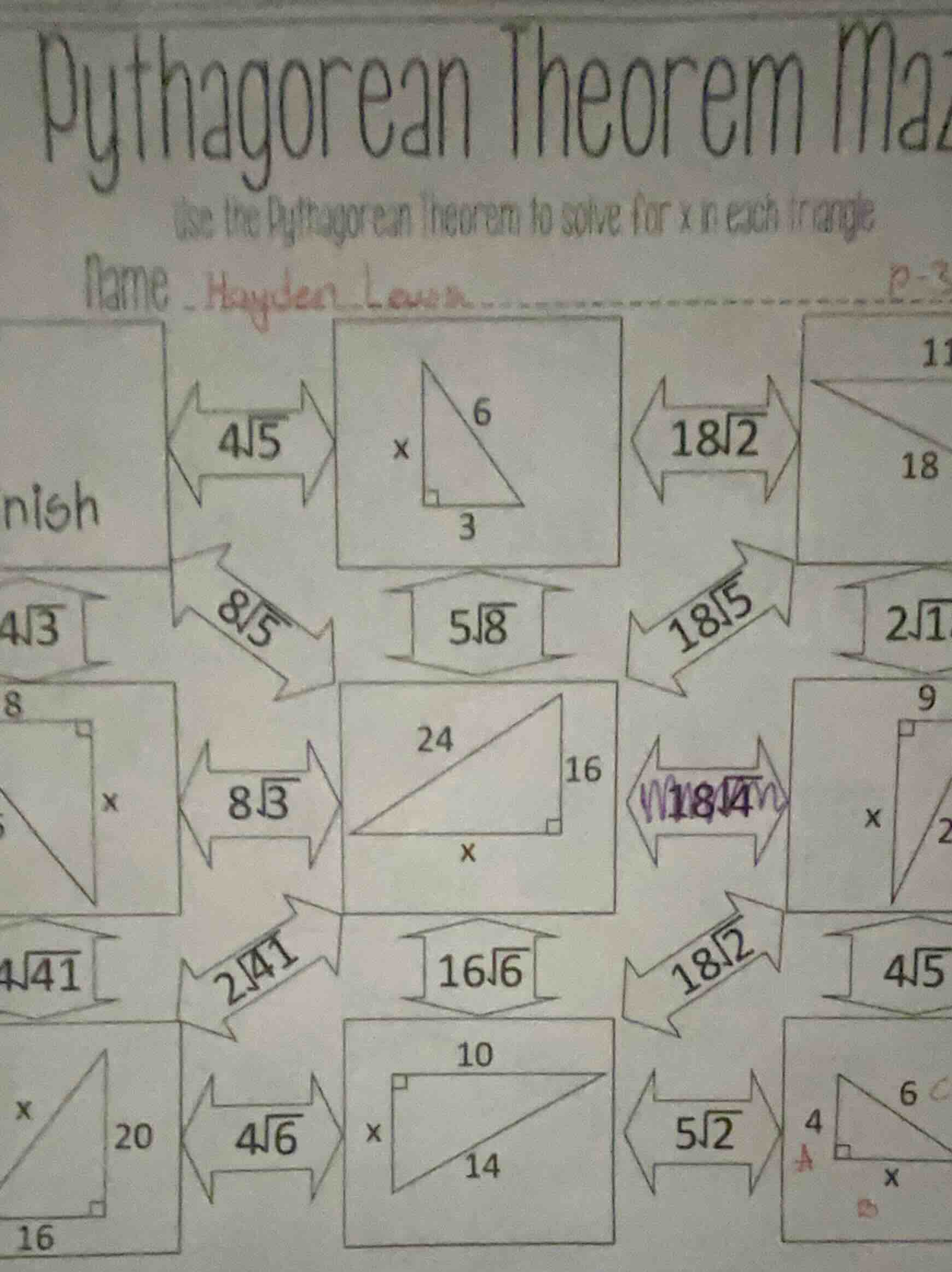
Let's solve the first right triangle (with legs \( x \) and \( 3 \), hypotenuse \( 6 \)) using the Pythagorean theorem (\( a^2 + b^2 = c^2 \), where \( c \) is the hypotenuse, \( a \) and \( b \) are the legs).
Step 1: Identify the sides
Let \( a = x \), \( b = 3 \), \( c = 6 \).
Step 2: Apply the Pythagorean theorem
\( x^2 + 3^2 = 6^2 \)
\( x^2 + 9 = 36 \)
Step 3: Solve for \( x^2 \)
\( x^2 = 36 - 9 \)
\( x^2 = 27 \)
Step 4: Simplify the square root
\( x = \sqrt{27} = \sqrt{9 \times 3} = 3\sqrt{3} \)? Wait, no, wait. Wait, maybe I misread. Wait, the triangle: leg \( 3 \), hypotenuse \( 6 \). Wait, \( 3^2 + x^2 = 6^2 \) → \( x^2 = 36 - 9 = 27 \) → \( x = 3\sqrt{3} \)? But the arrows have \( 4\sqrt{5} \), \( 8\sqrt{5} \), etc. Wait, maybe another triangle. Let's take the triangle with legs \( 16 \) and \( x \), hypotenuse \( 24 \).
Step 1: Identify sides
\( a = x \), \( b = 16 \), \( c = 24 \)
Step 2: Apply Pythagorean theorem
\( x^2 + 16^2 = 24^2 \)
\( x^2 + 256 = 576 \)
Step 3: Solve for \( x^2 \)
\( x^2 = 576 - 256 = 320 \)
Step 4: Simplify
\( x = \sqrt{320} = \sqrt{64 \times 5} = 8\sqrt{5} \)
Ah, that matches the arrow \( 8\sqrt{5} \).
Another triangle: legs \( 10 \) and \( x \), hypotenuse \( 14 \).
Step 1: Identify sides
\( a = x \), \( b = 10 \), \( c = 14 \)
Step 2: Apply theorem
\( x^2 + 10^2 = 14^2 \)
\( x^2 + 100 = 196 \)
Step 3: Solve for \( x^2 \)
\( x^2 = 196 - 100 = 96 \)
Step 4: Simplify
\( x = \sqrt{96} = \sqrt{16 \times 6} = 4\sqrt{6} \), which matches the arrow \( 4\sqrt{6} \).
Another triangle: legs \( 4 \) and \( x \), hypotenuse \( 6 \).
Step 1: Identify sides
\( a = 4 \), \( b = x \), \( c = 6 \)
Step 2: Apply theorem
\( 4^2 + x^2 = 6^2 \)
\( 16 + x^2 = 36 \)
Step 3: Solve for \( x^2 \)
\( x^2 = 36 - 16 = 20 \)
Step 4: Simplify
\( x = \sqrt{20} = \sqrt{4 \times 5} = 2\sqrt{5} \)? Wait, no, the arrow has \( 4\sqrt{5} \)? Wait, maybe I mixed up legs and hypotenuse. Wait, the triangle with legs \( x \) and \( 3 \), hypotenuse \( 6 \): \( x^2 + 3^2 = 6^2 \) → \( x^2 = 27 \) → \( x = 3\sqrt{3} \), but that's not in the arrows. Wait, maybe the triangle with legs \( 9 \) and \( 21 \)? No, the image shows a triangle with leg \( 9 \), leg \( x \), hypotenuse \( 21 \)? Wait, no, the image has a triangle with leg \( 9 \), leg \( 21 \)? No, let's check the triangle with leg \( 4 \), leg \( x \), hypotenuse \( 6 \): \( 4^2 + x^2 = 6^2 \) → \( x^2 = 20 \) → \( x = 2\sqrt{5} \), not matching. Wait, the first triangle I solved with legs \( 16 \) and \( x \), hypotenuse \( 24 \) gave \( x = 8\sqrt{5} \), which is an arrow. Let's confirm:
\( 16^2 + x^2 = 24^2 \)
\( 256 + x^2 = 576 \)
\( x^2 = 576 - 256 = 320 \)
\( x = \sqrt{320} = \sqrt{64 \times 5} = 8\sqrt{5} \). Yes, that's correct. So that's one solution.
Another triangle: legs \( 10 \) and \( x \), hypotenuse \( 14 \):
\( 10^2 + x^2 = 14^2 \)
\( 100 + x^2 = 196 \)
\( x^2 = 96 \)
\( x = \sqrt{96} = 4\sqrt{6} \), which matches the arrow \( 4\sqrt{6} \).
Let's do the triangle with legs \( 16 \) and \( x \), hypotenuse \( 24 \) again:
Step 1: Recall Pythagorean Theorem
For a right triangle, \( a^2 + b^2 = c^2 \), where \( c \) is the hypotenuse, \( a \) and \( b \) are the legs.
Step 2: Identify \( a \), \( b \), \( c \)
Here, \( a = x \), \( b = 16 \), \( c = 24 \).
Step 3: Substitute into the formula
\( x^2 + 16^2 = 24^2 \)
Step 4: Calculate squares
\( x^2 + 256 = 576 \)
Step 5: Solve for \( x^2 \)
\( x^2 = 576 - 256 = 320 \)
Step 6: Simplify the square root
\( x = \sqrt{320} = \sqrt{64 \times 5} = 8\sqrt{5} \)

Snap & solve any problem in the app
Get step-by-step solutions on Sovi AI
Photo-based solutions with guided steps
Explore more problems and detailed explanations
For the triangle with legs \( 16 \) and \( x \), hypotenuse \( 24 \), \( x = 8\sqrt{5} \)