QUESTION IMAGE
Question
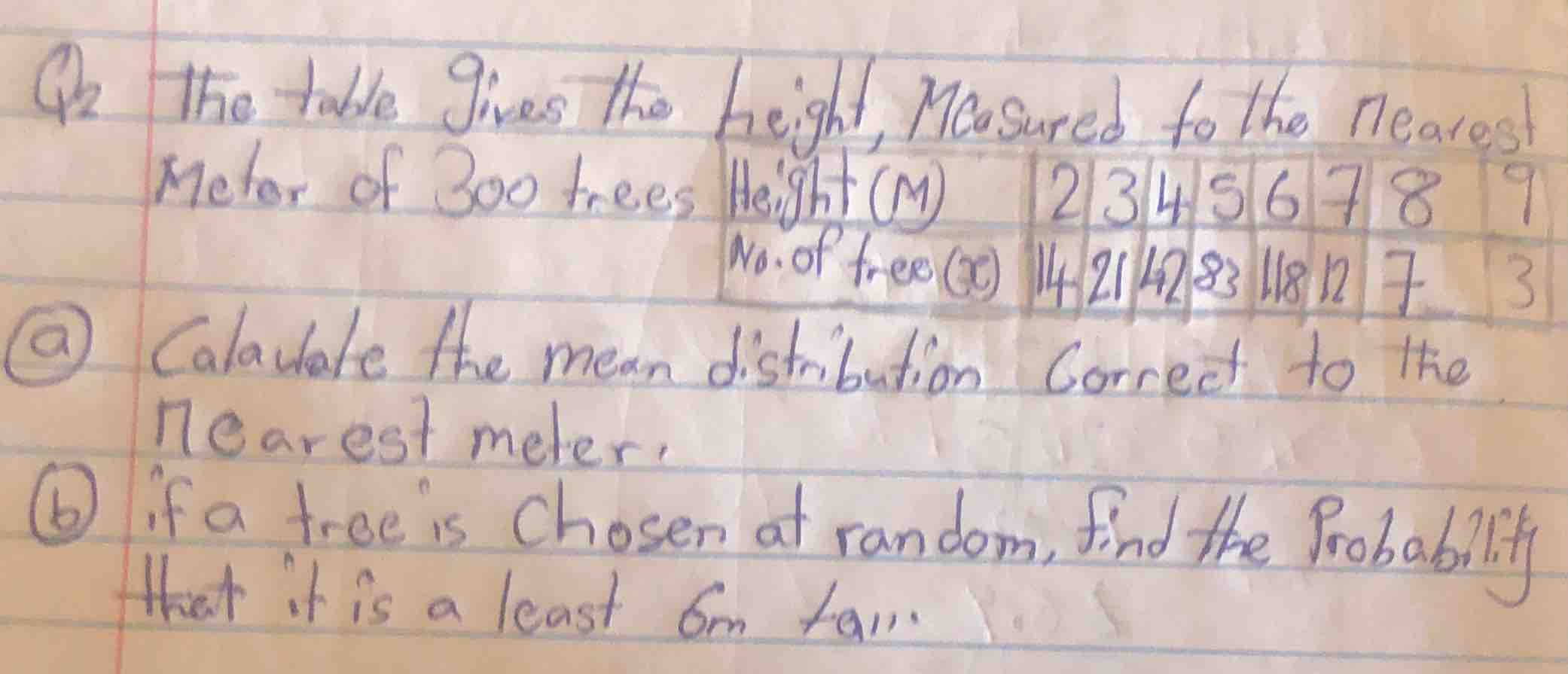
q2 the table gives the height, measured to the nearest meter of 300 trees
height (m) | 2 | 3 | 4 | 5 | 6 | 7 | 8 | 9
no. of tree (x) | 14 | 21 | 42 | 83 | 118 | 12 | 7 | 3
(a) calculate the mean distribution correct to the nearest meter.
(b) if a tree is chosen at random, find the probability that it is at least 6m tall.
Part (a)
Step 1: Recall the formula for the mean of a frequency distribution
The formula for the mean (\(\bar{x}\)) of a frequency distribution is \(\bar{x}=\frac{\sum_{i = 1}^{n}f_{i}x_{i}}{\sum_{i=1}^{n}f_{i}}\), where \(x_{i}\) is the value of the variable and \(f_{i}\) is the corresponding frequency.
Step 2: Create a table to calculate \(f_{i}x_{i}\)
| Height (\(x_{i}\)) | Number of trees (\(f_{i}\)) | \(f_{i}x_{i}\) |
|---|---|---|
| 3 | 21 | \(21\times3 = 63\) |
| 4 | 42 | \(42\times4 = 168\) |
| 5 | 83 | \(83\times5 = 415\) |
| 6 | 118 | \(118\times6 = 708\) |
| 7 | 12 | \(12\times7 = 84\) |
| 8 | 7 | \(7\times8 = 56\) |
| 9 | 3 | \(3\times9 = 27\) |
Step 3: Calculate \(\sum f_{i}\) and \(\sum f_{i}x_{i}\)
First, calculate \(\sum f_{i}\):
\(\sum f_{i}=14 + 21+42 + 83+118+12+7+3\)
\(=14+21 = 35\); \(35 + 42=77\); \(77+83 = 160\); \(160+118 = 278\); \(278+12 = 290\); \(290+7 = 297\); \(297 + 3=300\)
Next, calculate \(\sum f_{i}x_{i}\):
\(\sum f_{i}x_{i}=28+63 + 168+415+708+84+56+27\)
\(28+63 = 91\); \(91+168 = 259\); \(259+415 = 674\); \(674+708 = 1382\); \(1382+84 = 1466\); \(1466+56 = 1522\); \(1522+27 = 1549\)
Step 4: Calculate the mean
Using the formula \(\bar{x}=\frac{\sum f_{i}x_{i}}{\sum f_{i}}\), we substitute \(\sum f_{i}=300\) and \(\sum f_{i}x_{i}=1549\)
\(\bar{x}=\frac{1549}{300}\approx5.163\)
Rounding to the nearest meter, \(\bar{x}\approx5\)
Part (b)
Step 1: Recall the formula for probability
The probability \(P\) of an event is given by \(P=\frac{\text{Number of favorable outcomes}}{\text{Total number of outcomes}}\)
Step 2: Determine the number of favorable outcomes
We want the probability that a tree is at least 6m tall. "At least 6m" means the height is 6m, 7m, 8m, or 9m.
The number of trees with height 6m is 118, with 7m is 12, with 8m is 7, and with 9m is 3.
So the number of favorable outcomes \(=118 + 12+7 + 3\)
\(118+12 = 130\); \(130+7 = 137\); \(137+3 = 140\)
Step 3: Calculate the probability
The total number of trees is 300 (since \(\sum f_{i}=300\))
So the probability \(P=\frac{140}{300}=\frac{7}{15}\approx0.467\)

Snap & solve any problem in the app
Get step-by-step solutions on Sovi AI
Photo-based solutions with guided steps
Explore more problems and detailed explanations
s:
(a) The mean height is \(\boxed{5}\) meters.
(b) The probability is \(\boxed{\frac{7}{15}}\) (or approximately \(0.47\)).