QUESTION IMAGE
Question
q5. how has the moon affected earths habitability?
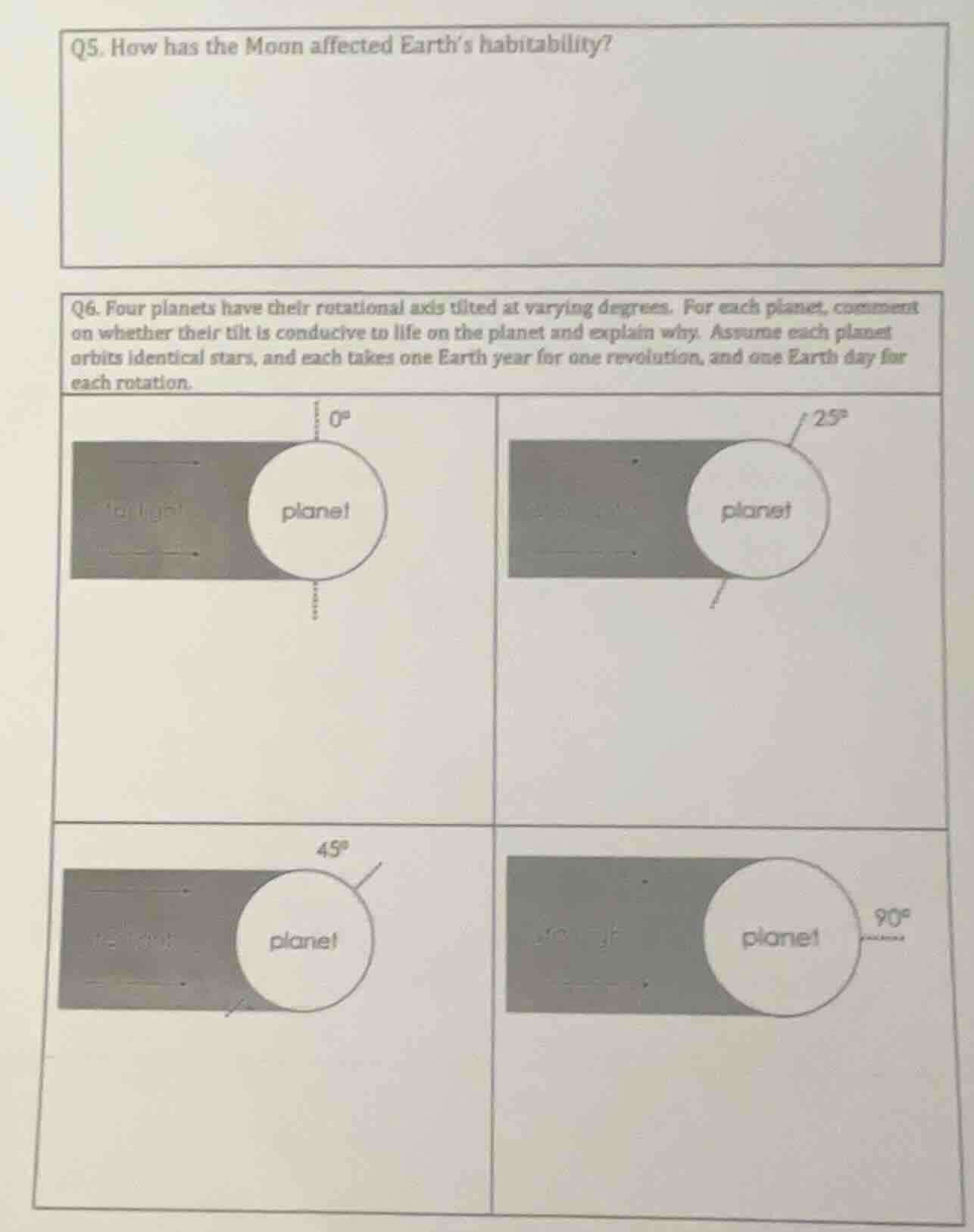
q6. four planets have their rotational axis tilted at varying degrees. for each planet, comment on whether their tilt is conducive to life on the planet and explain why. assume each planet orbits identical stars, and each takes one earth year for one revolution, and one earth day for each rotation.
Brief Explanations
For Q5:
- Stabilized Axial Tilt: The Moon's gravitational pull restricts Earth's axial tilt variation to a narrow range (≈22.1° to 24.5°), preventing extreme, chaotic climate shifts that would make life unviable.
- Tidal Forces: Lunar (and solar) tides mix ocean waters, distribute nutrients, and may have helped drive the origin of life by concentrating organic molecules in shallow tidal pools. Tides also shaped coastal habitats, supporting diverse ecosystems.
- Extended Day Length: The Moon's gravitational drag has slowed Earth's rotation over time, lengthening the day from ~6 hours to 24 hours. This moderates temperature extremes between day and night, making conditions more suitable for life.
For Q6:
- 0° Tilt: No seasonal variation occurs. Polar regions are in permanent dim twilight, and equatorial regions receive constant intense sunlight. This creates extreme, unbalanced climates with no temperate zones, making it not conducive to complex life.
- 25° Tilt: This tilt is very similar to Earth's current tilt (~23.5°). It creates mild, predictable seasonal changes, distributes sunlight relatively evenly across the planet, and supports temperate zones with stable conditions that are highly conducive to life.
- 45° Tilt: This causes extremely severe seasonal variation. Hemispheres experience intense, long periods of direct sunlight (scorching heat) and prolonged, frigid darkness. These extreme temperature swings and unstable conditions are not conducive to most complex life.
- 90° Tilt: The planet's axis is perpendicular to its orbital plane, resulting in extreme, permanent seasonal-like conditions. One pole faces the star for half the year (constant, intense heat) while the other is in permanent darkness (extreme cold). Only a narrow twilight band would have milder conditions, making this very unconducive to widespread complex life.

Snap & solve any problem in the app
Get step-by-step solutions on Sovi AI
Photo-based solutions with guided steps
Explore more problems and detailed explanations
Q5:
- Stabilizes Earth's axial tilt to prevent extreme climate shifts.
- Drives tidal forces that support ocean mixing, nutrient distribution, and potentially the origin of life.
- Slowed Earth's rotation to create longer, temperature-moderating days.
Q6:
- 0° tilt: Not conducive; no seasons, extreme polar/equatorial conditions.
- 25° tilt: Conducive; mild, Earth-like seasons and stable climates.
- 45° tilt: Not conducive; extremely severe seasonal temperature swings.
- 90° tilt: Not conducive; permanent extreme heat/darkness at poles, only a narrow habitable twilight band.